
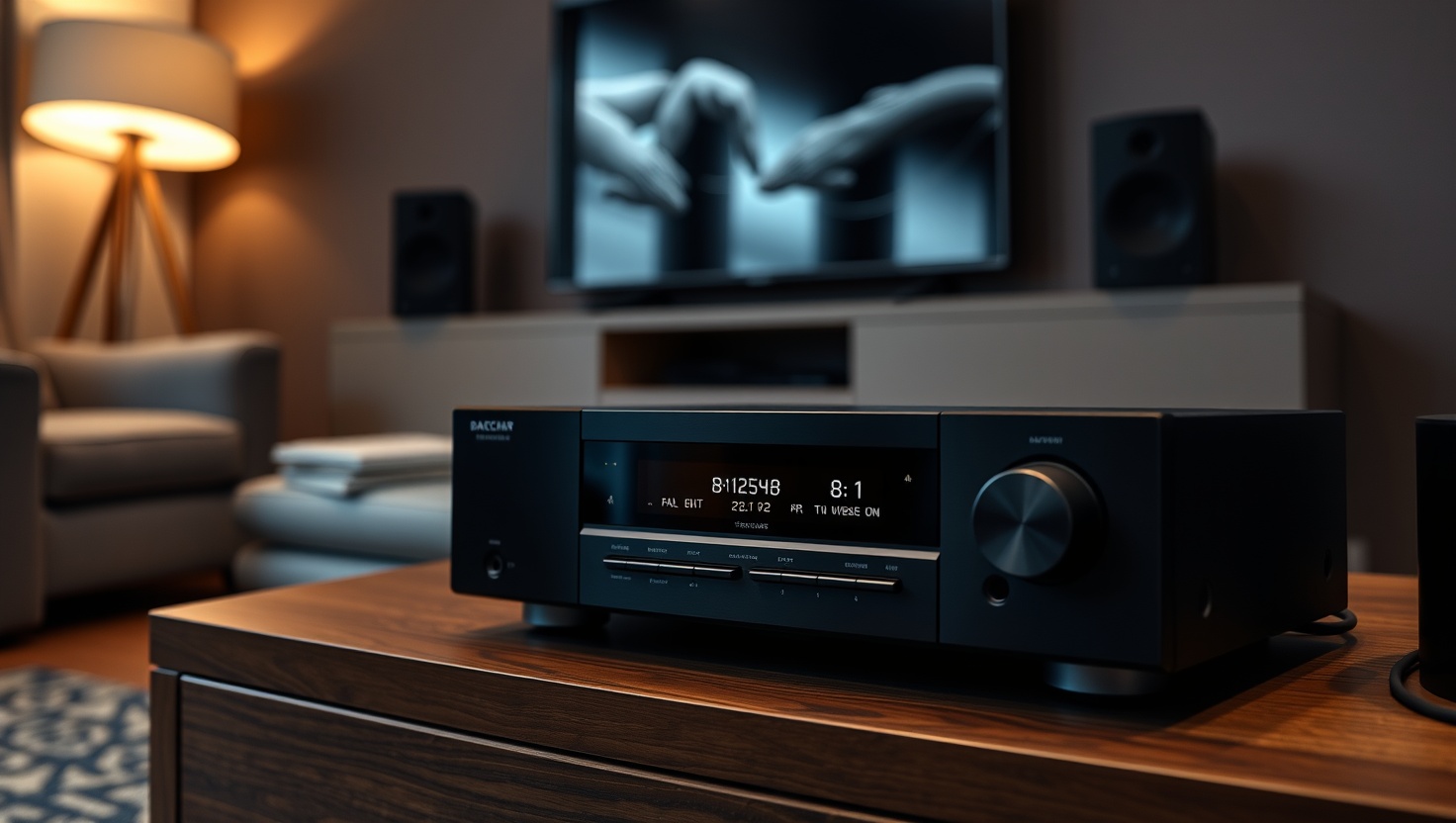
Your speakers get all the glory, but the receiver is the brain quietly running the whole show. Pick the wrong one and even great speakers sound flat.
Denon AVR-X1800H — Top Pick
The Denon AVR-X1800H is the receiver we recommend to almost everyone: 7.2-channel Dolby Atmos, HDMI 2.1 with 4K120 and 8K, and Audyssey room correction, all at a price that makes sense. It does everything well, sets up easily, and gets out of the way so you can enjoy the show.
In a hurry? That's our pick. Want the reasoning and the full comparison? Keep reading.
You bought the TV. Maybe you splurged on speakers. Now you're staring at a wall of AV receivers, drowning in numbers like 7.2, Dolby Atmos, HDMI 2.1, and Audyssey, wondering which box actually matters. That's the brain of your home theater, and it decides how everything connects, decodes, and sounds. Get it right and movie night feels like the cinema. Get it wrong and you're stuck squinting at menus instead of enjoying the film.
We tested the receivers that matter in 2026 and ranked them by what you actually feel: clean power per channel, true Atmos height effects, 4K120 and 8K passthrough over HDMI 2.1, and room correction that fixes your messy living room. Below you'll find our top pick, the best for music, a slim premium option, and a feature-packed alternative, each with honest pros, cons, and who it's really for.
Key Takeaways
- The Denon AVR-X1800H is our best overall pick: 7.2 channels, Dolby Atmos, HDMI 2.1, and Audyssey room correction at a fair price.
- Channel counts like 5.2, 7.2, and 9.2 tell you how many speakers you can run, plus subwoofers, so plan your room before you buy.
- Dolby Atmos adds overhead sound for rain, planes, and helicopters that move above you, turning flat audio into a bubble.
- HDMI 2.1 matters if you own a 4K120 gaming console or an 8K TV, since older receivers choke on those signals.
- Room correction (Audyssey on Denon, YPAO on Yamaha) auto-tunes your speakers to your room so dialog stays clear and bass stops booming.
What an AV Receiver Actually Does (In Plain English)
Think of the receiver as the traffic controller for your entire setup. Your Blu-ray player, game console, streaming stick, and TV all plug into it. It takes the incoming signal, decodes the audio (Dolby Atmos, DTS, and the rest), pushes clean power to each speaker, and sends the video onward to your screen. One box, all the work. That's why we call it the brain of the home theater.
The numbers you keep seeing, like 5.2, 7.2, or 9.2, describe how many speaker channels and subwoofers the receiver drives. The first number is speakers, the second is subwoofers. A 7.2 receiver runs seven speakers plus two subwoofers, which is the sweet spot for most living rooms: front left, center, front right, two surrounds, and two Atmos height or rear channels. Go 5.2 for a small room, or 9.2 if you're building a serious dedicated theater.
Power gets listed as watts per channel. Bigger rooms and less sensitive speakers need more watts, but don't get hypnotized by the number alone, because how a receiver drives all channels at once matters more than a single headline figure. For most 2026 living rooms, any receiver on this list has the muscle to fill the space and then some.
The Features That Actually Change Your Movie Night
Dolby Atmos is the headline upgrade. Instead of sound only coming from around you, Atmos adds height channels so a helicopter passes overhead and rain falls from above. You'll need either in-ceiling speakers or upward-firing speaker modules, but the receiver has to support it first. Every pick here does, so you're future-proofed the day you add height speakers.
HDMI 2.1 is the spec gamers and 8K owners cannot skip. It carries 4K at 120 frames per second and 8K passthrough, so your PS5 or high-refresh TV runs at full quality through the receiver instead of getting bottlenecked. If you only stream movies at 4K60, older HDMI is fine, but 2.1 is the safer buy for the next several years.
Room correction is the quiet hero. Denon and Marantz use Audyssey, Yamaha uses YPAO, and Onkyo uses AccuEQ. You plug in the included microphone, the receiver plays test tones, and it measures your room's quirks, then auto-adjusts each speaker so dialog stays crisp and bass stops booming in the corners. This single step does more for sound quality than most speaker upgrades, and it's free with every receiver here.
Quick Comparison
| Product | Channels | Atmos | HDMI 2.1 | Room Correction |
|---|---|---|---|---|
| Denon AVR-X1800H | 7.2ch | Yes | Yes (4K120/8K) | Audyssey MultEQ |
| Yamaha RX-V6A | 7.2ch | Yes | Yes (4K120/8K) | YPAO |
| Marantz Cinema 70s | 7.2ch (slim) | Yes | Yes (4K120/8K) | Audyssey MultEQ |
| Onkyo Receiver | 7.2ch | Yes | Yes (4K120/8K) | AccuEQ |
1. Denon AVR-X1800H — Best Overall
Denon AVR-X1800H
The Denon AVR-X1800H hits the exact spot where price, features, and sound quality meet, which is why it's our top pick for most people building a theater in 2026. You get true 7.2-channel output, full Dolby Atmos and DTS:X decoding, HDMI 2.1 with 4K120 and 8K passthrough, and Audyssey room correction that tunes the whole system to your space in minutes. Nothing here feels stripped down or padded out.
Setup is refreshingly friendly thanks to Denon's on-screen guide, and the HEOS app handles streaming from Spotify, Amazon Music, and more without a separate box. For the money, you're getting features that used to live in receivers costing far more. If you want one receiver that simply does everything well and gets out of the way, this is the one we point people toward first.
Pros
- 7.2 channels with full Dolby Atmos and DTS:X support
- HDMI 2.1 handles 4K120 gaming and 8K passthrough
- Audyssey MultEQ room correction included in the box
- Guided on-screen setup that beginners can actually follow
- Built-in HEOS streaming for Spotify, Amazon Music, and more
Cons
- Not enough channels for a full 9.2 dedicated theater
- Styling is functional rather than a design statement
- Advanced Audyssey app tuning costs extra
2. Yamaha RX-V6A — Best for Music
Yamaha RX-V6A
If you split your time between blockbusters and albums, the Yamaha RX-V6A is the one to grab. Yamaha has decades of hi-fi heritage, and it shows in how clean and musical two-channel stereo sounds here. The RX-V6A still delivers full 7.2 Atmos for movies, but songs get a natural, detailed presentation that many home theater receivers flatten out.
You get HDMI 2.1 for 4K120 and 8K, YPAO room correction to tune your speakers to the room, and Yamaha's MusicCast platform for whole-home streaming. It's a genuine do-it-all machine that leans slightly toward the music lover. If your setup pulls double duty as a stereo system on weekday evenings, this receiver earns its keep.
Pros
- Exceptional stereo music playback for the price
- Full 7.2 Dolby Atmos and DTS:X for movies
- HDMI 2.1 with 4K120 and 8K passthrough
- YPAO room correction tunes speakers to your space
- MusicCast multi-room streaming built in
Cons
- YPAO is less granular than higher-end Audyssey
- Menu system feels dated next to rivals
- No phono input for turntable owners
3. Marantz Cinema 70s — Best Premium Slim
Marantz Cinema 70s
The Marantz Cinema 70s is for anyone who wants big theater sound without a big ugly box dominating the shelf. It's noticeably slimmer than a standard receiver, so it slides into a media cabinet where a full-height unit never would. And Marantz gives it that famously warm, smooth house sound that makes long movie sessions and late-night listening easy on the ears.
Under the sleek shell you still get 7.2-channel Atmos, HDMI 2.1 for 4K120 and 8K, and Audyssey room correction. You pay a little more for the slim design and the polished sound signature, but for a living room where looks matter as much as performance, that trade is worth it. This is the receiver you buy when the setup is part of the decor.
Pros
- Slim chassis fits tight cabinets and shelves
- Warm, smooth Marantz sound that never fatigues
- Full 7.2 Dolby Atmos and DTS:X support
- HDMI 2.1 for 4K120 gaming and 8K video
- Audyssey MultEQ room correction included
Cons
- Costs more than similarly specced standard receivers
- Slim design means slightly less headroom for big rooms
- Fewer physical connections than bulkier rivals
4. Onkyo Receiver — Best Alternative
Onkyo Receiver
If our top pick is out of stock or you just want to compare, the Onkyo receiver is a feature-packed alternative that punches above expectations. Onkyo has long stuffed its receivers with connections and power, and this one keeps the tradition: 7.2-channel Atmos, HDMI 2.1 for 4K120 and 8K, and AccuEQ room correction to smooth out your speakers.
You also get generous inputs and outputs plus solid streaming support, so it slots neatly into a growing setup. It's the receiver to consider when you want maximum features per dollar and you're comfortable with a slightly busier interface. For value hunters and tinkerers who like options, the Onkyo makes a strong case.
Pros
- Loaded with inputs, outputs, and connectivity
- Full 7.2 Dolby Atmos and DTS:X decoding
- HDMI 2.1 with 4K120 and 8K passthrough
- AccuEQ room correction tunes your speakers
- Strong feature set for the price
Cons
- Interface feels busier than Denon's guided setup
- AccuEQ is less refined than Audyssey MultEQ
- Streaming app is less polished than HEOS or MusicCast
Which Should You Choose?
How many channels do you actually need?
For most living rooms, 7.2 is the sweet spot and every receiver here delivers it: five main speakers, two Atmos or rear channels, and two subwoofers. Small apartment or bedroom? A 5.2 layout is plenty and keeps wiring simple. Only chase 9.2 if you're building a dedicated theater room with the space and speakers to justify it. Buy for the room you have, not the one you dream about.
Do you really need HDMI 2.1?
If you own a PS5, Xbox Series X, a gaming PC, or an 8K TV, yes, absolutely. HDMI 2.1 carries 4K at 120 frames per second and 8K passthrough that older receivers simply can't handle. If you only stream 4K movies and don't game at high frame rates, you'd technically survive without it, but every receiver on this list includes it anyway, so you're covered either way.
Music lover or movie buff?
If your receiver spends weeknights playing albums, lean toward the Yamaha RX-V6A for its cleaner stereo sound. If it's mostly for films and you want the best all-around package, the Denon AVR-X1800H wins. Care about looks and want a warm, smooth tone in a slim body? The Marantz Cinema 70s is your pick. There's no wrong answer, just the right fit for how you actually listen.
Ready to Build the Theater You Deserve?
The receiver is the brain of your setup, so start there and the rest falls into place. The Denon AVR-X1800H gives you Atmos, HDMI 2.1, and room correction without overpaying, and it's the pick we'd hand a friend today. Check the current price and turn your living room into the cinema you actually want.
Explore Brainstamped's Free ToolsFrequently Asked Questions
The first number is speakers, the second is subwoofers. A 7.2 receiver powers seven speakers (front left, center, front right, two surrounds, and two rear or Atmos height speakers) plus two subwoofers. It's the most popular layout for living rooms because it delivers full surround sound without needing a dedicated theater room.
You don't need it, but it's a real upgrade. Atmos adds overhead sound, so rain, planes, and effects move above you instead of just around you. Every receiver on this list supports Atmos, so you can enjoy standard surround now and add height speakers later without buying a new receiver.
Yes, especially if you game or own an 8K TV. HDMI 2.1 passes 4K at 120 frames per second and 8K signals that older receivers can't handle. Since every pick here includes HDMI 2.1, you're future-proofed even if you don't need it today.
Room correction uses an included microphone to measure how your room affects sound, then auto-tunes each speaker to fix it. Denon and Marantz use Audyssey, Yamaha uses YPAO, and Onkyo uses AccuEQ. It's one of the biggest, easiest upgrades you can make, and it comes free with every receiver here.
The Denon AVR-X1800H is the friendliest starting point. Its guided on-screen setup walks you through connecting speakers and running Audyssey step by step, and the HEOS app makes streaming simple. You get pro-level features without needing to be an audio expert to enjoy them.