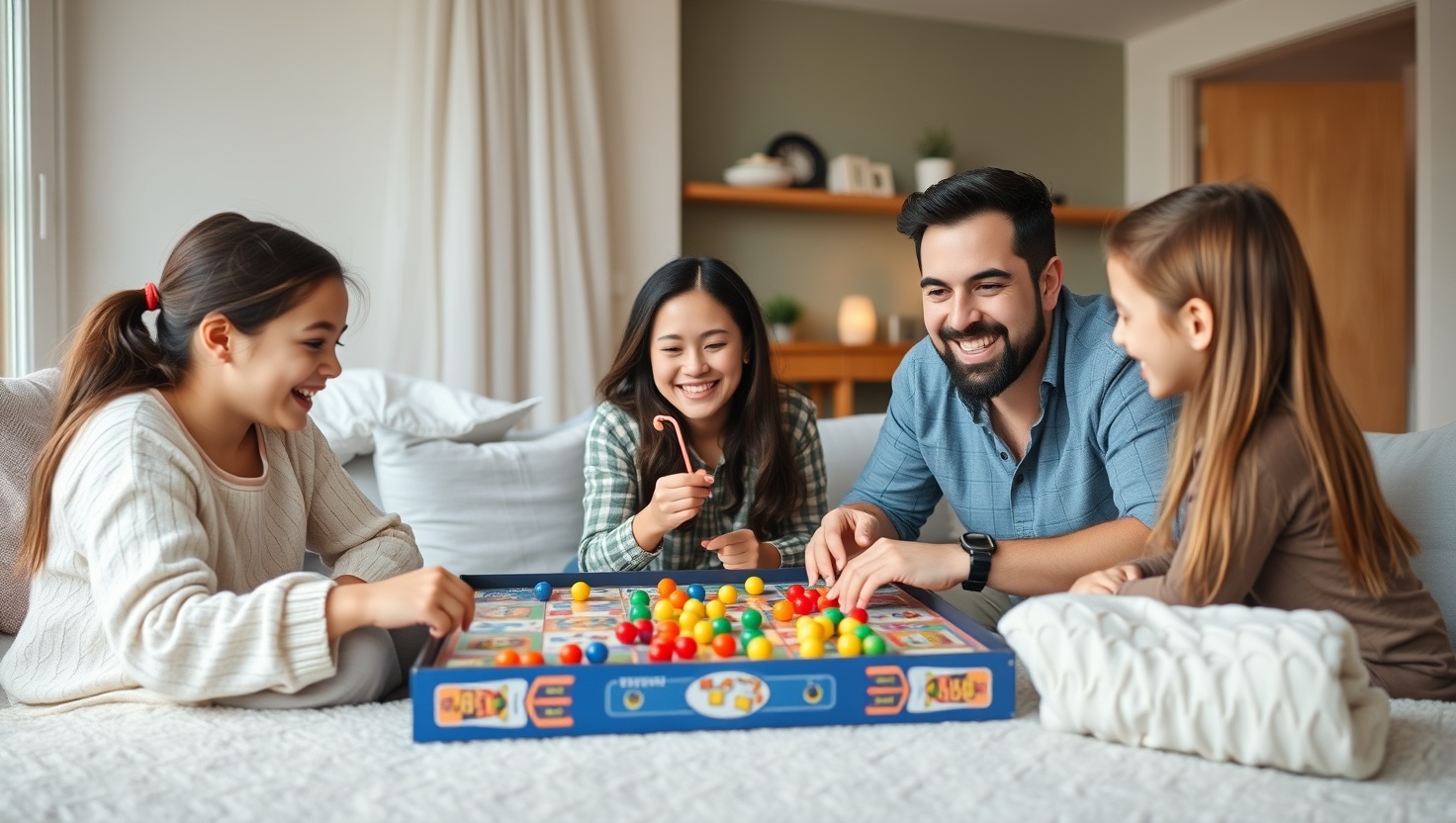
Your kid is face-down in their phone again. You suggest doing something together. They look at you like you've just proposed a weekend of competitive tax filing. Sound familiar?
Here's what's actually going on: phones win because they're frictionless. They require zero effort and deliver instant dopamine. If you want to compete with that, you don't need to lecture anyone about screen time — you need something genuinely more interesting on the table. Literally.
The best family board games to replace screen time in 2026 aren't dusty Monopoly revivals that stretch for four hours before someone flips the board. Modern board games are fast, clever, beautiful, and — here's the secret weapon — social in a way a phone never can be. They create moments. Stories. Grudges. Inside jokes. The stuff family memories are made of.
We've picked five games that will actually hold attention, work across a range of ages, and make game night something your family will look forward to instead of dread. No bribery required.
Key Takeaways
- Modern board games are engineered to be engaging — they're built to compete with screens, and many succeed.
- Cooperative games (everyone wins or loses together) are especially effective with teenagers who resist "losing" to family members.
- The best starter games teach themselves in under 10 minutes — no one needs to read a 40-page rulebook aloud.
- A consistent weekly game night, even just 45 minutes, builds more connection than most family screen-time together.
- Price range: $25–$45. All five picks offer far more hours of engagement than any streaming subscription.
Why Board Games Work When Nothing Else Does
Telling a teenager to "put down their phone" works approximately never. But inviting them to beat you at something? Different conversation entirely.
Board games work for a few reasons that align neatly with what kids and teens actually want. First, there's social pressure — good games make your choices matter to other players, which creates real-time stakes that no solo scroll session can match. Second, genuine uncertainty — you don't know who's going to win, which is inherently more engaging than watching a TikTok algorithm that's already calculated your attention span to the millisecond. Third, and this is the big one: shared experience. You can't laugh together at a meme the same way you laugh when Dad confidently builds a train route to nowhere and loses by 40 points.
A 2023 study from the University of Toronto found that families who played cooperative games together showed measurably higher communication quality in the hours following play. Phones do the opposite — they fragment attention even when everyone's in the same room.
You're not fighting screens. You're offering something better.
What Makes a Great Screen-Time Replacement Game?
Not every board game is built equal. A few things separate the ones that collect dust from the ones that become household staples:
- Setup time under 5 minutes. If the game takes longer to set up than a Netflix episode takes to load, you've lost half the battle before the first card hits the table.
- Plays in 30–90 minutes. Short enough to fit a weeknight; long enough to feel satisfying.
- Every player stays engaged the whole time. Long wait-your-turn games kill momentum. The best games keep everyone thinking even when it's not their turn.
- A range of player ages. Unless you want to run two separate games, look for titles that work from age 8 or 10 up through adults.
- Cooperative or semi-competitive. Cooperative games are gold for mixed-age families — the 11-year-old and the 45-year-old are on the same team, which removes age-gap awkwardness instantly.
Every game on this list passes all five tests.
Quick Comparison
| Game | Price | Players | Min Age | Play Time | Type |
|---|---|---|---|---|---|
| Ticket to Ride | ~$35 | 2–5 | 8+ | 45–75 min | Competitive |
| Wingspan | ~$45 | 1–5 | 10+ | 40–70 min | Competitive |
| Pandemic | ~$30 | 2–4 | 8+ | 45–60 min | Cooperative |
| Bomb Busters | ~$25 | 2–5 | 8+ | ~20 min | Cooperative |
| Castle Panic | ~$30 | 1–6 | 10+ | 45–60 min | Cooperative |
The 5 Best Family Board Games to Replace Screen Time in 2026
Ticket to Ride
If board games had a red pill, Ticket to Ride would be it. It's the game that has converted more "I don't play board games" people into genuine enthusiasts than almost anything else on the market. The premise is elegantly simple: collect train cards, claim routes across a map, and connect destination cities for points. That's it. You can learn the rules in 10 minutes and be mid-game in 15.
But here's what makes it special — the strategic depth sneaks up on you. Halfway through your first game, you realize that the route you needed someone else already took, and now you have to rethink your entire plan. Suddenly everyone at the table is paying very close attention to everyone else. No one is checking their phone. That, right there, is the point.
The base game is set in North America, but there are versions covering Europe, Asia, and more if you want variety later. Start with the original. It's a classic for a reason.
Pros
- Fastest learning curve of any gateway game
- Works brilliantly with all ages from 8 up
- Creates genuine tension without feeling mean
- Massive replayability — different routes every game
Cons
- Can feel slightly slow with only 2 players
- Some blocked routes cause mild family friction
Wingspan
Wingspan is the game that makes people say "wait, this is a board game?" The artwork alone is worth the price — 170 illustrated bird cards, each with a real species, a real habitat, and a real biological fact. Your kids will learn more about birds from one session of Wingspan than from a month of nature documentaries they half-watched while scrolling.
The gameplay is what's called "engine building" — you play birds to your habitat boards and their special abilities chain together over the course of the game, becoming more powerful as the game progresses. It's satisfying in a way that's hard to describe until you experience it. That feeling of your engine clicking into place is genuinely better than any notification ping.
Wingspan has won more awards than we have room to list, including the prestigious Kennerspiel des Jahres. It's the highest-rated family game on BoardGameGeek for good reason. If your family has any interest in nature, this is the one.
Pros
- Stunning production quality — genuinely beautiful
- Educational without feeling like homework
- Solo mode for one player available
- Multiple expansion packs add European/Oceania birds
Cons
- Slightly more setup time than others on this list
- Learning curve steeper for under-10s
Pandemic
Pandemic is the original cooperative board game — the one that proved families could play together against the game instead of against each other. Four diseases are spreading across a world map. Your team plays specialist roles — medic, scientist, dispatcher — and has to coordinate to cure all four before outbreaks spin out of control. You either all win, or you all lose.
This is the game to choose if your teenager is particularly resistant to competition with family. There's no "I beat Dad" energy here — just "we almost had it!" or "we actually pulled it off!" Both create connection. The game is also legitimately difficult, which means beating it feels like a real achievement. Expect to lose your first couple of games. That's part of the experience.
For families that want a lighter version, Pandemic: Hot Zone is a faster, simpler variant that plays in 30 minutes. But the original is the one that earns the applause.
Pros
- Cooperative mechanic eliminates sibling rivalry
- Builds genuine communication and strategic planning
- Replayable — disease spread is randomized each game
- Multiple difficulty settings for different skill levels
Cons
- Risk of "quarterbacking" — one player dominating decisions
- Can feel intense; not ideal for anxious younger kids
Bomb Busters
Bomb Busters won the 2025 Spiel des Jahres — which is the Oscar of the board game world — and if you've been sleeping on it, now is the time to wake up. The concept: you're a team of bomb disposal experts working your way through a series of bombs. Each bomb is a puzzle of wires, and players have to communicate carefully to defuse them without triggering a detonation.
What makes it genius for families is the self-teaching design. There's no rulebook read-aloud. The game literally teaches you as you go through a series of tutorial scenarios. You can go from box open to playing in under 10 minutes, which solves the single biggest barrier to game nights: setup friction. The whole game plays in about 20 minutes, making it the perfect "one more round" game. You will play it more than once in a sitting. Guaranteed.
At $25 it's also the most affordable pick on this list, and it punches well above its price. The cheapest way to prove to your family that board games in 2026 are nothing like the board games they remember.
Pros
- Self-teaching — no rulebook required
- Plays in ~20 minutes — perfect for weeknights
- 2025 Spiel des Jahres winner
- Most affordable pick — great entry point
Cons
- Very short — dedicated gamers may want more depth
- Limited to 5 players
Castle Panic
Castle Panic is cooperative castle defense, and it nails the sweet spot between accessible and genuinely fun. Monsters march out of the forest toward your castle towers. You and your fellow defenders draw cards and play them to stop the invaders before they tear your fortress apart. Everyone wins together — or everyone watches their towers fall together.
The rules click in about 5 minutes, which matters more than people give it credit for. The moment your kid says "wait, I get it now" and starts making strategic suggestions is the moment you've won the battle against screen time for that evening. Castle Panic also supports up to six players, making it one of the better options for bigger families or when friends are over.
It also scales well — there are expansions that add significantly more complexity if your family outgrows the base game, but the base game alone has enough variety to keep things interesting for months.
Pros
- Rules explained in under 5 minutes
- Supports up to 6 players — great for bigger gatherings
- Strong expansions add longevity
- Accessible for a wide age range
Cons
- Some sessions end in crushing defeat — younger kids may find this frustrating
- Artwork style won't appeal to every family
How to Make Game Night Actually Happen
Buying the game is the easy part. Getting your family to the table consistently is the real work — and it's mostly about removing friction.
Pick a fixed night and protect it
Flexibility sounds good in theory but kills consistency. Pick one night — Friday after dinner, Sunday afternoon — and make it non-negotiable. After three or four sessions, it stops needing to be enforced because people start looking forward to it.
Phones go in another room
No exceptions. Not "face down on the table," not "just in case someone calls." In another room. This isn't about punishing anyone — it's about creating conditions where the game can actually compete. Modern games are genuinely interesting. They just can't win against a device that's literally engineered to hijack your attention.
Let someone else pick first
Give your teenager the first pick from a shortlist of two or three games. Ownership of the choice matters. They're far more likely to stay engaged in a game they helped choose.
Start with cooperative games
For families where game nights have historically ended in arguments, cooperative games remove the "I won, you lost" dynamic entirely. Bomb Busters, Pandemic, and Castle Panic are all great starting points. Build to competitive games once the habit is established.
The Bigger Picture: What You're Actually Building
A weekly game night isn't just about getting your kid off their phone for 90 minutes. That's the minimum version of what's happening.
The deeper thing — and this is the part worth saying out loud — is that you're proving to your family that real life can be more interesting than a screen. Every time someone laughs around a game table, every "just one more round," every moment of genuine strategy or surprise, you're building evidence. Evidence that connection happens in person. Evidence that fun doesn't require a subscription. Evidence that your family, together, around a table, is genuinely a good time.
That's not a small thing. In a world where the algorithm is engineered to keep every individual alone and scrolling, choosing the table is a quiet act of rebellion. And a much more fun one than lecturing anyone about dopamine.
Ready to Reclaim the Table?
Pick one game from this list. Pick a night this week. Put the phones in another room and see what happens. You might be surprised how fast everyone forgets to check them.
Start with Ticket to Ride →Frequently Asked Questions
What are the best family board games to replace screen time?
The best board games for replacing screen time are ones that demand real engagement from every player. Our top picks include Ticket to Ride (easy to learn, hard to put down), Wingspan (beautiful and educational), Pandemic (cooperative teamwork), Bomb Busters (the 2025 Spiel des Jahres winner), and Castle Panic (quick cooperative fun). All work for ages 8–10 and up.
What age are family board games suitable for?
Most of the games on this list work well from age 8 or 10 and up. Ticket to Ride and Pandemic are great from age 8. Wingspan and Castle Panic work well from age 10. Bomb Busters is self-teaching and accessible for slightly younger players with adult guidance.
How do I get my teenager interested in board games?
Start with short, fast-moving games that feel dynamic — Bomb Busters takes just 20 minutes. Cooperative games like Pandemic and Castle Panic work especially well with teens because everyone wins or loses together, which removes the pressure of one person being "the loser." Let them pick the first game from a shortlist you've already approved.
Are board games actually better than screen time?
Yes — and research backs this up. Board games build face-to-face communication, strategic thinking, turn-taking, and emotional regulation. Unlike passive screen time or social media scrolling, board games require active participation and have a definitive end point. They also create shared memories, which screens rarely do.
How often should families do a game night?
Once a week is a great starting point — pick a consistent night, put phones in another room, and make it a ritual. Even 45 minutes of focused game time builds stronger family connection than most "half-watching TV together" evenings. Once you have a few good games in rotation, many families find themselves playing 2–3 times a week naturally.