
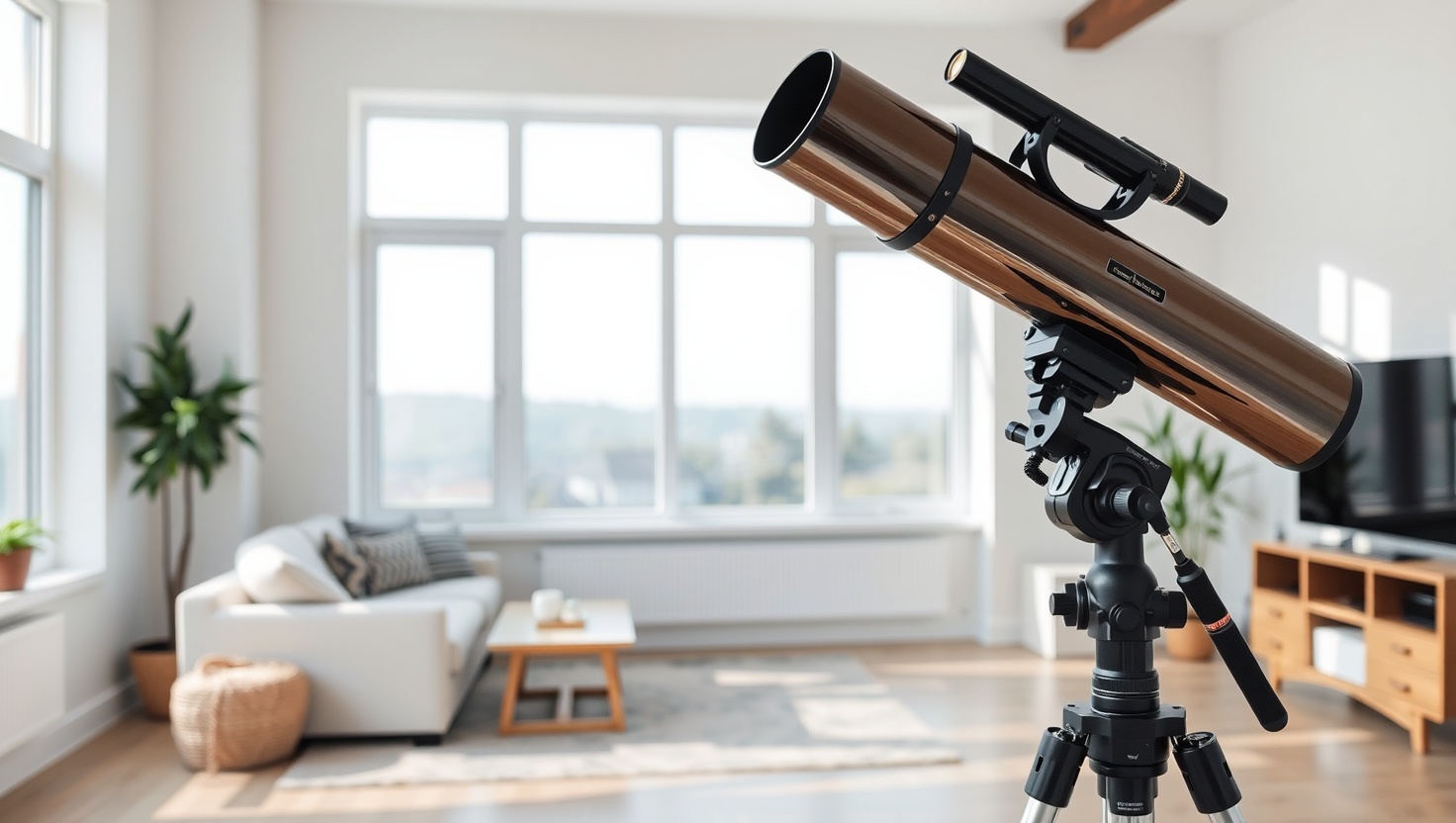
If you want to actually see galaxies, nebulae, and star clusters with your own eyes, aperture is everything. A Dobsonian gives you the most of it per dollar.
Sky-Watcher Dobsonian — Top Pick
With a large, crisp mirror, a smooth and stable mount, and easy handling that rewards you night after night, the Sky-Watcher Dobsonian is the best all-around telescope for deep-sky and planetary viewing in 2026.
In a hurry? That's our pick. Want the reasoning and the full comparison? Keep reading.
There is a reason seasoned stargazers keep coming back to the Dobsonian. It is a big Newtonian reflector sitting on a simple wooden rocker mount, and that no-nonsense design strips out the expensive tripods and heavy heads that eat your budget on other telescopes. Every dollar you save on the mount goes straight into the mirror, and the mirror is what gathers light. More light means fainter galaxies, richer nebulae, and detail on planets that smaller scopes simply cannot show you.
But not all Dobsonians are created equal. A larger aperture shows more, yet a bigger tube is also heavier to lift and slower to cool down. The focal ratio changes how the scope behaves at the eyepiece. Some models arrive with the eyepieces and finders you need, while others expect you to buy extras. Below you get the four Dobsonians worth your money in 2026, plus a plain-English guide to aperture, focal ratio, collimation, and portability so you pick the right one the first time.
Key Takeaways
- Aperture is the number that matters most: a bigger primary mirror gathers more light and reveals fainter deep-sky objects.
- For the best all-around performance and optics, the Sky-Watcher Dobsonian is our top pick.
- Want the most complete out-of-the-box package with quality accessories included? The Apertura Dobsonian is the best value.
- New to the hobby and want the easiest start? The Zhumell Dobsonian keeps things simple and rewarding.
- Prefer help finding targets without a computer chasing the scope? The Celestron Dobsonian with StarSense app tech points you right at them.
Why Aperture Wins: How to Read a Dobsonian's Specs
Aperture is the diameter of the primary mirror, measured in millimeters or inches, and it is the single most important number on a Dobsonian. A larger mirror gathers more light, and light is what lets you see faint, distant objects. Step up from a small scope to an 8-inch or 10-inch Dobsonian and dim galaxies that were invisible suddenly appear, star clusters resolve into pinpoints, and planets show real surface detail. This is exactly why the Dobsonian is so loved: because the mount is cheap and simple, nearly all your money buys mirror, so you get more aperture per dollar than any other design.
Next comes focal ratio, written as an f-number like f/6 or f/5. You get it by dividing the focal length by the aperture. A longer, slower ratio around f/6 or f/8 is forgiving on eyepieces and gives punchy, high-contrast views of the Moon and planets. A shorter, faster ratio around f/4 or f/5 keeps a big tube more compact and delivers a wider field for sweeping the Milky Way, though it demands better eyepieces to stay sharp at the edges. Neither is wrong. It is a trade between planetary crispness and wide-field portability.
Finally, think about eyepieces and finders. A Dobsonian's magnification comes from the eyepiece, not the scope itself, so the eyepieces in the box matter. Two decent eyepieces, a low-power one for finding objects and a higher-power one for close-ups, cover most nights. A quality finder, a red-dot or a right-angle finderscope, saves you real frustration when you are hunting a faint smudge in a huge sky. Some models include all of this, while others leave you to buy it, so read the kit list before you compare prices.
Collimation, Cool-Down, and Carrying It: Living With a Big Tube
Because a Dobsonian is a Newtonian reflector, its mirrors need to be aligned, and that alignment is called collimation. It sounds intimidating and it is not. With a simple collimation cap or a cheap laser tool you can check and tweak the alignment in a couple of minutes, and once you have done it twice it becomes routine. A well-collimated scope delivers tack-sharp stars, so this small habit is the difference between fuzzy and stunning. Bigger, faster scopes drift out of alignment a little more easily with transport, so budget a minute for it before each session.
Two more realities of a big tube. First, cool-down: a large mirror needs time to match the outside air temperature, often 30 to 45 minutes, before it settles and gives its sharpest views. Set it outside while you eat dinner and it is ready when the sky darkens. Second, size and weight. An 8-inch Dobsonian is manageable for most adults to carry in two pieces, the tube and the base, while 10-inch and larger models get heavier and may need two trips or a car. And the truth every guide should tell you: dark skies matter more than any spec. Drive away from city lights and even a modest Dobsonian will floor you, while the biggest scope under a glowing suburban sky shows far less than it should.
Quick Comparison
| Product | Best For | Optics | Strength | Portability |
|---|---|---|---|---|
| Sky-Watcher Dobsonian | Overall pick | Large aperture, crisp mirror | Best all-around performance | Good |
| Apertura Dobsonian | Value package | Large aperture, rich extras | Complete kit out of the box | Good |
| Zhumell Dobsonian | Beginners | Solid aperture, simple design | Easiest to learn on | Very good |
| Celestron Dobsonian | Finding targets | Solid aperture, app assist | StarSense push-to guidance | Good |
1. Sky-Watcher — Best Overall
Sky-Watcher Dobsonian
The Sky-Watcher Dobsonian is the scope we recommend to almost anyone serious about seeing the sky. It nails the fundamentals that actually matter: a large, well-figured primary mirror that drinks in light, a smooth and stable rocker mount that glides to your target and stays put, and a build that feels solid without being fussy. Point it at a galaxy or the Orion Nebula and the amount of detail it pulls out will change how you think about backyard astronomy.
What sets it apart is consistency. The optics are crisp across planets and deep-sky alike, the focuser is smooth enough for careful high-power work, and the whole scope is easy to collimate and live with night after night. It carries in two manageable pieces, cools down predictably, and simply gets out of your way so you can observe. If you want one Dobsonian that does everything well and grows with you, this is the one to buy.
Pros
- Large aperture gathers plenty of light for faint deep-sky objects
- Crisp, high-contrast optics for both planets and galaxies
- Smooth, stable rocker mount that tracks your nudges precisely
- Easy to collimate and maintain night after night
- Excellent all-around performer that grows with your skills
Cons
- Fewer bundled accessories than some value-focused rivals
- Big tube still needs cool-down time before sharpest views
- Larger apertures get heavy to carry in one trip
2. Apertura — Best Value Package
Apertura Dobsonian
The Apertura Dobsonian wins on sheer completeness. Where many scopes send you shopping for the parts you actually need, Apertura loads the box: multiple eyepieces, a quality finder, a collimation tool, a cooling fan for the primary mirror, and other extras that would cost a small fortune bought separately. For a first big Dobsonian, that means you open the box, assemble it in minutes, and observe the same night without a second purchase.
None of that would matter if the optics were weak, but they are not. The large primary delivers the bright, detailed deep-sky views you buy a Dobsonian for, and the mount is smooth and steady. Add the built-in cooling fan that shortens the wait for sharp images, and you have a package that punches well above its price. If you want the most telescope and the most accessories for your money, Apertura is the smart buy, and it is our clear runner-up overall.
Pros
- Comes with a generous set of eyepieces and accessories included
- Built-in cooling fan speeds up mirror cool-down for sharper views
- Large aperture delivers bright, detailed deep-sky performance
- Collimation tool included so you are ready on night one
- Outstanding value for a complete, ready-to-observe kit
Cons
- Large tube and base are still heavy to move around
- Bundled eyepieces are good but you may upgrade over time
- Big aperture needs dark skies to truly shine
3. Zhumell — Best for Beginners
Zhumell Dobsonian
If this is your first telescope, the Zhumell Dobsonian makes the learning curve gentle. It keeps everything simple: a straightforward rocker mount you just nudge toward a target, easy assembly, and a size that most people can carry and store without a struggle. There is no computer to align, no menus to learn, just point and look. That simplicity is a feature, because the sooner you are actually observing, the faster the hobby hooks you.
Simple does not mean weak. The aperture is generous enough to show the Moon in crisp detail, resolve the rings of Saturn, and pull in brighter galaxies and clusters from a reasonably dark site. The included accessories get you started, and the whole scope is forgiving to collimate and use. When friends ask what telescope their family should start with, the Zhumell is an easy, honest recommendation.
Pros
- Beginner-friendly point-and-look design with no computer to align
- Quick, simple assembly gets you observing fast
- Manageable size and weight for easy carrying and storage
- Solid aperture shows the Moon, planets, and brighter deep-sky objects
- Forgiving to collimate and learn the basics on
Cons
- Smaller aperture than the top picks shows fainter objects less
- Fewer premium extras than the value-package options
- You may outgrow it as your skills and appetite grow
4. Celestron — Best Tech (StarSense)
Celestron Dobsonian
Finding faint objects in a huge sky is the hardest part of the hobby, and the Celestron Dobsonian tackles it head-on. Its StarSense technology uses your phone to figure out where the scope is pointed, then shows on-screen arrows that guide you to nudge the tube until the target lands in the eyepiece. There is no motorized computer chasing the sky, so you keep the simple, reliable feel of a true Dobsonian while gaining a smart assistant that removes the guesswork.
Under the app, this is a proper reflector with solid aperture, so once StarSense points you at a galaxy or nebula, there is real light-gathering power to make it worth the trip. For beginners intimidated by star-hopping, or busy observers who want to see more objects in a single night, the guidance pays for itself. If you love the idea of a Dobsonian but want help locating targets, this is the model to get.
Pros
- StarSense app guides you straight to targets with on-screen arrows
- Keeps the simple, reliable manual feel of a true Dobsonian
- Solid aperture delivers real deep-sky and planetary views
- Great for beginners intimidated by manual star-hopping
- Helps you see more objects in a single observing session
Cons
- App guidance depends on your phone and a quick alignment
- Aperture trails the largest scopes in this lineup
- Tech convenience adds cost over a plain manual model
Which Should You Choose?
Pick the Sky-Watcher if you want the best all-around scope
If you want one Dobsonian that does everything well, the Sky-Watcher is the clearest choice. Its large, crisp mirror pulls detail from planets and deep-sky objects alike, the mount is smooth and steady, and it stays easy to collimate and live with over years of observing. It is the best balance of optics, build, and long-term value on this list, and the scope we hand to most serious buyers.
Pick the Apertura for the most complete package, or the Zhumell to start simple
Want to open the box and observe the same night with quality eyepieces, a finder, and a cooling fan already included? The Apertura gives you the most complete kit for your money and is our runner-up overall. Brand new to the hobby and want the gentlest learning curve? The Zhumell keeps setup simple and manageable while still showing you plenty of sky. Both are smart, honest first-scope choices.
Pick the Celestron if finding objects is your biggest hurdle
Some observers get frustrated hunting faint smudges across a huge sky, and that is exactly what the Celestron solves. Its StarSense app shows arrows that walk you right to your target while keeping the simple manual feel of a real Dobsonian. You still get solid aperture for genuine deep-sky views, so you are not trading performance for convenience, you are adding a guide that helps you see more every night.
Ready to See More of the Night Sky?
The Sky-Watcher Dobsonian gathers the light you need to reveal galaxies, nebulae, and planetary detail, all on a simple mount that gets out of your way. Check current pricing and see why it tops our 2026 list.
Explore Brainstamped's Free ToolsFrequently Asked Questions
For most people, the Sky-Watcher Dobsonian is the best choice in 2026. It combines a large, crisp mirror with a smooth, stable mount and easy handling, delivering excellent all-around views of planets and deep-sky objects. If you want the most complete package, the Apertura Dobsonian is the top alternative and our runner-up.
Aperture is the diameter of the primary mirror, and it decides how much light your telescope gathers. More light lets you see fainter galaxies, nebulae, and clusters, plus finer detail on planets. Because a Dobsonian's mount is simple and inexpensive, most of your money buys mirror, so you get more aperture per dollar than any other design.
Not at all. A Dobsonian assembles in minutes with no computer to align, you just nudge the tube toward your target. Collimation, the alignment of the mirrors, takes a couple of minutes with a simple cap or laser tool, and it quickly becomes routine. That simplicity is a big reason beginners and veterans alike love the design.
A slower ratio around f/6 to f/8 is forgiving on eyepieces and gives high-contrast views of the Moon and planets. A faster ratio around f/4 to f/5 keeps a big tube more compact and offers wider fields for sweeping the Milky Way, but it asks for better eyepieces to stay sharp at the edges. Choose based on whether you prioritize planetary crispness or wide-field portability.
Dark skies help enormously. Light pollution washes out faint deep-sky objects, so driving away from city glow reveals dramatically more than the same scope in a bright suburb. The Moon and planets still look great from anywhere, but for galaxies and nebulae, a darker site does more for your views than almost any spec upgrade.