
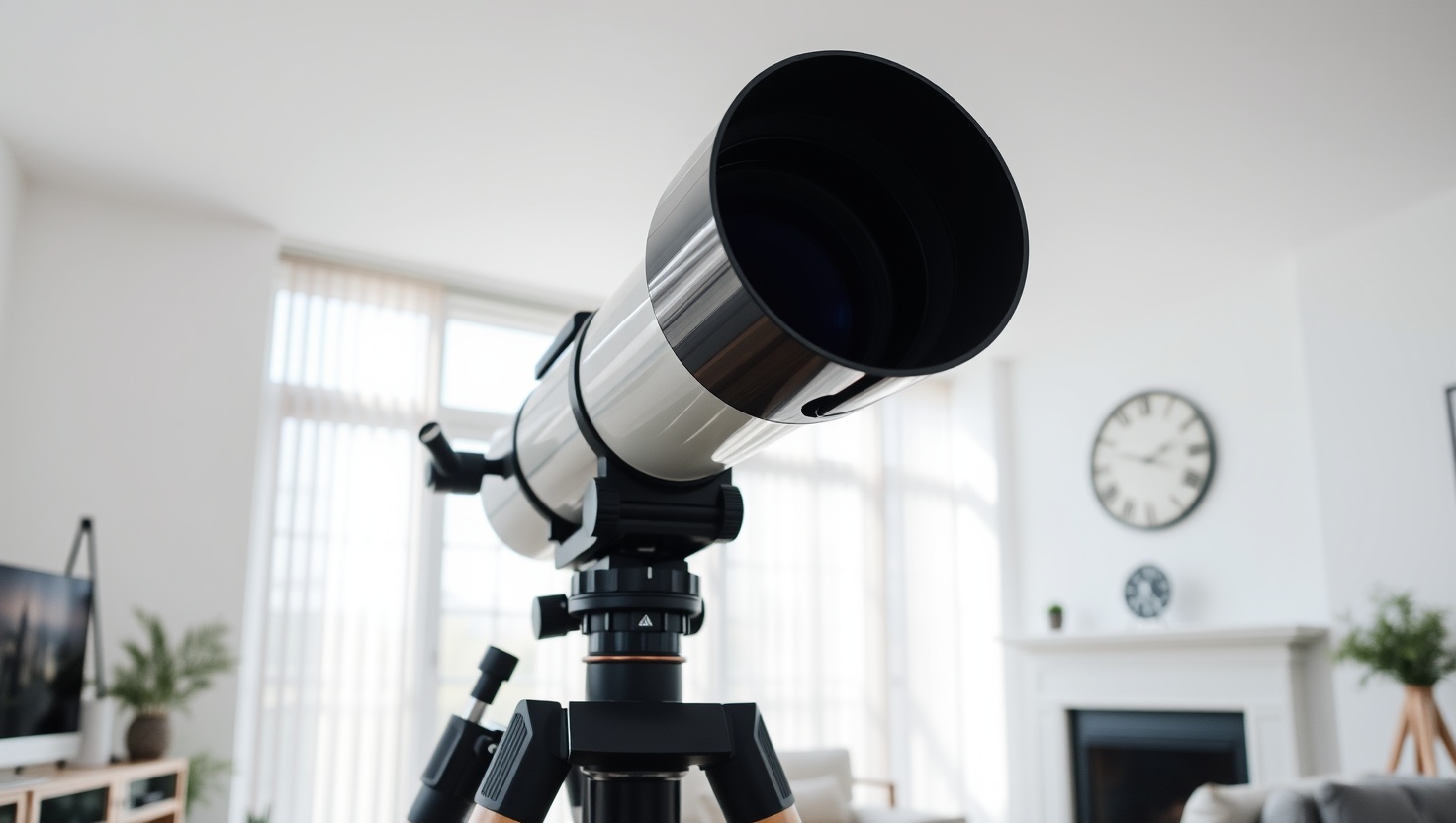
You want to see Saturn's rings tonight, not spend an hour hunting for them. A computerized GoTo telescope points itself, so the sky opens up in minutes.
Celestron NexStar 8SE — Top Pick
With a big 8-inch aperture that gathers the light for detailed planets and real deep-sky reach, all on a proven GoTo mount that points itself, the NexStar 8SE is the best all-around computerized telescope for 2026.
In a hurry? That's our pick. Want the reasoning and the full comparison? Keep reading.
There is a moment the first time a scope swings on its own, stops, and drops Saturn dead center in the eyepiece. No star charts, no fumbling in the dark, no guessing whether that faint smudge is a galaxy or a bug on the lens. A computerized telescope with a motorized GoTo mount does the finding for you: align it on a couple of bright stars, punch in a target from its database of tens of thousands of objects, and the motors slew right to it and track it as the Earth turns. That is the whole promise, and in 2026 it finally works smoothly even for total beginners.
But the marketing can fool you. A big database and a fancy app mean nothing if the aperture is too small to gather light, or the tripod wobbles every time you touch the focuser. The number that actually decides what you can see is aperture, the diameter of the main lens or mirror in millimeters, because that is how much starlight the scope collects. Below you get the four computerized telescopes worth your money right now, plus a plain-English breakdown of aperture, optical design, focal length, mount stability, and app control so you buy the right one the first time.
Key Takeaways
- Aperture in millimeters decides how much light your scope gathers, which sets how bright and detailed the view is, more than any other spec.
- For the best all-around views and the deepest reach, the Celestron NexStar 8SE is our top pick: a big 8-inch mirror on a proven GoTo mount.
- Want GoTo convenience for the least money? The Celestron Astro-Fi controls straight from your phone over WiFi and delivers strong value.
- Chasing the sharpest, highest-contrast views of planets and the Moon? The Sky-Watcher GoTo Telescope earns it on optics.
- Short on space or always on the move? The compact Celestron NexStar 4SE packs GoTo into a grab-and-go body.
How to Read a Computerized Telescope (Without Getting Fooled)
Start with aperture, because it does most of the work. Aperture is the diameter of the main lens or mirror in millimeters, and it decides how much starlight your scope collects. More light means brighter, more detailed views and the ability to reach fainter, more distant objects like galaxies and nebulae. An 8-inch (about 200mm) scope gathers far more light than a 4-inch (about 100mm) one, so it shows you things the smaller scope simply cannot. Do not let a big object database distract you from this: the computer decides where the scope points, but aperture decides what you actually see when it gets there.
Next comes optical design, because it shapes the kind of viewing you get. A Schmidt-Cassegrain (SCT) folds a long focal length into a short, portable tube, making it a versatile all-rounder for planets and deep-sky alike. A Maksutov-Cassegrain is even more compact and delivers crisp, high-contrast views that shine on the Moon and planets. A refractor uses lenses for sharp, low-maintenance views with no collimation needed. Focal length matters too: longer focal lengths give higher magnification and a narrower field, great for planets, while shorter ones give wider views for star clusters. Match the design to what you most want to look at.
Mount, App Control, and the Sky You Actually Have
The GoTo mount is the brain, and its stability is the quiet dealbreaker. A motorized computerized mount slews to targets and tracks them as the Earth rotates, but it needs a solid tripod underneath or every view shakes when you touch the focuser. Alignment is the other half: you point the scope at two or three bright stars so it learns where it is aiming, and from then on it finds objects for you. Better mounts align faster and hold targets more precisely. Many 2026 scopes swap the handset for phone control over WiFi, so you tap a target in a planetarium app and the scope slews to it, which is genuinely easier for beginners than menus on a tiny screen.
Then there is the sky you actually live under. No computer can beat light pollution, so darker skies always reveal more, especially for faint deep-sky objects. Plan a little upkeep, too. Reflecting and catadioptric optics can need occasional collimation, a simple alignment of the mirrors, and any scope can fog up with dew on humid nights, which a cheap dew shield or heater strap prevents. And every GoTo mount needs power, so budget for a good battery pack rather than draining AA cells in an hour. Get the aperture, the mount, and the dark sky right, and the app becomes what it should be: the easy part.
Quick Comparison
| Product | Best For | Optical Design | Strength | Portability |
|---|---|---|---|---|
| Celestron NexStar 8SE | Overall pick | 8" Schmidt-Cassegrain | Big aperture, deep reach | Good |
| Celestron Astro-Fi | Best value | Compact catadioptric/refractor | Phone WiFi control | Very good |
| Sky-Watcher GoTo Telescope | Best optics | High-contrast optics | Sharp planetary views | Good |
| Celestron NexStar 4SE | Best compact | 4" Maksutov-Cassegrain | Grab-and-go GoTo | Excellent |
1. NexStar 8SE — Best Overall
Celestron NexStar 8SE
The NexStar 8SE is the scope we hand to almost anyone who is serious about seeing the sky. That 8-inch aperture is the star of the show: it gathers enough light to show sharp detail on Jupiter's belts and Saturn's rings, resolve craters on the Moon, and reach out to galaxies and nebulae that smaller scopes leave as faint blurs. The Schmidt-Cassegrain design folds a long focal length into a short, luggable tube, so you get big-aperture reach without a telescope the size of a fence post.
The GoTo mount ties it together. Align on a few bright stars, pick from a database of tens of thousands of objects, and the motors slew right to your target and track it as the night turns. It is the classic that earned its reputation for a reason: enough light-gathering power to keep impressing you for years, wrapped in a system that finds the sky for you. If you want one telescope that grows with you, this is it.
Pros
- Large 8-inch aperture gathers plenty of light for bright, detailed views
- Reaches deep-sky objects like galaxies and nebulae, not just planets
- Compact Schmidt-Cassegrain tube is portable for its light-gathering power
- Reliable GoTo mount with a huge object database and accurate tracking
- Grows with you from first light to serious observing and imaging
Cons
- Single-arm mount and larger tube want a sturdy setup to stay steady
- GoTo mount needs a good external power source for a full night out
- SCT optics can need occasional collimation to stay razor sharp
2. Astro-Fi — Best Value
Celestron Astro-Fi
The Astro-Fi is the smart-money way into computerized astronomy. Instead of a physical handset, it creates its own WiFi network so you drive the whole scope from your phone or tablet. Tap a planet or a star cluster in the planetarium app and the motors slew right to it, which is far more intuitive for a beginner than scrolling menus on a little screen in the dark. It is GoTo convenience stripped down to the essentials and priced for people just getting started.
You give up the deep light-gathering reach of an 8-inch scope, but you keep the part that makes computerized astronomy magical: point-and-go targeting that actually works. For a first telescope, or as a grab-and-go companion to a bigger rig, the Astro-Fi delivers the modern, app-driven experience without the flagship price. It gets people from unboxing to seeing Saturn faster than almost anything else here.
Pros
- Controls entirely from your phone over built-in WiFi, no handset to fuss with
- Beginner-friendly GoTo that goes from setup to first target fast
- Strong value for a fully computerized, self-pointing telescope
- Compact and light, easy to carry out to a dark spot
- Planetarium app makes finding objects genuinely simple
Cons
- Smaller aperture gathers less light than the bigger scopes here
- WiFi control leans on your phone's battery as well as the mount's power
- Less reach on faint deep-sky objects than a larger telescope
3. Sky-Watcher GoTo — Best Optics
Sky-Watcher GoTo Telescope
If you care most about how clean and sharp the view looks, the Sky-Watcher GoTo Telescope makes the case. Sky-Watcher has built its reputation on well-figured optics that deliver high contrast and crisp detail, and it shows on the targets where sharpness matters most: the Moon's terminator, the cloud bands of Jupiter, and the rings of Saturn snapping into focus. Good glass rewards you with views that feel a cut above scopes that skimp on optical quality.
The motorized GoTo mount handles the finding and tracking, so you get that sharp view without hunting for it by hand. This is the pick for the observer who would rather have optics that punch above their aperture than chase the biggest database or the flashiest app. When contrast and resolution are your priority, and you want every photon the optics collect delivered cleanly to your eye, Sky-Watcher earns the nod.
Pros
- High-contrast, well-figured optics deliver sharp, clean views
- Excellent on planets and the Moon where resolution counts
- Motorized GoTo finds and tracks targets automatically
- Solid optical quality that punches above its aperture class
- Great for observers who prize view quality over gimmicks
Cons
- App and database ecosystem is less polished than Celestron's
- Reflector-based designs may need collimation to stay perfectly sharp
- GoTo mount still needs a steady tripod and its own power source
4. NexStar 4SE — Best Compact
Celestron NexStar 4SE
The NexStar 4SE is the one you actually take outside, because it is small enough to grab on a whim. Its Maksutov-Cassegrain design tucks a long focal length into a stubby, sealed tube that resists dew and holds its alignment well, and it delivers crisp, high-contrast views of the Moon and planets that belie its size. For a scope you can carry in one hand and set up in minutes, the image quality is genuinely satisfying.
It runs the same proven NexStar GoTo brain as its bigger sibling, with a database of tens of thousands of objects and accurate tracking, so you lose the portability tax without losing the point-and-go convenience. You trade the deep light-gathering of the 8-inch for a body that fits in a backpack and rides along on trips. If space is tight, or you want a computerized scope you will never talk yourself out of hauling out, the 4SE is the answer.
Pros
- Compact, light Maksutov body that is a joy to grab and go
- Sharp, high-contrast views of the Moon and planets for its size
- Sealed optics resist dew and rarely need collimation
- Same proven NexStar GoTo system and large object database
- Sets up in minutes, so it actually gets used
Cons
- Small 4-inch aperture gathers less light for faint deep-sky objects
- Long focal length gives a narrow field, less ideal for big star clusters
- GoTo mount still needs a good power source for extended sessions
Which Should You Choose?
Pick the NexStar 8SE if you want the deepest, most impressive views
If you want one telescope that keeps rewarding you for years, the Celestron NexStar 8SE is the clearest choice. Its 8-inch aperture gathers the light you need to see sharp planetary detail and reach out to galaxies and nebulae, and the proven GoTo mount finds them all for you. It is the best balance of light-gathering power, versatility, and self-pointing convenience on this list.
Pick the Astro-Fi or NexStar 4SE if easy and portable rule everything
Want the simplest way into GoTo for the least money? The Celestron Astro-Fi drives entirely from your phone over WiFi, so beginners go from setup to Saturn fast. Short on space or always traveling? The compact Celestron NexStar 4SE packs the same NexStar smarts into a grab-and-go body. Both trade some aperture for convenience, and that is a smart trade if you value getting outside over chasing the faintest objects.
Pick the Sky-Watcher GoTo if view quality matters most
Some observers care more about how clean and sharp the image looks than about database size or app polish. The Sky-Watcher GoTo Telescope answers that with well-figured, high-contrast optics that shine on the Moon and planets. It still finds and tracks targets for you, so you are not sacrificing convenience, but crisp, contrast-rich views are what you are really buying, and that is worth it if that is your priority.
Ready to Let the Scope Find the Sky?
The Celestron NexStar 8SE gives you big-aperture light-gathering power and a GoTo mount that slews right to your target, so you spend the night seeing wonders instead of hunting for them. Check current pricing and see why it tops our 2026 list.
Explore Brainstamped's Free ToolsFrequently Asked Questions
For most people, the Celestron NexStar 8SE is the best computerized telescope in 2026. Its 8-inch aperture gathers enough light for detailed planetary views and real reach into deep-sky objects, and its proven GoTo mount points itself at tens of thousands of targets. If you want the easiest, most affordable way in, the Celestron Astro-Fi is the top alternative.
Aperture is the diameter of your telescope's main lens or mirror in millimeters, and it decides how much starlight the scope collects. More aperture means brighter, more detailed views and the ability to reach fainter, more distant objects. Two computerized scopes with the same database can show very different views, so always weigh aperture heavily, not just the object count or the app.
A GoTo telescope has a motorized computerized mount. You align it by pointing at two or three bright stars so it learns its orientation, then you pick a target from its database or a planetarium app. The motors slew the scope to that object and track it as the Earth rotates, keeping it centered in the eyepiece so you can just look.
A Schmidt-Cassegrain (SCT) like the NexStar 8SE is a compact all-rounder good for planets and deep-sky alike. A Maksutov-Cassegrain like the NexStar 4SE is small and gives crisp, high-contrast planetary views. A refractor uses lenses for sharp, low-maintenance images with no collimation. Match the design to what you most want to observe and how much you want to carry.
Darker skies always help, especially for faint deep-sky objects, since no computer can beat light pollution. The Moon and bright planets show well even from a backyard in the city, but galaxies and nebulae reward you far more under dark skies. Plan for a little upkeep too, like a dew shield on humid nights and a solid power source for the GoTo mount.