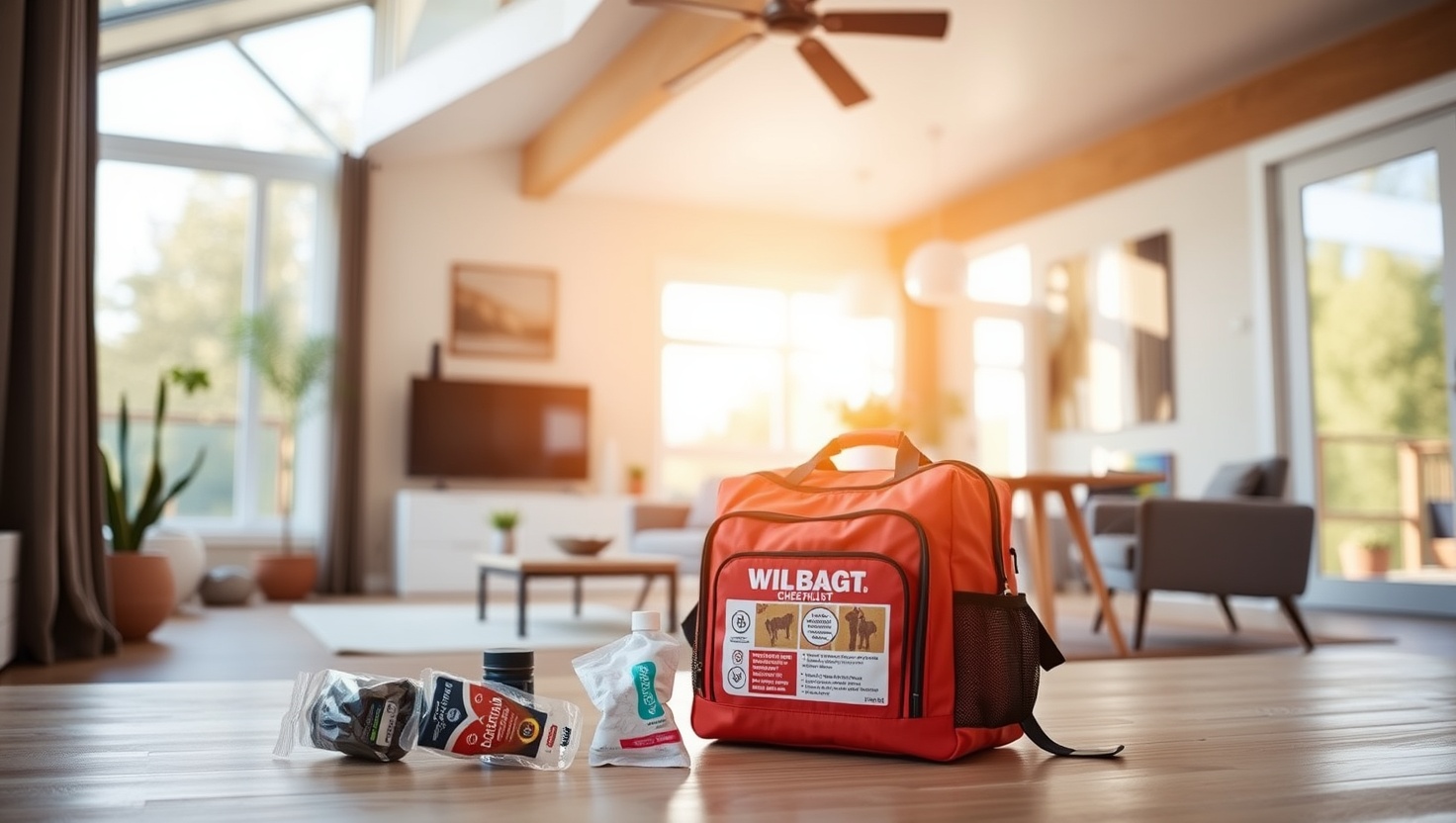
When a wildfire evacuation order hits your phone, you get 15 to 30 minutes. That is not an estimate designed to scare you — that is the average time between alert and mandatory departure reported by CAL FIRE and FEMA across hundreds of evacuations. In those minutes, you are not thinking clearly. Adrenaline narrows your focus. You grab what you see. And if you have not packed a go-bag in advance, what you see is a house full of things you cannot carry.
Pre-Packed Emergency Go-Bag — Our Top Recommendation
If you want a head start, a pre-packed emergency go-bag gives you the foundation — backpack, water pouches, food bars, first aid basics, emergency blanket, light stick, and a whistle. You then…
In a hurry? That’s our pick. Want the reasoning and the full comparison? Keep reading.
The 2026 wildfire season is already historic. As of mid-May, 26,568 wildfires have burned across the United States — 41% above the 10-year average. Nearly 1.9 million acres are gone. A developing El Nino pattern is expected to extend fire conditions through late fall. California just wrapped Wildfire Preparedness Week, and fire agencies across the West are urging residents to prepare now, not later.
The good news: a properly packed go-bag takes about an hour to assemble and costs less than $200. Once it is packed, it sits by your door and gives you something priceless — the ability to walk out with everything you need and zero panic. This guide covers exactly what goes in that bag, how to organize it, and three pre-made options if you want to skip the assembly entirely.
Key Takeaways
- Pack for 72 hours minimum — most wildfire evacuations last 1 to 5 days
- Documents and photos should be digitally backed up AND stored in a fireproof bag
- N95 masks are essential — wildfire smoke is a serious health hazard, especially for children and anyone with respiratory conditions
- One bag per person plus one family bag with shared essentials like the first aid kit and documents
- Test your bag every 6 months — check expiration dates, update documents, swap seasonal clothes
- Already packed equals zero stress when the evacuation alert hits your phone
The Essential Go-Bag: What Everyone Needs
Your go-bag is not a camping setup or a doomsday kit. It is a grab-and-go bag that keeps you comfortable, healthy, and documented for 72 hours while you are away from your home. Think of it as a 3-day travel bag for an unplanned trip where the destination is "anywhere safe."
The foundation is simple: water, food, shelter from smoke, light, communication, first aid, documents, and personal essentials. Every item in your bag should answer one question: Do I need this in the first 72 hours after walking out my door? If the answer is no, leave it out. Weight and speed matter more than completeness.
Pre-Packed Emergency Go-Bag
If you want a head start, a pre-packed emergency go-bag gives you the foundation — backpack, water pouches, food bars, first aid basics, emergency blanket, light stick, and a whistle. You then customize it with your own documents, medications, and personal items. This saves you the time of sourcing individual pieces and ensures nothing critical is forgotten. Look for bags rated for at least 72 hours and 1-2 people.
Check Price on Amazon →N95 Respirator Masks
Wildfire smoke contains fine particulate matter (PM2.5) that penetrates deep into your lungs. Standard cloth masks and surgical masks do not filter these particles. N95 masks do. Pack at least 2 per person in your go-bag, plus extras for your car. If you have children, get child-sized N95s — adult masks leave gaps on smaller faces and provide almost no protection. This is one of the most important and most overlooked items in any evacuation bag.
Check Price on Amazon →Fireproof Document Bag
Your IDs, insurance policies, property deeds, and medical records need to survive even if your house does not. A fireproof document bag rated to 2000 degrees Fahrenheit keeps your paperwork intact. Even better: it forces you to organize all your critical documents in one place, which makes grabbing them during evacuation a one-second decision instead of a frantic search through filing cabinets.
Check Price on Amazon →Documents and Digital Backup
When homes are lost to wildfire, the physical destruction is devastating — but the loss of documents can create months or years of bureaucratic headaches. Insurance claims, identity verification, medical records, and property ownership all require paperwork. Protect yourself with a two-layer approach: physical copies in a fireproof bag AND digital backups in the cloud.
Physical copies to include in your fireproof bag:
- Government-issued IDs (driver's license, passport) for every family member
- Home insurance policy and contact number for your agent
- Property deed or lease agreement
- Vehicle registration and insurance cards
- Medical records, prescription lists, and health insurance cards
- A USB drive with family photos and important digital files
- Emergency contact list (printed — your phone might die)
- Cash ($200-$500 in small bills — ATMs may be down)
Digital backups to maintain: Use a cloud storage service to keep scanned copies of everything listed above. Share access with a trusted family member who lives outside your area. If you lose both the originals and the fireproof bag, the cloud copies give you a path to recovery. Also consider emailing copies to yourself — your email archive becomes a document vault you can access from any device.
The Complete Go-Bag Checklist
Here is every item organized by category. Use this as your packing list. Each category has the essentials — do not skip any category, but you can adjust specific items based on your family's needs.
Water and Food
1 Water — 1 Gallon Per Person Per Day
Pack 3 liters minimum per person. Pre-sealed water pouches last 5 years and take up less space than bottles. Add water purification tablets as a backup — they weigh almost nothing and can purify creek or tap water if your supply runs out. A collapsible water bottle saves space when empty.
2 Emergency Food Bars
Calorie-dense emergency food bars are designed for exactly this situation — no cooking, no water needed, 5-year shelf life. Pack 3,600 calories per person (that is 1,200 per day for 3 days). They are compact, lightweight, and taste better than you would expect. Supplement with granola bars, dried fruit, or nuts if you have space.
3 Water Purification Tablets
A small bottle of water purification tablets weighs under 2 ounces and can purify up to 25 liters. If you are evacuated longer than expected or your water supply runs out, these turn questionable water into drinkable water in 30 minutes. Cheap insurance that takes up almost no space.
Shelter and Warmth
4 Emergency Mylar Blanket
These weigh 2 ounces, fold to the size of a deck of cards, and retain 90% of your body heat. Pack 2 per person. Evacuation shelters can be cold, and you may spend hours in your car or outdoors. A mylar blanket also works as a ground cover, rain shield, or signaling device. At under $2 each, there is no reason not to pack extras.
5 Change of Clothes
Pack one complete change of clothes per person in a zip-lock bag to keep them dry and smoke-free. Include: underwear, socks, a t-shirt, long pants, and a warm layer. Choose synthetic or wool fabrics — they dry faster than cotton. If you have young children, pack an extra set. Sturdy closed-toe shoes should be by your door, not in the bag.
Light and Communication
6 Headlamp or Flashlight
A headlamp keeps your hands free, which matters when you are carrying bags, kids, or pets in the dark. Choose a rechargeable model with at least 200 lumens. Pack extra batteries or make sure it charges via USB so your power bank can keep it going. Wildfires cause power outages — you need your own light source.
7 NOAA Weather Radio
When cell towers go down — and during major wildfires, they often do — a NOAA weather radio is your lifeline to official updates. Hand-crank models do not need batteries or electricity. Many also include a flashlight, USB charging port, and AM/FM radio. This single device covers communication, light, and phone charging in one package.
8 Power Bank
Your phone is your map, your communication tool, and your access to emergency alerts. A dead phone during an evacuation is a serious problem. Pack a power bank with at least 20,000mAh — enough to fully charge most phones 4 to 5 times. Keep it charged and in your bag at all times. Add the appropriate charging cables for every phone in your household.
9 Whistle
A whistle carries further than your voice and requires no batteries. If you are trapped, lost, or need to signal rescuers through thick smoke, three short blasts is the universal distress signal. Many emergency kits include one, but if yours does not, add a simple pealess whistle — they work even when wet.
First Aid and Medication
10 First Aid Kit
A compact first aid kit should include adhesive bandages, gauze, medical tape, antiseptic wipes, tweezers, pain relievers (ibuprofen and acetaminophen), antihistamines, and any personal medications. Pre-assembled kits save time and cover the basics. Customize with extras specific to your family — EpiPens, inhalers, or children's medications.
11 Prescription Medications
Pack a 7-day supply of every prescription medication your family takes. Rotate this supply every month to keep it fresh. If you cannot get extras from your pharmacy, ask your doctor for an emergency prescription specifically for your go-bag. Include a written list of all medications, dosages, and prescribing doctors — pharmacies in other cities need this to issue emergency refills.
12 N95 Masks (2+ Per Person)
Wildfire smoke is not just unpleasant — it is a health emergency. PM2.5 particles from burning structures can cause respiratory distress, trigger asthma attacks, and worsen heart conditions. N95 masks are the minimum protection level that actually filters these particles. Pack at least 2 per person, sealed in a zip-lock bag. Replace them if the packaging has been opened for more than 6 months.
Documents
13 Fireproof Document Bag
All your critical documents go in here: IDs, passports, insurance policies, property deeds, vehicle registrations, medical records, and a printed emergency contact list. Add $200-$500 in cash (small bills). A USB drive with family photos and digital copies of everything. This single bag protects your identity, your property claims, and your memories.
Personal Essentials
14 Phone Charger and Cables
Pack cables for every device in your household. A car charger is essential since you will likely be driving to safety. Your power bank handles charging when you are away from outlets, but a wall charger is needed once you reach a shelter or hotel.
15 Comfort Items for Kids
A small stuffed animal, a favorite book, or a simple card game makes an enormous difference for children during evacuations. The stress of leaving home is hardest on kids. One comfort item per child — small enough to fit in their own little bag — gives them something familiar to hold onto. Let them choose the item in advance so they feel part of the process, not just swept along by it.
Best Go-Bags to Buy Pre-Made
Not everyone has the time or energy to source 15+ individual items. Pre-made emergency kits give you a ready-to-go foundation that you customize with your own documents and medications. Here are three options at different price points.
Basic 72-Hour Emergency Kit (1 Person)
Entry-level kits include water pouches, food bars, an emergency blanket, a light stick, basic first aid supplies, and a whistle — all in a compact backpack. These cover the bare minimum for one person for 72 hours. You will want to add your own N95 masks, documents, medications, power bank, and a headlamp. Think of this as 60% of your go-bag done in one purchase.
Mid-Range Emergency Kit (2 Person)
Two-person kits double the food and water and typically add a better first aid kit, a multi-tool, dust masks, ponchos, and a hand-crank flashlight. Some include a basic radio. These are the sweet spot for couples or single parents with one child. The backpack is larger but still manageable at 15-20 pounds. Upgrade the included dust masks to N95s and add your own power bank and documents.
Premium Emergency Kit (4 Person / Family)
Family-sized kits are designed for 4 people and 72 hours. They include more food, more water, a comprehensive first aid kit, a NOAA radio, a multi-tool, hygiene supplies, playing cards, and better storage containers. Some premium kits include a solar-powered phone charger and water filtration straw. These are the closest thing to a truly grab-and-go solution — add your documents, medications, and N95 masks and you are ready.
Your Family Evacuation Plan
A go-bag is only half the equation. The bag gets you out the door prepared — but your evacuation plan gets you out the door fast. Spend 30 minutes with your family creating a plan, and practice it once. That single rehearsal eliminates 90% of the confusion that slows people down during real evacuations.
- Identify two evacuation routes — your primary route and an alternate in case roads are blocked. Drive both routes in advance so every driver in your family knows them by memory, not by GPS alone.
- Choose a meeting point — pick a location outside your immediate area where everyone gathers if you are separated. A friend's house, a specific parking lot, or a community center 20+ miles from your home.
- Assign bag responsibilities — who grabs which bag? Who gets the pet carrier? Who gets the kids? Assign roles so nobody is standing in the hallway asking "what should I take?"
- Stage your bags and keys — go-bags by the door, car keys on a hook near the door, shoes nearby. Shave every second off your departure time. Some families keep their car backed into the driveway facing out during fire season.
- Practice once — set a timer and do a full rehearsal. You will discover problems you never anticipated: the go-bag is behind the stroller, the dog leash is upstairs, the car seat is in the wrong car. Fix these in advance, not during an actual evacuation.
If you live in a high-risk wildfire area, sign up for your county's emergency alert system. Most use Wireless Emergency Alerts (WEA) that go directly to your phone, but local systems like Nixle, Alert Marin, or ReadySD provide earlier and more specific notifications. Know which system covers your area and make sure every adult in your household is registered.
For a deeper look at all-hazard emergency preparation, including supplies for extended power outages and storm scenarios, check our hurricane preparedness guide. And if wildfire smoke is already affecting your area, our extreme heat survival guide covers indoor air quality strategies that work for both heat waves and smoke events. Your home water filtration system is also worth checking — municipal water quality can be affected during and after wildfire events.
How Prepared Are You, Really?
Take our free Emergency Preparedness Scan. It takes 2 minutes and shows you exactly where the gaps are in your household readiness — from supplies to documents to evacuation planning.
Take the Free Emergency Scan →Shop Pre-Made Go-Bags on Amazon
Frequently Asked Questions
Aim for 15-25 pounds per person. Your go-bag needs to be light enough that anyone in your household can carry it while moving quickly. A bag that is too heavy slows you down during the exact moment speed matters most. If your bag is heavier than 25 pounds, remove anything that is not directly keeping you alive, hydrated, or documented for the next 72 hours. Children's bags should be under 10 pounds and contain only their essentials plus a comfort item.
Yes. Your pet go-bag should include 3 days of food and water, a collapsible bowl, any medications, a leash or carrier, copies of vaccination records, a recent photo of your pet for identification, and familiar comfort items like a small toy or blanket. Keep the pet carrier near the go-bags so you can load up quickly. Many evacuation shelters do not accept pets, so research pet-friendly hotels and shelters along your evacuation routes in advance.
Check your go-bag every six months — set a reminder for the start and end of fire season. Replace expired food bars, water, and medications. Update copies of insurance documents and IDs. Swap out seasonal clothing. Check that your power bank holds a charge and your flashlight batteries work. Replace N95 masks if the packaging has been opened, as they can degrade over time. A go-bag you packed two years ago and never checked is almost as risky as having no bag at all.
A go-bag is designed for short-term evacuations lasting 1-5 days, typically when you are heading to a shelter, hotel, or a friend's house. It focuses on documents, medications, basic supplies, and comfort. A bug-out bag is designed for extended self-sufficiency in the wilderness, often for 72 hours or more without infrastructure support, and includes survival tools like fire starters, water filtration, shelter-building gear, and more food. For wildfire evacuations, a go-bag is what you need — you are evacuating to civilization, not into the woods.
Store your go-bag near your most-used exit door — front door, garage entry, or mudroom. It should be the first thing you can grab on your way out. Do not store it in the attic, basement, or a closet you rarely open. Some families keep a second smaller bag in their car with basic supplies in case they cannot return home. If you live in a high-risk wildfire zone, consider storing a backup copy of your important documents with a trusted friend or family member outside the fire zone.