Best Shortwave Radios for World News and Emergency Listening in 2026
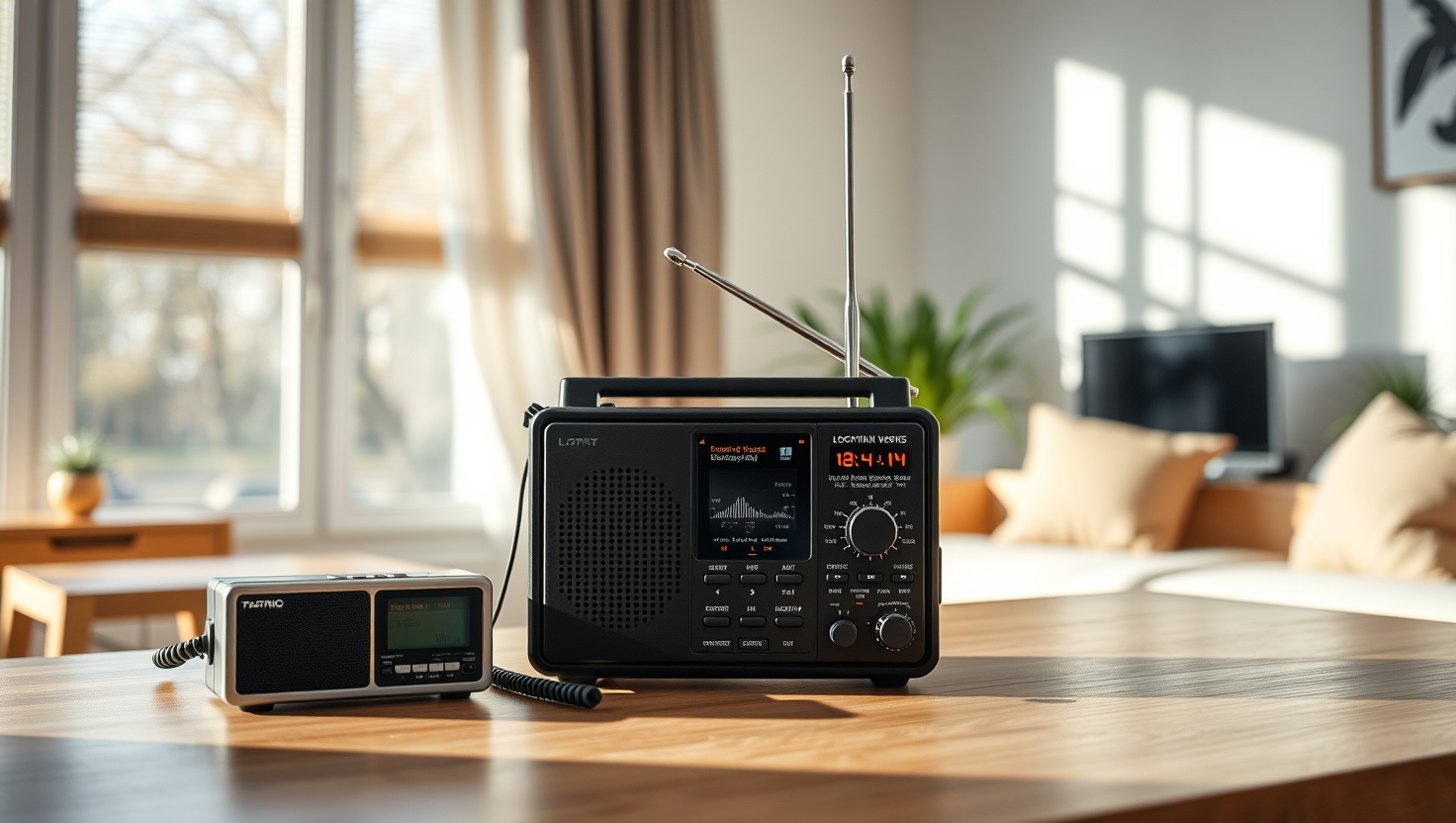
When the internet goes down, the news doesn’t stop — you just stop hearing it. Shortwave radio signals bounce off the ionosphere and travel thousands of miles without a single cell tower, satellite, or fiber optic cable. BBC World Service, Radio Australia, Voice of America — they’re all still broadcasting on shortwave, 24/7, right now. During natural disasters, grid failures, and communication blackouts, shortwave is how the rest of the world keeps talking. No subscription. No WiFi. No algorithm deciding what you see. Just raw, unfiltered information from every continent, arriving at the speed of light. Here’s how to start listening.
Tecsun PL-330 — Best Overall
The Tecsun PL-330 is the radio the shortwave community consistently recommends to beginners in 2026, and for good reason. It uses DSP (Digital Signal Processing) technology that was once found only…
In a hurry? That’s our pick. Want the reasoning and the full comparison? Keep reading.
Shortwave listening requires no license, no technical skill, and no expensive equipment. A $55 radio and a wire stretched across a room will pull in broadcasts from Europe, Asia, Australia, and the Americas with startling clarity. In an era where every platform is curating your information diet, shortwave radio is genuinely different: it is a direct line to the planet, available to anyone willing to turn a dial.
Key Takeaways
- Shortwave radio requires no license — receiving international broadcasts is 100% legal for anyone, anywhere
- Best overall pick: Tecsun PL-330 at $55 — DSP technology, SSB, pocket-sized, the enthusiast community’s favorite budget radio
- Best premium: Sangean ATS-909X2 at $200 — reference-grade receiver, 406 memory presets, the gold standard for serious listeners
- Best portable: C.Crane CC Skywave SSB2 at $170 — shirt-pocket size, air band monitoring, NOAA weather alerts, SSB reception
- Best value: XHDATA D-808 at $65 — full shortwave + SSB + air band at one-third the price of the premium models
- Best ultra-budget: Retekess V115 at $25 — USB rechargeable, AM/FM/SW, MP3 player — remarkable for the price
Why Shortwave Radio Still Matters in 2026
Shortwave radio has been pronounced dead approximately every five years since the 1990s. First the internet was going to kill it, then streaming audio, then smartphones. Yet here we are in 2026, and BBC World Service is still broadcasting on shortwave frequencies, reaching an estimated 40 million listeners globally. The reason shortwave survives is the same reason it thrived in the first place: it works everywhere, without infrastructure.
A shortwave signal does not need a tower in your city. It does not need your ISP to be running. It does not pass through a server farm or a content moderation algorithm. A transmitter in London beams energy into the sky, the ionosphere reflects it back toward Earth, and it lands in your living room in Montana, or on a mountainside in Nepal, or in a village with no reliable internet. The physics of the ionosphere does not care whether your cable company is having an outage.
Internet censorship and the value of outside perspective
There is a growing global trend of internet censorship — social media blocks, news site restrictions, and platform throttling during periods of social unrest. In dozens of countries, access to outside information is selectively filtered. Shortwave radio bypasses all of it. You cannot firewall a radio signal. No government agency can block BBC World Service from entering the airspace over their territory with a policy memo. Shortwave has historically been, and remains, one of the most reliable ways to receive uncensored information from outside a country’s media environment.
Even in countries with full internet access, there is value in hearing news through a completely different channel. International broadcasters serve audiences who have nowhere else to turn for outside perspective. Listening to the BBC or Radio France Internationale gives you a view of world events that is not filtered through the same editorial lens as your domestic news sources. That independent signal is increasingly rare, and increasingly valuable.
Grid failures and communication blackouts
Natural disasters knock out communications in predictable ways: first cell towers go down, then power fails, then internet connectivity drops. In that sequence, shortwave radio keeps working as long as your radio has battery power. Major international broadcasters have emergency broadcasting protocols specifically designed for audiences who have lost access to all other information channels. The BBC, VOA, and Deutsche Welle all maintain shortwave transmission specifically because it is the only medium that reaches people when everything else fails.
In the aftermath of major storms, earthquakes, and flooding events, shortwave receivers have been used to gather critical information about road conditions, shelter availability, and emergency guidance when local infrastructure was completely non-functional. A radio that runs on AA batteries and fits in your emergency kit is not a hobby toy in those moments. It is a direct line to the world outside your affected area.
Shortwave vs. ham radio: the key difference
This distinction matters. Shortwave radios are receivers only. You listen but cannot transmit. Ham radio transceivers do both — you can transmit and receive — but require an FCC license. Shortwave radios operate in the same HF (High Frequency) spectrum as amateur ham radio, but they are purely passive listeners. No license required. No registration. No exam. You buy the radio, you turn it on, and you start hearing the world.
If you want to transmit — to talk back, to coordinate with other people, to participate in emergency networks — you need a licensed ham radio setup. But if your goal is independent information access, global perspective, and emergency listening, a shortwave receiver is simpler, cheaper, and requires nothing from you except the willingness to tune in.
What to Look For in a Shortwave Radio
Frequency coverage: SW, MW, FM, LW
Shortwave (SW) covers roughly 1.7 to 30 MHz and is the band you are primarily buying the radio for. But good shortwave radios also cover Medium Wave (MW, the standard AM broadcast band), FM, and sometimes Long Wave (LW, used in Europe and parts of Asia for regional broadcasts). Full coverage gives you a radio that handles all your listening in one device. Every radio on this list covers SW, MW, and FM at minimum.
The shortwave spectrum is divided into named “meter bands” based on wavelength. The 31-meter band (9.4–9.9 MHz), 19-meter band (15.1–15.8 MHz), and 16-meter band (17.5–17.9 MHz) are where the strongest international broadcasts concentrate. These are the bands you will spend most of your time on as a new listener.
SSB capability
Single Sideband (SSB) is a transmission mode used by amateur ham operators, utility stations, and some international broadcasters. Without SSB, your radio hears only standard AM-mode broadcasts. With SSB, you can also monitor ham radio conversations, maritime traffic, aeronautical communications, and utility stations on the HF bands. SSB is not strictly required for international broadcasting, but it expands what you can hear dramatically. Any radio you plan to use for serious emergency monitoring should have SSB. The Tecsun PL-330 and XHDATA D-808 both offer it for under $70 — excellent value for the capability.
Sensitivity and selectivity
Sensitivity determines how well the radio picks up weak signals. In shortwave, signals that have bounced off the ionosphere arrive with varying strength depending on propagation conditions, time of day, and distance. A more sensitive receiver pulls in stations that a cheaper radio would miss entirely. Selectivity determines how well the radio separates adjacent stations on nearby frequencies — critical when the shortwave bands are crowded. DSP (Digital Signal Processing) technology, which the Tecsun PL-330 and XHDATA D-808 use, dramatically improves both sensitivity and selectivity over older analog designs.
Portability and battery options
For emergency use, portability matters. A radio that runs on AA batteries gives you universal power compatibility — you can source AAs anywhere, and they work in solar-powered chargers and hand-crank generators. A radio with a built-in rechargeable battery (18650, LiPo) gives you longer runtime but requires a power source to recharge. The best emergency radios offer both: a built-in rechargeable battery for normal use, and the ability to fall back to standard AA or AAA batteries when recharging is not possible. Check this specification before buying.
Antenna quality and external antenna options
The telescoping antenna that comes with most portable shortwave radios is adequate for strong broadcasts but limiting for weaker stations. All serious shortwave listeners eventually add a length of wire as an external antenna. Look for a radio with an external antenna jack (usually a 3.5mm mono socket or dedicated antenna port) — it lets you connect a wire antenna, a clip-on balcony antenna, or a dedicated shortwave antenna. A 20-foot wire strung around the perimeter of a room will noticeably improve reception on almost every radio on this list.
Air band and weather reception
Some of the radios on this list include air band reception (108–137 MHz), which lets you listen to commercial aviation communications. This is not critical for emergency use but is fascinating for hobbyists, and provides an additional layer of situational awareness. NOAA weather alerts are a more practically useful addition — the C.Crane CC Skywave SSB2 covers both air band and NOAA weather channels, making it one of the most versatile portable receivers available.
Quick Comparison
| Radio | Price | SSB | Key Feature | Best For |
|---|---|---|---|---|
| Tecsun PL-330 | ~$55 | Yes | DSP, pocket size, 18650 battery | Best overall beginner |
| Sangean ATS-909X2 | ~$200 | Yes | 406 presets, air band, reference grade | Best premium |
| C.Crane CC Skywave SSB2 | ~$170 | Yes | Shirt-pocket, NOAA alerts, aviation | Best portable |
| XHDATA D-808 | ~$65 | Yes | Full coverage, external antenna jack | Best value |
| Retekess V115 | ~$25 | No | USB rechargeable, MP3, voice recorder | Best ultra-budget |
Our Top 5 Picks for 2026
The Tecsun PL-330 is the radio the shortwave community consistently recommends to beginners in 2026, and for good reason. It uses DSP (Digital Signal Processing) technology that was once found only in radios costing ten times as much. DSP allows the PL-330 to achieve sensitivity and selectivity that analog-tuned radios at this price simply cannot match — it hears stations that a similarly priced traditional radio would miss, and separates them cleanly.
The hardware specs are impressive for $55: full shortwave coverage from 1711 kHz to 29999 kHz, SSB capability for ham radio and utility monitoring, FM and AM (MW/LW) coverage, and a pocket-friendly form factor that runs on a single 18650 lithium battery. The 18650 format is ideal for preparedness — these are the same cells used in many flashlights and power tools, they are widely available, and they deliver long runtime between charges. A USB charge cable is included.
The tuning interface is clean and the display is readable. Memory presets allow you to store your favorite frequencies for one-touch recall — critical when you want to quickly check BBC World Service, Voice of America, and Radio France Internationale in rotation without hunting through the dial. The PL-330’s combination of DSP performance, SSB capability, compact size, and $55 price makes it the obvious starting point for the vast majority of shortwave listeners.
Pros
- DSP technology — sensitivity far above the price
- SSB capability for ham and utility monitoring
- Pocket-sized — fits in a jacket pocket
- 18650 battery — long runtime, universally available
- Clean tuning interface with memory presets
Cons
- No air band reception
- No NOAA weather alerts
- Plastic build (lightweight but not rugged)
- No external antenna jack on all versions — check before buying
The Sangean ATS-909X2 is the gold standard of portable shortwave receivers in 2026. Sangean has been making shortwave radios since the 1970s, and the ATS-909X2 represents the accumulated knowledge of a company that has spent decades understanding what serious listeners need. The receiver performance is reference-grade: exceptional sensitivity, excellent selectivity, and an audio output that brings out the voice and texture in a broadcast that budget radios flatten into noise.
The feature set is comprehensive. 406 memory presets let you store an entire directory of international stations organized by region and language. Auto-tuning storage scans active frequencies and stores them automatically — useful when you first arrive in a new location or want to find what is active on a band without manual scanning. Air band reception (108–137 MHz) adds aviation monitoring capability. SSB is well-implemented and precise. The tuning dial and controls feel like they were designed to be used, not just to look impressive in a product photo.
The ATS-909X2 is built like a serious piece of equipment. The controls are solid. The display is backlit, readable, and informative. The audio from the built-in speaker is genuinely good — at $200, you expect the radio to sound like a radio and not a phone speaker, and it delivers. For emergency preparedness, the auto-tune storage means you can have a radio that is pre-loaded with every active international broadcaster on a given band, ready to tune in immediately when you need it. This is not a hobby radio that you put in a drawer. It is a tool you keep ready.
Pros
- Reference-grade receiver performance
- 406 memory presets with auto-tuning storage
- Air band reception (aviation monitoring)
- Excellent audio quality from built-in speaker
- SSB with fine-tuning control
- Proven track record from a trusted manufacturer
Cons
- $200 — most expensive on this list
- Larger and heavier than the PL-330 or CC Skywave
- No NOAA weather alert feature
- Overkill for casual listeners
The C.Crane CC Skywave SSB2 is remarkable because of what it fits into so small a space. This radio covers AM, FM, shortwave, air band (108–137 MHz for aviation), NOAA weather channels with emergency alert activation, and SSB — all in a package that genuinely fits in a shirt pocket. Nothing else at this price point combines all five band capabilities in a package this compact.
C.Crane is a Humboldt, California company that has been making shortwave radios for decades and has a reputation for genuine listening performance rather than spec-sheet marketing. The CC Skywave SSB2 lives up to that reputation. The AM and shortwave sensitivity are notably strong for a radio this size, the SSB implementation is clean and usable, and the NOAA weather alert function — which can wake the radio from standby when a severe weather bulletin is issued — is genuinely useful for emergency preparedness.
The air band capability is a bonus that travel enthusiasts particularly appreciate: you can monitor commercial aviation communications at airports and listen to approach control, ground control, and tower frequencies. Interesting as a hobby, and adds situational awareness context that broader radio coverage simply provides. The CC Skywave SSB2 runs on two AA batteries, giving it universal power compatibility for emergency use. Carry a few spare AAs and this radio runs indefinitely without needing to plug anything in.
Pros
- Shirt-pocket size — genuinely ultraportable
- AM/FM/SW/Air band/Weather — broadest coverage on this list
- NOAA weather alerts (activates from standby)
- SSB reception for full HF monitoring
- AA batteries — universal emergency power
Cons
- $170 — premium price for a small radio
- Small speaker limits audio quality at volume
- Fewer memory presets than the Sangean
- Small controls can be fiddly with larger hands
The XHDATA D-808 has earned a devoted following in the shortwave community for one simple reason: it performs at a level that has no right being at its price point. For $65, you get a DSP-based receiver with full shortwave coverage, SSB capability, air band reception, an external antenna jack, and a rechargeable battery — specifications that rival radios costing two to three times as much. The radio enthusiast community regularly compares its sensitivity and selectivity favorably to the Tecsun PL-660 (which costs nearly twice as much) and credibly benchmarks against even higher-tier radios.
The external antenna jack is a standout feature at this price. A 3.5mm antenna socket allows you to connect a wire antenna, a portable loop antenna, or any passive antenna to dramatically boost reception. On a built-in telescoping antenna, the D-808 already performs well. With a simple 20-foot wire strung around the room, it transforms into a genuinely high-performing HF receiver. For emergency preparedness, this means you can carry the compact radio in a kit and set up an external antenna at a fixed location for maximum reception when you need it.
The D-808 charges via USB from any power source — power bank, solar panel, car charger, or wall adapter. The battery life is solid for a radio with this level of capability. The display is clear, the tuning is precise, and the audio quality through headphones is notably better than through the small built-in speaker. If your budget tops out at $65 and you want the best possible shortwave performance for that money, the XHDATA D-808 is where the value curve peaks in 2026.
Pros
- Extraordinary value — $65 for premium-adjacent performance
- External antenna jack for boosted reception
- SSB capability included
- Air band reception
- USB charging from any power source
Cons
- Newer brand — shorter track record than Tecsun or Sangean
- No NOAA weather alert
- Built-in speaker is small
- Occasional quality control variability (buy from reputable seller)
The Retekess V115 is a $25 radio that does more than a $25 radio has any right to do. AM, FM, and shortwave reception cover the basic listening needs. A built-in MP3 player with microSD card slot lets you store and play audio files. A voice recorder means you can capture what you hear on shortwave for later reference. USB rechargeable battery means no proprietary charging cables and compatibility with any USB power source. That is a lot of capability for two $10 bills and some change.
The shortwave performance should be assessed honestly: the V115 is not a DSP radio, and its sensitivity and selectivity are budget-level. Strong international broadcasts — BBC World Service, Voice of America, Deutsche Welle — come in clearly under good propagation conditions. Weaker or more distant stations that a PL-330 would pull in cleanly may be marginal or noisy on the V115. There is no SSB capability, limiting it to standard AM-mode broadcasts. For a first shortwave experience or a backup emergency radio, these limitations are acceptable. For serious listening, upgrade to the Tecsun PL-330.
The V115 shines as a keep-everywhere radio. Put one in your emergency kit, your car, your hiking pack, your desk at work. At $25 you can own five of them for the price of a single Sangean, ensuring you always have a shortwave receiver within reach. The voice recorder is genuinely useful for capturing station identifications, emergency broadcasts, or signal tests when you want to document what you heard. For the price, the V115 is a remarkable tool.
Pros
- $25 — lowest barrier to entry for shortwave
- MP3 player + microSD slot built in
- Voice recorder for capturing broadcasts
- USB rechargeable from any power source
- Compact and pocketable
Cons
- Budget-level shortwave sensitivity
- No SSB capability
- Limited shortwave band range vs. higher-end models
- Small speaker with limited volume
Getting Started: Your First Night of Shortwave Listening
One of the things that surprises new shortwave listeners is how immediately rewarding it is. There is no long setup, no accounts to create, no configuration menus to navigate. You extend the antenna, set a frequency, and start hearing the world. Here is how to make your first session a good one.
Best times to listen
Shortwave propagation is driven by the sun’s effect on the ionosphere. As a practical starting guide: evenings and nights are generally best for medium and lower shortwave frequencies. The 31-meter band (9.4–9.9 MHz) is a classic evening band — BBC World Service, Voice of America, and Radio France Internationale all broadcast here and can be heard across North America, Europe, and beyond after dark. During daytime, higher frequencies like the 19-meter band (15.1–15.8 MHz) and 16-meter band (17.5–17.9 MHz) open up and carry daytime broadcasts over longer distances.
A rough cheat sheet: start your first evening session on 9.580 MHz (Voice of America) or 9.410 MHz (BBC World Service) and see what you hear. If those are weak, try scanning from 9.400 to 9.900 MHz slowly and note what stations appear. You will almost certainly find something broadcasting in English within minutes.
How to find active stations
Major shortwave broadcasters publish their frequency schedules online. The BBC World Service shortwave schedule, Voice of America frequency guide, and Radio France Internationale schedule are all available on their respective websites and updated seasonally as broadcasters adjust for changing propagation conditions. The WRTH (World Radio TV Handbook), published annually, is the comprehensive reference that serious shortwave listeners keep on their shelf — it lists every shortwave broadcaster in the world, their frequencies, languages, and transmission times.
Free online tools like Short-wave.info and EIBI frequency database allow you to search by frequency, language, or broadcaster to find what is being transmitted right now. These are good resources for planning a listening session before you sit down with the radio.
External antenna tips
The telescoping antenna on a portable shortwave radio is a starting point, not an endpoint. The single most effective improvement you can make to any radio on this list is adding a simple wire antenna. Cut 20 to 30 feet of insulated wire, connect one end to the radio’s antenna jack (or clip it to the tip of the telescoping antenna with an alligator clip), run the wire as high and as horizontal as possible around the room, and the difference in reception can be startling. More wire, higher up, in a straighter line = better signal.
Outdoors, a wire strung between two trees or hung from a balcony railing is even better. You do not need to build anything complex — basic wire physics applies. Many shortwave enthusiasts use a $5 spool of 22-gauge wire from a hardware store as their main shortwave antenna for years. Keep a roll in your emergency kit alongside the radio.
Frequency guides to bookmark
Before your first listening session, bookmark these resources: Short-wave.info for real-time frequency activity, the BBC World Service shortwave page for their current transmission schedule, and the EIBI database (eibispace.de) for a comprehensive list of all active shortwave broadcasts. Once you have the habit of checking these before tuning in, you will find stations reliably and build your own list of favorite frequencies and time slots.
Start With the Tecsun PL-330. Upgrade When You’re Ready.
The Tecsun PL-330 at $55 is the best-performing shortwave radio for the price on the market in 2026. Get it, spend your first evening scanning the 31-meter band, and experience what independent global listening actually feels like. When you want more capability, the XHDATA D-808 adds an external antenna jack and air band for $10 more. When you want the best, the Sangean ATS-909X2 is waiting.
Get the Tecsun PL-330 →