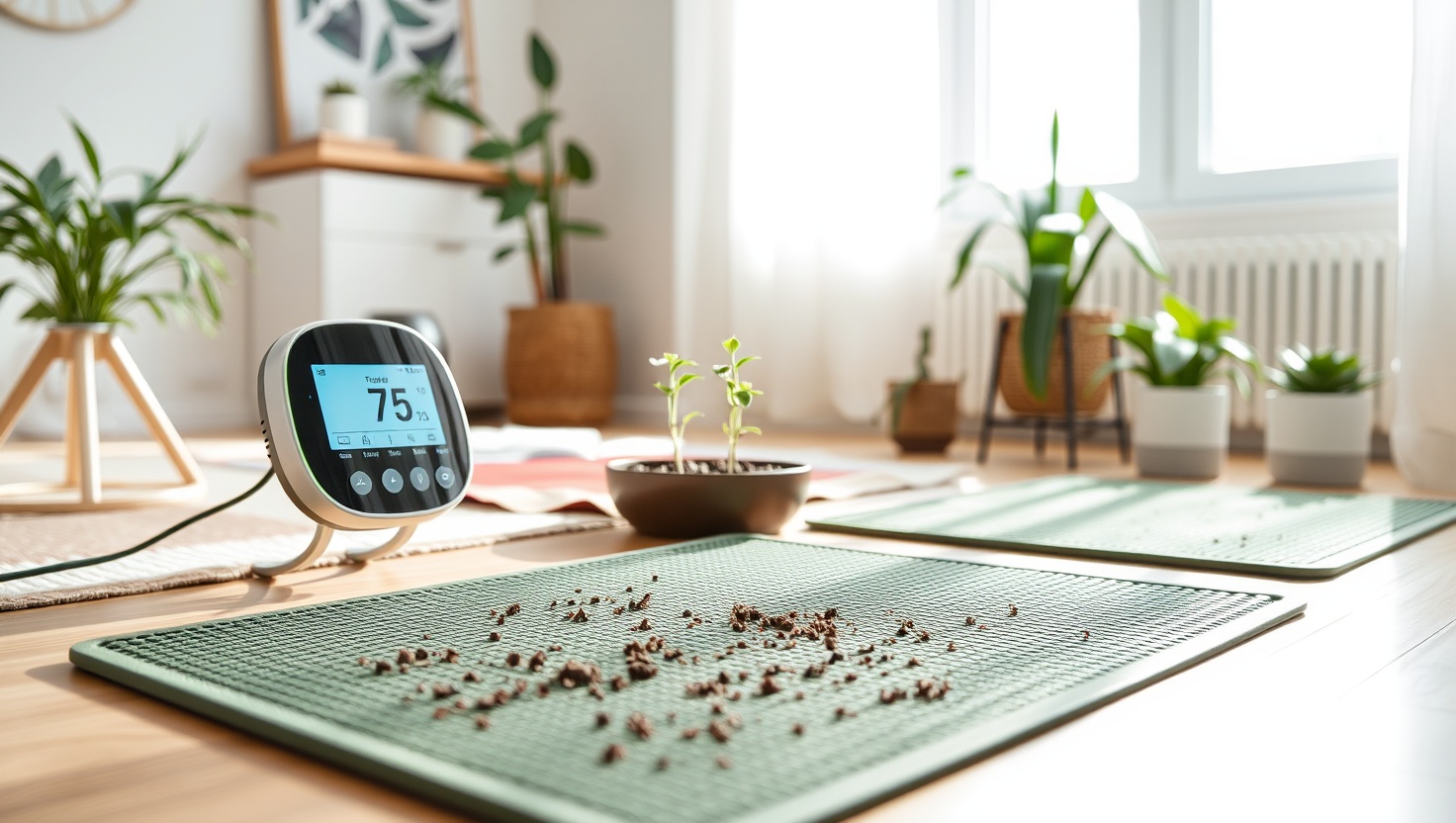
You followed the instructions. You bought the seed starting kit, filled the cells with fresh potting mix, planted the seeds at the right depth, watered gently, and covered the tray with a humidity dome. Two weeks later: nothing. No sprouts. No green. Just moist dirt staring back at you. The problem is not your seeds, your soil, or your technique. The problem is temperature. Most warm-season vegetable seeds — tomatoes, peppers, eggplant, squash, basil — need soil temperatures of 75-85°F to germinate. The surface of your kitchen counter or garage shelf is sitting at 65-68°F. That 10-15 degree gap is the difference between seeds that pop in 5 days and seeds that rot in 14.
VIVOSUN Seedling Heat Mat + Digital Thermostat — Our Top Recommendation
VIVOSUN has become the default brand for indoor seed starting equipment, and their heat mat + thermostat combo is the reason. At $35, you get a properly sized mat (fits one standard 1020 tray), a…
In a hurry? That’s our pick. Want the reasoning and the full comparison? Keep reading.
A seedling heat mat is a thin, flat heating pad that slides under your seed tray and raises the soil temperature to the optimal germination range. Pair it with a thermostat controller and you get precise, consistent warmth — no overheating, no cold spots, no guesswork. The mat runs on 17-45 watts (less than a light bulb), costs $30-$60 for a mat and thermostat combo, and transforms seed starting from a gamble into a system.
This is the single most impactful upgrade for any indoor seed starter. Better soil, better lights, and better trays all help — but none of them matter if the soil is too cold for the seed to wake up. Warm soil is the trigger. Everything else comes after.
Key Takeaways
- Most vegetable seeds need 75-85°F soil temperature to germinate — typical indoor surfaces are 10-15°F too cold
- A heat mat + thermostat combo raises soil temperature precisely and maintains it within 1-2°F of your target
- The VIVOSUN mat + thermostat combo at $35 offers the best value for most seed starters
- Always use a thermostat — unregulated mats can overheat soil to 90°F+ and kill seeds
- Run the mat 24/7 until germination (5-14 days), then remove it to grow stocky, strong seedlings
- Standard 10x20" mats fit one 1020 seed tray — the most common size for home growers
Why Soil Temperature Is the #1 Germination Factor
Seeds are biological clocks. They sit dormant until environmental conditions tell them it is safe to sprout. The three triggers are moisture, oxygen, and temperature — and temperature is the one most home growers get wrong. A tomato seed sitting in 65°F soil may take 14-21 days to germinate, if it germinates at all. The same seed in 80°F soil germinates in 5-7 days. Pepper seeds are even more dramatic: 14+ days at 65°F, 7-10 days at 80°F, and near-zero germination below 60°F.
The science is straightforward. Seeds contain enzymes that break down stored starches into sugars to fuel the emerging root and shoot. These enzymes are temperature-dependent — they work slowly in cool conditions and optimally in warm conditions. Below a species-specific minimum temperature, enzymatic activity is so slow that the seed cannot outpace fungal growth in the moist soil. The seed rots before it sprouts. Above the optimal range, enzymes denature and the embryo is damaged. The sweet spot for most garden vegetables is 75-85°F — the temperature range where enzyme activity peaks without causing thermal stress.
Indoor environments rarely hit this range naturally. Most homes are heated to 68-72°F in winter and early spring — exactly when you start seeds for transplanting outdoors. Countertops, shelves, and basement tables run even cooler. A heat mat bridges this gap by adding 10-20°F of gentle, consistent warmth directly where it matters: at the soil surface, not in the room air.
Why You Need a Thermostat (Not Just a Mat)
A heat mat without a thermostat is a blunt instrument. It runs at full power continuously, adding 10-20°F above whatever the ambient room temperature happens to be. On a cool spring morning when the room is 65°F, the mat pushes soil to 80°F — perfect. But in the afternoon when the sun heats the room to 75°F, the mat pushes soil to 92°F — too hot for most seeds and actively damaging to peppers and lettuce. Overnight when the room drops to 62°F, the mat brings soil to only 78°F, which is fine but inconsistent. This constant fluctuation produces uneven germination across the tray: some cells sprout on day 5, others on day 12, and a few cook themselves into oblivion.
A thermostat eliminates all of this. You set a target temperature (say 80°F), insert the probe into the soil, and the controller cycles the mat on and off to maintain that exact temperature regardless of room fluctuations. Day, night, sunny afternoon, cold morning — the soil stays within 1-2°F of your target. This produces uniform germination across the entire tray, which means uniform seedlings at transplant time, which means uniform plants in the garden.
Every heat mat in this guide includes a thermostat. Buying a mat without one and adding a thermostat later costs more and creates compatibility hassles. The combo is always the better buy.
The 5 Best Seedling Heat Mats for 2026
VIVOSUN Seedling Heat Mat + Digital Thermostat — Best Overall
VIVOSUN has become the default brand for indoor seed starting equipment, and their heat mat + thermostat combo is the reason. At $35, you get a properly sized mat (fits one standard 1020 tray), a digital thermostat with a backlit display, a stainless steel temperature probe, and a waterproof mat surface that handles spills and overwatering without any risk of electrical failure.
The thermostat maintains temperature within ±2°F of your setting, cycling the mat on and off automatically. The probe cable is long enough (6 feet) to place the controller on a nearby shelf while the probe sits in the soil. The display shows both current temperature and set temperature simultaneously, so you can verify at a glance that the system is working. Temperature range is 68-108°F, covering everything from cool-season lettuce to tropical pepper varieties.
The mat draws just 17 watts — running it 24/7 for a 14-day germination period adds roughly $0.50 to your electric bill. The heating element is distributed evenly across the mat surface with no hot spots, which is critical for uniform germination across all cells of your tray. The durable MET-listed construction gives you confidence that a device running continuously near water is built to safety standards.
- $35 for mat + thermostat — best value combo on the market
- IP67 waterproof mat — safe around water and spills
- ±2°F thermostat accuracy — consistent soil temperature
- 17W draw — costs about $0.04/day to run
- MET-listed safety certification
- Thermostat does not have memory — resets to default after power outage
- 10x20" size only in this combo — need to buy larger mats separately
- Probe is basic stainless steel — no app or data logging
BN-LINK Heat Mat with Thermostat Controller — Best Budget
BN-LINK undercuts VIVOSUN by $5 while adding one feature the VIVOSUN lacks: a dual-outlet thermostat controller. The controller has two outlets — one for the heat mat and one for a supplemental device like a small fan or grow light — both regulated by the same thermostat probe. This is a small but genuinely useful upgrade for growers who want to trigger a fan when the temperature exceeds a certain threshold or sync lighting with heating cycles.
The mat itself is comparable to VIVOSUN: 10x20.75" dimensions, 18W draw, even heat distribution, and a waterproof surface. The thermostat holds temperature within ±1°F — slightly tighter than VIVOSUN's ±2°F spec, though in practice both are accurate enough for seed germination. The temperature range covers 40-108°F, which includes cool-season applications like controlling fermentation temperature for brewing or maintaining reptile tank warmth.
At $30, this is the cheapest mat + thermostat combo that uses a digital controller rather than an analog dial. Analog thermostats (the ones with a twisting knob) are less precise and lack temperature readouts, making it impossible to verify your exact soil temperature without a separate thermometer. The BN-LINK's digital display eliminates that problem.
- $30 — cheapest digital thermostat + mat combo
- Dual-outlet controller — run a fan or light on the same thermostat
- ±1°F accuracy — tightest tolerance in this category
- Wide temperature range (40-108°F) for multiple uses
- Mat waterproofing is adequate but not IP67 rated
- Probe cable is shorter (4 feet) than VIVOSUN
- Less brand support and documentation than VIVOSUN
Spider Farmer Waterproof Heat Mat + Thermostat Kit — Best Waterproof
Spider Farmer built their reputation on LED grow lights, and their heat mat brings the same build quality to seed starting. The standout feature is the full IP68 waterproof rating on the mat — not just splash-resistant like most competitors, but fully submersible. For seed starters who use bottom-watering (where trays sit in a reservoir of water), this is the only mat that guarantees zero water intrusion risk even when partially submerged.
The 21W heating element runs slightly warmer than 17-18W competitors, which translates to faster heat-up time from cold start. On a 65°F surface, the Spider Farmer reaches 80°F soil temperature in about 25 minutes compared to 35-40 minutes for lower-wattage mats. This is a minor advantage for daily use but meaningful if you frequently move the mat between locations or unplug it overnight.
The thermostat controller is well-designed with a large, clear display, touch buttons, and a high/low alarm feature that alerts you if soil temperature drifts outside your set range. The alarm is useful during cold snaps when room temperature drops significantly — it catches the situation before your seeds feel the effects.
- IP68 waterproof — safe even for bottom-watering setups
- 21W heater — reaches target temperature faster
- High/low temperature alarm on thermostat
- Spider Farmer build quality and customer support
- $45 — $10-$15 more than VIVOSUN/BN-LINK
- Slightly higher power consumption over a season
- Thermostat display is not backlit — hard to read in dim grow areas
Mars Hydro Heat Mat 48"x20.75" + Thermostat — Best for Multiple Trays
If you start more than two trays of seeds at a time, buying individual 10x20" mats and thermostats for each tray is wasteful and expensive. The Mars Hydro 48"x20.75" mat accommodates four standard 1020 trays in a single row, controlled by one thermostat. At $60 for the large mat + thermostat, the per-tray cost works out to $15 — less than half the cost of individual VIVOSUN combos.
The 45W heating element is distributed across the full 48-inch length with consistent heat output. Mars Hydro uses an aluminum substrate under the heating wire that spreads warmth more evenly than the flexible polymer substrates used in smaller mats. The result is minimal temperature variation across the mat surface — typically less than 3°F between the center and the edges, which means all four trays germinate at the same rate.
The included thermostat uses the same digital controller design as the smaller Mars Hydro mats. Probe placement on a mat this large matters more — position the probe in the center of the mat at soil depth for the most representative reading. If you notice edge trays germinating slightly later, it means the probe is too close to the center where heat is highest; move it halfway between center and edge for better regulation across the full surface.
- Fits 4 standard trays — $15/tray cost vs $30-$35/tray individually
- Aluminum substrate for even heat distribution
- Single thermostat controls the entire surface
- Waterproof construction
- Requires 48 inches of shelf space — large footprint
- 45W draw is noticeable on a small circuit with other grow equipment
- Cannot heat individual trays to different temperatures
Luxbird Smart Thermostat Heat Mat Controller — Best Smart Option
Luxbird takes a different approach: instead of selling a mat + thermostat combo, they sell a smart thermostat controller that upgrades any existing heat mat with WiFi connectivity, app control, and temperature data logging. If you already own a heat mat but want better control, or if you want to monitor soil temperature remotely from your phone, the Luxbird controller is the upgrade path.
The app shows real-time soil temperature, set temperature, and a historical temperature graph over the past 7 days. You can adjust the target temperature from your phone without walking to the grow shelf. Push notifications alert you if soil temperature drops below or exceeds your set range — useful during cold snaps or if the mat develops a fault. The data logging feature exports CSV files, which is overkill for casual growers but valuable for anyone optimizing germination protocols across multiple seed varieties.
The controller accepts any heat mat up to 1000W via a standard outlet. Plug the mat into the Luxbird controller, insert the probe into your soil, set the target temperature in the app, and the controller regulates the mat automatically. It works over 2.4GHz WiFi — no hub needed. For growers who run a serious indoor seed starting operation and want the kind of temperature data and remote control that professional propagation greenhouses use, the Luxbird is the only consumer-grade option that delivers it.
- WiFi app control — adjust temperature and view data from your phone
- 7-day temperature history with CSV export
- Push notifications for temperature alerts
- Works with any heat mat up to 1000W — universal compatibility
- $40 for controller only — mat sold separately
- Requires 2.4GHz WiFi — does not work on 5GHz networks
- App is functional but not polished — occasional connection hiccups
Quick Comparison
| Mat | Price | Size | Watts | Best For |
|---|---|---|---|---|
| VIVOSUN | ~$35 | 10"x20" | 17W | Best overall value |
| BN-LINK | ~$30 | 10"x20" | 18W | Budget pick |
| Spider Farmer | ~$45 | 10"x20" | 21W | Bottom-watering setups |
| Mars Hydro | ~$60 | 48"x20" | 45W | Multiple trays |
| Luxbird | ~$40 | Controller only | — | Smart/app control |
A heat mat handles germination. A grow light handles growth. Pair them for a complete indoor seed starting setup.
How to Use a Seedling Heat Mat for Best Results
Getting the most out of a heat mat requires a few simple practices that dramatically improve germination rates:
- Place the mat on an insulated surface: A thin towel or foam pad under the mat prevents heat loss downward into the table. More heat goes up into the tray where you need it.
- Use a humidity dome: A clear plastic dome over the tray traps both moisture and warmth, creating a mini-greenhouse effect that maintains consistent conditions. Remove the dome as soon as seeds sprout to prevent damping off.
- Position the probe at seed depth: Insert horizontally into the soil, not on the mat surface. The difference between mat surface temperature and soil temperature at 1/4" depth can be 10-15°F.
- Pre-moisten soil before planting: Warm, dry soil wicks moisture away from seeds faster than cool soil. Moisten the mix before filling cells and planting.
- Remove the mat after germination: Once you see green above the soil, the heat mat's job is done. Continued warmth produces leggy, weak stems. Let the seedlings grow at ambient room temperature (65-72°F) for stocky, transplant-ready plants.
After germination, seedlings need light — 14-16 hours daily. LED grow lights provide the right spectrum at pennies per day.
Grow Your Own Food
Practical growing guides for every skill level. Start seeds, grow food, gain independence. No spam.
Control your growing environment completely — grow tents give you the perfect space for seed starting and indoor food production.
Warm Soil, Fast Seeds
A $35 heat mat turns 14-day germination waits into 5-day certainties. The cheapest upgrade with the biggest impact on your seed starting success.
See the VIVOSUN Heat Mat →Frequently Asked Questions
Most vegetable seeds germinate best at 75-85°F soil temperature. Tomatoes and peppers prefer 80-85°F. Lettuce and cool-season crops prefer 65-75°F. Start at 78°F for warm-season vegetables and adjust based on results. Reduce to 65-70°F or remove the mat once seedlings emerge.
Yes. An unregulated mat runs at full power and can push soil to 90°F+ in a warm room — too hot for most seeds. A thermostat cycles the mat to maintain your target within 1-2°F regardless of room temperature. Every mat in this guide includes a thermostat because using one without regulation is the number one cause of heat-mat seed failures.
Run the mat 24/7 until seeds germinate — typically 5-14 days for warm-season vegetables. Seeds do not need a day/night temperature cycle. Once seedlings emerge and show true leaves, remove the mat. Continued warmth after germination produces leggy, weak stems.
Yes. Heat mats run at low wattage (17-45W) and reach surface temperatures of 80-95°F — warm to the touch but not hot enough to damage wood, laminate, or plastic. Place a thin towel under the mat for extra insulation and to direct more heat upward into the seed tray.
The standard 10x20" mat fits one 1020 seed tray — the most common size. For two trays, get a 20x20" mat. For four trays, the 48x20" size works. Match the mat to the number of trays you run simultaneously. Slightly oversized is fine; significantly undersized creates uneven germination.