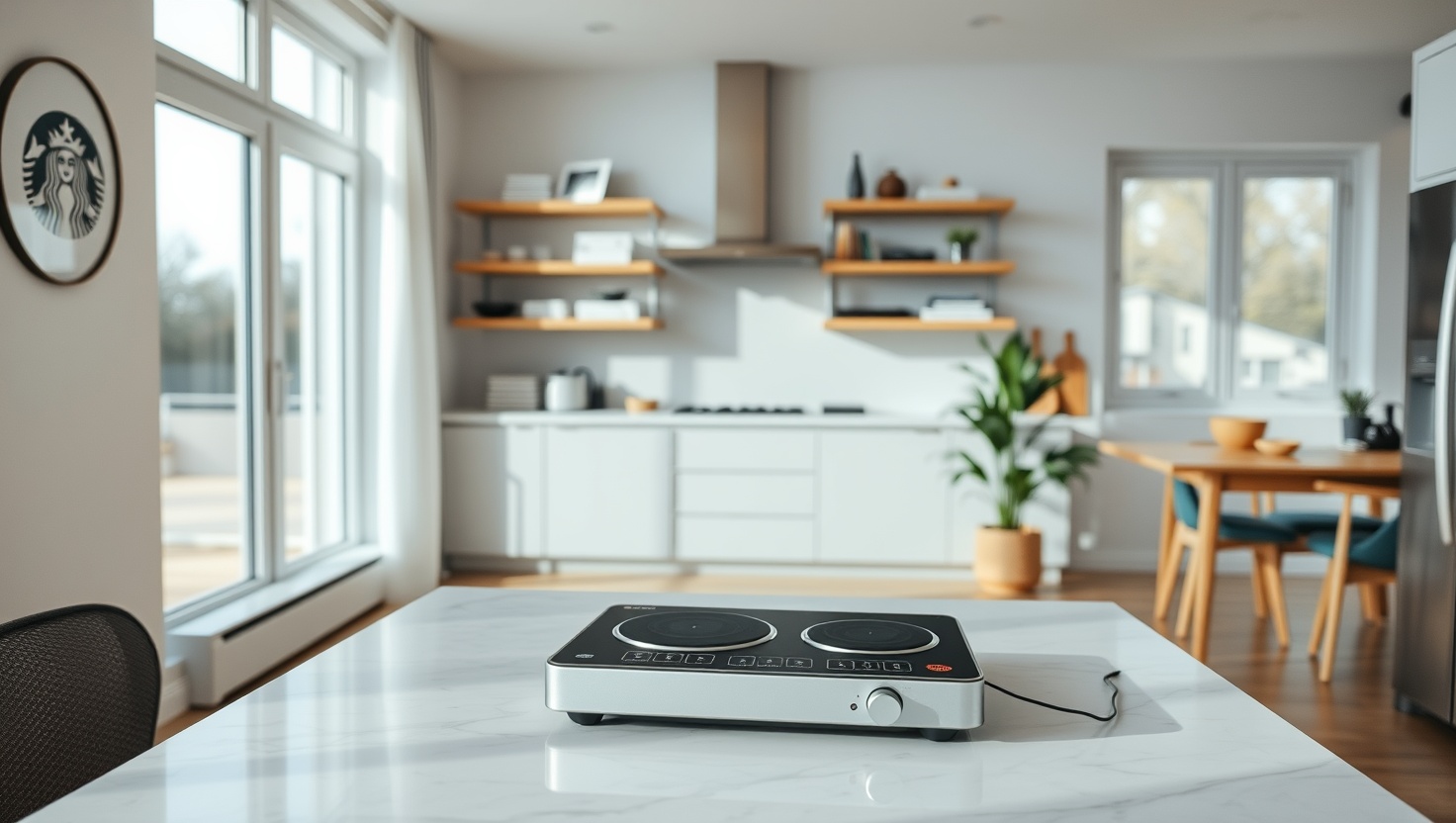
Your gas line goes down. The grid is out. You've got a portable power station humming in the corner and no idea how to cook dinner. Portable induction cooktops are the answer — and they're one of the most underrated pieces of off-grid gear you can own. Ninety percent energy efficient, no open flame, no fumes, heats water faster than any gas burner, and completely safe to run indoors. Pair one with a solar power station and you've got a self-sufficient cooking setup that runs on sunshine.
Duxtop 9600LS Induction Cooktop — Best Overall
The Duxtop 9600LS is the benchmark portable induction cooktop for a reason. At $99, you're getting a unit with the kind of build quality — solid plastic housing, metal-reinforced chassis…
In a hurry? That’s our pick. Want the reasoning and the full comparison? Keep reading.
Key Takeaways
- Induction cooktops are 90% energy efficient vs 40% for gas — a major advantage for off-grid cooking on limited battery power
- Best overall: Duxtop 9600LS (~$99) — LCD display, 1800W, rock-solid build quality that punches far above its price
- Best budget: Duxtop 9100MC (~$70) — 20 power settings, 1800W, proven reliability that's earned a cult following among van lifers
- Best precision: NuWave Flex (~$120) — degree-by-degree temperature control, best for sous vide and delicate cooking tasks
- Pairing with power stations: you need a 2000W+ pure sine wave inverter — the EcoFlow Delta Pro and Jackery 2000 are ideal matches
- A single 30-minute cooking session on an induction cooktop averages 300-350Wh — five full meals per 2000Wh charge
Why Induction Beats Gas Off-Grid
The argument for portable induction in off-grid scenarios comes down to one number: efficiency. A gas burner transfers roughly 40% of its fuel energy into the food. An induction cooktop transfers 85-90%. That's not a small difference — it's the difference between cooking five meals or two meals on the same amount of stored energy. When your power station has a finite charge and the sun isn't out, that efficiency margin matters enormously.
Beyond efficiency, induction eliminates the problems that make gas cooking genuinely dangerous in emergency or enclosed settings. No combustion means no carbon monoxide — a gas cooktop in a tent, van, or sealed room is a real CO hazard. No open flame means no ignition risk. The cooktop surface stays cool to the touch while cooking. And perhaps most practically: no propane tanks to stockpile, no refill logistics, and no running out of fuel at the worst moment.
How Induction Cooking Works
Induction cooktops don't produce heat directly. Instead, they generate a rapidly alternating magnetic field that induces an electrical current in your cookware — and that current creates heat inside the pan itself. The cooktop surface stays cool. Only the pan and its contents heat up.
This is why compatible cookware matters. The magnetic field only works with ferromagnetic metals — cast iron, carbon steel, and magnetic stainless steel. A quick test: hold a refrigerator magnet to the bottom of your pan. If it sticks firmly, it works on induction. Most modern stainless cookware in the US is induction-compatible. Copper, aluminum, and plain glass will not work unless they have a magnetic base added by the manufacturer.
Pairing with Portable Power Stations
Every induction cooktop in this guide draws up to 1800W at full power. That means you need a power station with a pure sine wave inverter rated at 2000W or higher. This is non-negotiable. A modified sine wave inverter — common in budget generators — can cause induction cooktops to malfunction, overheat, or fail completely. Pure sine wave mimics the clean AC power from a wall outlet and is what induction electronics require.
For capacity, the math works in your favor. A typical cooking session — boiling water for pasta, then simmering for 20 minutes — draws close to 1800W for the first few minutes and drops to 400-600W while simmering. Total energy consumed in a 30-minute session: roughly 300-350Wh. On a 2000Wh power station, that's five or six full cooking sessions before you need to recharge.
The best power station pairings
The EcoFlow Delta Pro (3600Wh, 3600W inverter) is the gold standard pairing — enough capacity for 10+ cooking sessions and enough inverter headroom to handle the 1800W startup spike without breaking a sweat. It accepts up to 1600W of solar input, meaning a couple of 400W panels can fully recharge it in 2-3 hours of good sunlight.
The Jackery Explorer 2000 Pro (2160Wh, 2200W inverter) is the more compact alternative — lighter, more portable, still perfectly matched to any 1800W induction cooktop. For RV and van life cooking where you're moving regularly, the Jackery's form factor is easier to live with than the EcoFlow's bulk.
Running a 1000Wh station? You can still cook — just be strategic. Use lower power settings (500-800W) for slower simmering, and reserve full power for boiling. You'll get 2-3 cooking sessions per charge, which is usually enough to cook dinner and breakfast before the solar panels top you back up.
Quick Comparison: 5 Best Portable Induction Cooktops
| Model | Price | Wattage | Settings | Best For |
|---|---|---|---|---|
| Duxtop 9600LS | ~$99 | 1800W | 15 power + 15 temp | Best overall |
| Duxtop 9100MC | ~$70 | 1800W | 20 power settings | Best budget |
| NuWave Flex | ~$120 | 1300W | 1° temp precision | Best precision |
| Mueller RapidTherm | ~$55 | 1800W | Basic power levels | Ultra-budget |
| Breville Control Freak | ~$400 | 1800W | 1° precision + probe | Best premium |
The 5 Best Portable Induction Cooktops in 2026
The Duxtop 9600LS is the benchmark portable induction cooktop for a reason. At $99, you're getting a unit with the kind of build quality — solid plastic housing, metal-reinforced chassis, scratch-resistant glass surface — that you'd expect from something twice the price. Pick it up and it doesn't feel cheap. Use it daily for six months and you'll still be saying that.
The LCD interface gives you two control modes: 15 power levels (100W to 1800W) for raw wattage control, and 15 temperature settings from 140°F to 460°F for precision cooking. For off-grid use, the power level mode is what matters — it lets you dial in exactly how much wattage you're pulling from your power station, which is critical when you're managing a finite battery bank. Set it to 800W for simmering and you'll stretch a 2000Wh station to eight or ten cooking sessions instead of five.
The timer function (up to 170 minutes) is a genuinely useful feature when you're running off battery power and want to walk away without worrying. Set it to turn off automatically after your rice is done and you're not wasting watt-hours while distracted. The unit is also compatible with virtually any induction-ready cookware — cast iron, carbon steel, or magnetic stainless.
Pros
- Built quality punches far above $99 price
- LCD display clear and easy to read
- 15 power levels for precise battery management
- Timer up to 170 minutes
- Wide cookware compatibility
- Child lock safety feature
Cons
- Single burner only
- Slightly heavier than budget models
- Fan can be audible at high power
If the 9600LS is the premium Duxtop, the 9100MC is the original that earned the brand its reputation. It's been on the market long enough to have tens of thousands of reviews, real-world tested in conditions ranging from dorm rooms to Alaskan cabins to converted van kitchens. It just works. At $70, it's one of the best value purchases you can make in off-grid cooking gear.
Twenty power settings give you more granular control over wattage than most cooktops at this price point — most budget units have 5-8 settings. That matters in off-grid scenarios where being able to drop from 1800W to 300W for a slow simmer gives you dramatically more flexibility with a limited battery bank. The auto-pan detection is a genuinely smart feature: if you remove the pan mid-cook, it shuts off automatically instead of continuing to draw power from your station.
The 9100MC doesn't have an LCD screen like the 9600LS — it uses LED indicators — and it lacks the temperature-mode control. But for most cooking tasks — boiling, frying, simmering, sautéing — you don't need temperature precision. You need reliable wattage control, and this delivers that at $30 less than its sibling.
Pros
- 20 power settings for precise control
- $70 — exceptional value
- Auto pan-detection saves battery
- Proven reliability over many years
- Compact and lightweight
Cons
- LED display less readable than LCD
- No temperature-mode control
- No timer function
Most induction cooktops give you temperature settings in broad steps — say, 250°F, 300°F, 350°F, 400°F. The NuWave Flex gives you individual degree control from 100°F to 575°F. Hold melted chocolate at exactly 88°F for tempering. Simmer a beurre blanc at precisely 160°F without it breaking. Set water for sous vide at exactly 140°F and maintain it for hours. That level of control is genuinely transformative if you care about food.
The 1300W maximum (versus 1800W on the Duxtops) is a trade-off for that precision — lower max wattage means slightly slower boiling times but also slightly lower battery drain at max power. For most precision cooking tasks — gentle sauces, custards, tempering, holding temperatures — you're running at 200-600W anyway, which is very friendly for off-grid use. Bringing a liter of water to a boil takes a couple of minutes longer, which is a small price for the control you gain.
The delay start timer is a useful feature for off-grid meal prep: set it to start cooking at a specific time so your oatmeal is ready when you wake up. The auto shut-off and child lock round out a safety package that makes the Flex a solid choice for family use.
Pros
- Degree-by-degree temperature precision
- Wide range: 100°F to 575°F
- Delay start timer — set it and sleep
- Lower 1300W draw is battery-friendlier
- Compact and travel-friendly design
Cons
- 1300W max — slower to boil than 1800W units
- Higher price than Duxtop options
- Temperature mode requires learning curve
The Mueller RapidTherm exists to answer one question: what's the cheapest way to get working induction cooking that won't fail you when you need it? At $55, it's the answer. You get 1800W of full induction power, basic but functional controls, and a compact design that fits easily in an emergency kit or a van buildout with limited counter space.
Eight power levels and six temperature settings won't satisfy precision cooks, but they handle the full range of real-world cooking tasks — boiling, frying, sautéing, simmering, keeping warm. The unit heats fast, performs reliably, and Mueller's customer service reputation is solid if you ever have an issue. For $55, you're not getting build quality that rivals the Duxtop 9600LS — the housing feels it — but the core function is there.
Where the RapidTherm genuinely earns its place: secondary units. If you're building a serious off-grid kitchen in an RV or tiny house, having a Mueller as your backup induction unit alongside a Duxtop as your primary costs about the same as buying two mid-range options. Two burners, more cooking flexibility, and if one fails you're not scrambling.
Pros
- $55 — lowest price for functional 1800W induction
- Compact and lightweight
- Full 1800W power when you need it
- Good as a secondary or backup burner
- Auto shut-off safety feature
Cons
- Fewer settings than Duxtop models
- Build quality reflects price point
- No timer function
- Limited temperature precision
The Control Freak — originally a PolyScience professional unit, now co-branded with Breville — is in a different category from everything else on this list. At $400 it costs four times the Duxtop 9100MC and nearly seven times the Mueller. What you're paying for isn't just better controls. You're paying for a paradigm shift in how precisely you can cook.
The Control Freak includes an integrated probe thermometer that you place directly in your pan or liquid. The cooktop reads the actual temperature of what you're cooking — not the surface of the cooktop, not an approximation — and adjusts power in real time to hold that temperature to within 1°F. Want to hold beef stock at exactly 180°F for three hours? Set it and walk away. The stock will be exactly 180°F when you come back. This is how professional restaurants have been using this unit for years.
For off-grid cooking specifically, the Control Freak's probe-based temperature management is remarkably efficient. Instead of cycling between high and low power levels trying to hold a temperature manually (which wastes energy), the unit precisely doses power to maintain exactly what you need. Longer cook times with better results and lower average power consumption. On a large power station with solar recharging, this becomes your go-to cooking appliance — not just off-grid, but full time.
Pros
- 1° precision with integrated probe thermometer
- Holds exact temperature for hours
- More energy-efficient than manual temperature chasing
- Professional-grade build quality
- Full 1800W when you need it
Cons
- $400 — significant investment
- More features than most off-grid cooks need
- Heavier than budget options
- Overkill for basic emergency cooking
Power Consumption Math for Off-Grid Cooking
Before you commit to an induction setup, run the numbers. Here's how to calculate how many cooking sessions you'll get from your power station:
- Boiling 1 liter of water at 1800W: roughly 3-4 minutes = ~120Wh
- 30-minute simmer at 400W: ~200Wh
- Full dinner cook session (boil + simmer, 35 min): ~300-350Wh
- On a 1000Wh station: 2-3 cooking sessions between charges
- On a 2000Wh station: 5-6 full dinner sessions before recharging
- Recharged by a 200W solar panel in good sun: 5-7 hours of solar gives you a full 2000Wh recharge
The practical implication: a 2000Wh power station paired with 400W of solar panels covers daily induction cooking indefinitely in a location with 4+ hours of peak sun per day. For RV and van life setups, that means cooking every meal without worrying about running out of power. For emergency preparedness, it means weeks of cooked meals from a single solar charging setup.
Who Should Buy a Portable Induction Cooktop
RV and van life cooks
Portable induction is the ideal RV kitchen appliance. No propane plumbing, no flame near flammable surfaces, no CO accumulation in an enclosed space. Pair a Duxtop 9600LS with a 2000Wh power station and you've got a complete kitchen that runs on solar. Many full-time van lifers have ditched their two-burner gas setups entirely in favor of single-burner induction.
Emergency preparedness households
Gas and power outages often happen simultaneously — and that's exactly when a portable power station plus induction cooktop combination shines. No fuel to stockpile, no carbon monoxide risk if you're cooking in a garage or laundry room, and the power station can be solar-recharged indefinitely. It's a more resilient emergency cooking solution than a propane camp stove with a limited fuel supply.
Apartment dwellers and renters
Portable induction cooktops are the upgrade most apartment kitchens need. They're faster and more precise than the cheap electric coil burners in most rental units, they don't require any installation, and they're safe to use on any stable surface. Plug it in, cook your meal, unplug it and store it. For small spaces, the Duxtop 9100MC is particularly compact.
Power station owners who aren't using them to their full potential
If you already own an EcoFlow, Jackery, or Bluetti power station that you use for charging phones and running fans, you're probably leaving significant capacity on the table. A portable induction cooktop turns that stored energy into hot food — the most fundamental human need. It's the natural next purchase for anyone who's already invested in a serious power station.
Start Cooking Off the Grid
The Duxtop 9600LS is the best all-around choice — rock-solid build, precise power control, LCD display, and under $100. Pair it with a 2000Wh power station and a couple of solar panels and you've got a complete off-grid cooking setup that runs indefinitely on sunshine.
See the Duxtop 9600LS →Frequently Asked Questions
Yes — as long as you have an AC power source that delivers at least 1800W. A portable power station rated 2000Wh or higher with a pure sine wave inverter (like the EcoFlow Delta series or Jackery 2000) will run a full-size induction cooktop reliably. For shorter cook sessions, even a 1000Wh station works for boiling water or simmering soups. Pair your cooktop with a solar generator and you have a truly self-sufficient off-grid cooking setup with no fuel, no fumes, and no open flame.
Induction cooktops only work with magnetic cookware — cast iron, carbon steel, and stainless steel pots and pans with a magnetic base. A simple test: hold a fridge magnet to the bottom of your pan. If it sticks firmly, the pan will work on induction. Aluminum, copper, and glass cookware will not work unless they have an induction-compatible base plate. Most modern stainless cookware sold in the US is induction-compatible — check the label for the induction symbol (a coil icon).
Most portable induction cooktops are rated at 1800W maximum, but they rarely draw that continuously. Bringing water to a boil draws close to full power for 3-5 minutes. Simmering drops to 200-400W. A typical 30-minute cooking session — boiling, then simmering — averages around 600-700W, consuming roughly 300-350Wh. On a 2000Wh power station, that's enough energy for 5-6 full cooking sessions before recharging. Paired with a solar panel, you can cook daily indefinitely.
Yes — induction is significantly safer than gas in emergency situations. There's no open flame, no combustion, no carbon monoxide risk, and no gas leak hazard. The cooktop surface itself stays cool to the touch (only the pan gets hot), dramatically reducing burn risk. It also works indoors without ventilation concerns — something you cannot say about gas or propane cooking. For RV, van life, and emergency home cooking, induction wins on safety every time.
You need a power station with: (1) at least a 2000W pure sine wave inverter — modified sine wave can damage induction electronics; (2) enough capacity for your cooking sessions — 2000Wh lets you cook multiple meals before recharging; (3) solar input capability so you can recharge from panels between uses. The EcoFlow Delta Pro (3600W inverter) and the Jackery Explorer 2000 Pro are both excellent matches for any induction cooktop in this guide. Avoid running induction on power stations rated below 2000W inverter output.