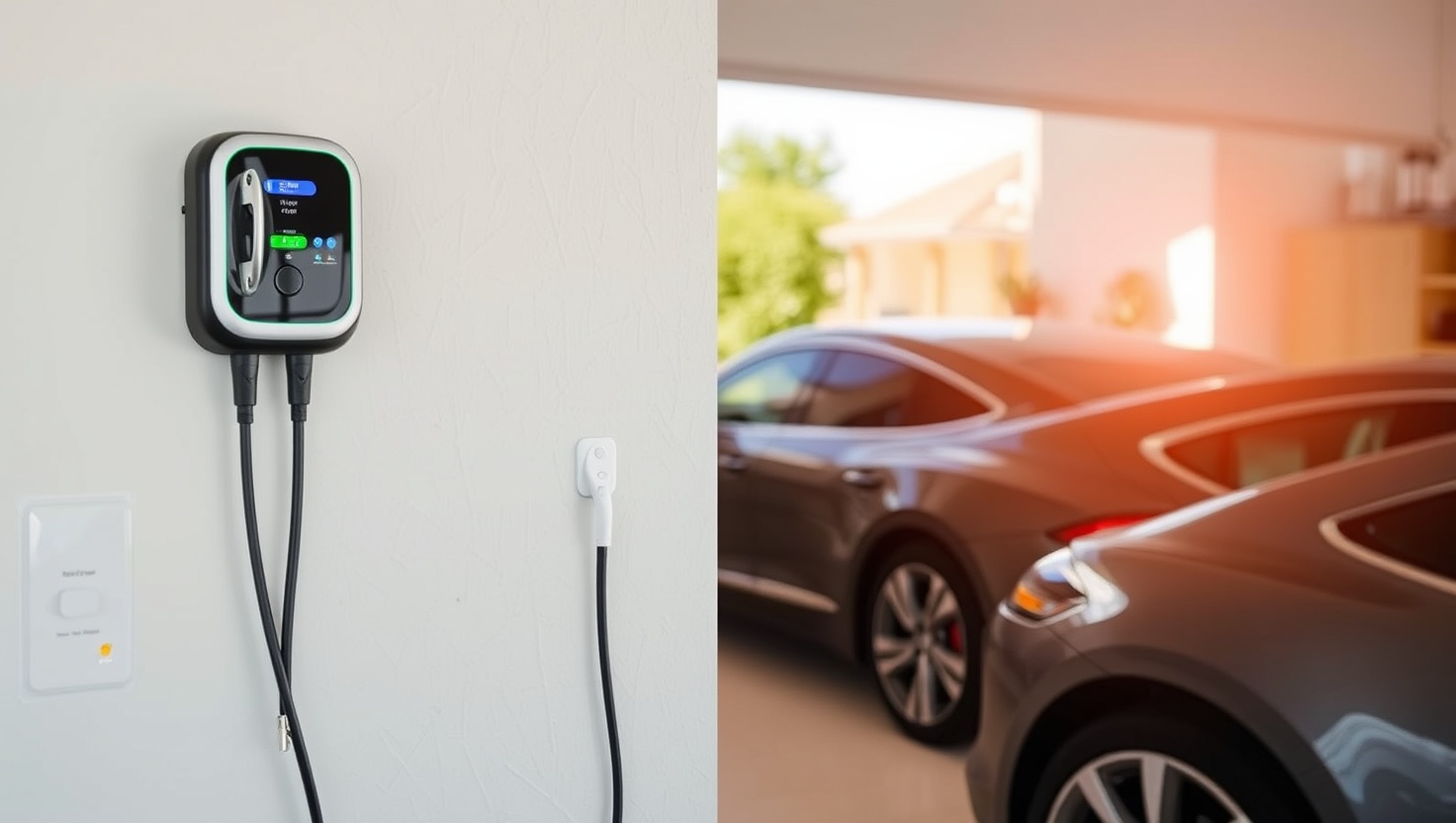
Every morning, your gas tank starts at whatever level you left it. Every morning, a Level 2 home EV charger starts you at full. That's the shift nobody tells you about when you go electric — you stop thinking about fuel entirely. You plug in when you get home, like you plug in your phone, and you wake up to a full battery. No gas station detours. No price anxiety. No standing in the rain while the pump runs.
ChargePoint Home Flex — Our Top Recommendation
The ChargePoint Home Flex earns the top spot because it solves the single biggest decision most EV owners face when buying a home charger: what if my panel can't support maximum amperage right now?…
In a hurry? That’s our pick. Want the reasoning and the full comparison? Keep reading.
The best Level 2 home EV chargers in 2026 charge most EVs at 25–30 miles of range per hour on a standard 240V circuit. That's enough to refill a typical 250-mile EV from near-empty to 100% overnight. And with the IRA's Section 30C tax credit still in effect through December 2026, you can claim up to $500 back on your charger and installation costs. This guide covers the five best options — from $300 budget picks to $600 feature-packed smart chargers — with honest pros, cons, and everything you need to make the right call for your home.
Key Takeaways
- Level 2 charges most EVs overnight — delivering 25–30 miles of range per hour on a 240V circuit
- The $500 IRA federal tax credit (Section 30C) applies to most chargers and installation costs — act before December 31, 2026
- ChargePoint Home Flex wins overall for flexibility and universal compatibility with every EV on the market
- No EV charger on this list requires a monthly subscription — all smart features work out of the box
- Installation typically costs $200–$800 depending on panel distance and electrical work required
- A 40–50A charger on a dedicated 240V circuit is the sweet spot for most homes and EV models
Why Level 2 Charging at Home Changes Everything
Let's run the numbers first, because they're genuinely compelling. The average American drives about 37 miles per day. A Level 1 charger — the standard 120V outlet that comes with your car — adds roughly 3–5 miles of range per hour. That's 8–12 hours to replace a typical day of driving, and if you park late or have a long commute, you may not fully recover by morning. Level 2 at 25–30 miles per hour? You're fully charged within 60–90 minutes of the average day's driving. The rest of the night is just insurance.
The cost savings are real and lasting. Electricity at the average US rate of $0.16/kWh delivers roughly 3–4 miles per kWh in a typical EV — that works out to about $0.04–$0.05 per mile. Gas at $3.20/gallon in a 30 MPG car costs about $0.11 per mile. Drive 15,000 miles per year and the fuel savings alone are $900–$1,100 annually. The charger pays for itself in two to three years in fuel savings alone, before you factor in the tax credit or reduced maintenance costs from having no oil changes, no transmission fluid, no exhaust system to repair.
There's also an energy independence angle that matters if you care about where your power comes from. Pair a Level 2 charger with a home solar system and you're driving on sunlight you generated yourself. Add a home battery like a Powerwall and you can charge your car from stored solar energy even when the sun isn't out. That's a degree of fuel independence that no gas-powered vehicle can offer, and it's already economically viable for many homeowners in 2026.
Level 1 vs Level 2: What's the Actual Difference?
Level 1 charging uses your home's standard 120V outlet — the same socket your toaster uses. It delivers about 1.2–1.4 kW of power, which translates to 3–5 miles of range per hour. It works in an emergency and it's fine if you drive 10 miles per day and have 10 hours to charge. For anyone else, it's a slow drip in a leaky bucket.
Level 2 uses a 240V circuit — the same voltage as your dryer or electric range. It delivers 7.2 kW to 11.5 kW depending on amperage, which translates to 25–30 miles of range per hour. That's not a marginal improvement. That's six to eight times faster. Most EVs can go from near-empty to full in four to eight hours on Level 2, which means they're fully charged by morning in virtually all real-world scenarios.
The practical gap is even wider than the numbers suggest. With Level 1, you're always managing a slow deficit — you drive 40 miles, gain back 30 overnight, start slightly lower each day. With Level 2, you simply never think about it. You plug in when you get home, the charger does its job, and you leave in the morning at 100%. That mental shift from managing scarcity to ignoring the problem is the real value of Level 2.
The 5 Best Level 2 Home EV Chargers for 2026
ChargePoint Home Flex — Best Overall
The ChargePoint Home Flex earns the top spot because it solves the single biggest decision most EV owners face when buying a home charger: what if my panel can't support maximum amperage right now? The Flex adjusts from 16A to 50A — you set it in the ChargePoint app during setup based on your available circuit capacity. Upgrade your panel later and you simply adjust the setting. No new hardware, no reinstallation. That flexibility alone makes it the safest choice for most homes.
The smart features are genuinely useful rather than gimmicky. Schedule charging for off-peak electricity hours when rates are lowest. Set charge limits to protect long-term battery health (stopping at 80% for daily use, full charge before road trips). The ChargePoint app shows session history, energy costs based on your electricity rate, and sends reminders if you forget to plug in. It works with every J1772-compatible EV on the market and accepts the Tesla J1772 adapter. Energy Star certified and qualifies for the $500 IRA tax credit. Available in both plug-in (NEMA 14-50) and hardwire versions.
- Adjustable 16–50A — works with any panel capacity, future-proof
- Universal J1772 compatibility — works with every non-Tesla EV
- Smart scheduling saves real money on time-of-use electricity plans
- Energy Star certified — qualifies for $500 IRA Section 30C credit
- Both plug-in and hardwire installation options
- $600 is the highest price on this list
- Smart features require WiFi — less useful in weak-signal garages
- Cable is 23ft — adequate but shorter than Grizzl-E's 24ft
- App account required to access scheduling features
Best for: Most EV owners who want maximum flexibility, smart features, and the confidence that their charger works with any EV they'll ever own. The right answer for homes with uncertain panel capacity.
Check Price on Amazon →Emporia Level 2 Smart Charger — Best Value Smart Charger
Emporia built its reputation with the Vue home energy monitor — a device that tracks real-time electricity use at the circuit level. The Emporia Level 2 EV Charger extends that philosophy to charging: it doesn't just deliver power, it monitors what you're using and integrates with your home energy picture. If you have the Emporia Vue energy monitor installed, the charger feeds directly into your dashboard so you can see EV charging costs alongside your whole-home electricity consumption in one place.
At 48A and $400, it delivers the same maximum amperage as chargers costing $175 more. The Emporia app handles scheduling, energy monitoring, and — critically — solar integration. If you have a solar system, Emporia's smart charging can prioritize charging when your panels are producing excess power rather than pulling from the grid, reducing your net electricity cost toward zero. Compact design, easy installation, and solid app reliability round out a genuinely impressive value proposition for energy-aware homeowners.
- 48A at $400 — best amperage-to-price ratio on the list
- Solar integration charges from excess solar production
- Pairs with Emporia Vue for whole-home energy monitoring
- Compact design fits tight garage installations
- No subscription required — full features in the free app
- Requires a 60A breaker for full 48A operation — larger circuit than some homes have available
- WiFi dependent — smart features fail if router is down or signal is weak
- Emporia is newer than ChargePoint — less long-term track record
- Cable management less polished than premium competitors
Best for: Solar-powered homes and energy-conscious owners who want to integrate EV charging into a broader home energy monitoring setup without spending $600.
Check Price on Amazon →Grizzl-E Classic — Best for Durability
The Grizzl-E Classic has earned a near-cult following among EV owners in cold climates, and the reason is simple: it works when everything else complains. NEMA 4 weatherproof rating, an operating range of -30°C to 50°C, and a rugged industrial-grade enclosure make it the charger you want if your garage is unheated, your winters are brutal, or you're installing outdoors where rain and freeze-thaw cycles are a genuine concern. Canadian EV owners in particular treat it as the obvious default choice.
There's no WiFi, no app, no smart features — and for many owners, that's a feature rather than a limitation. Plug it in, set the DIP switches to match your circuit amperage, and it charges. No account to create, no router dependency, no firmware updates that brick the device. The 24ft hardwire cable is the longest on this list, giving you maximum flexibility for where the car parks relative to where the charger mounts. If your priority is a unit that works flawlessly in any weather for the next ten years with zero fuss, the Grizzl-E Classic is your charger.
- NEMA 4 weatherproof — handles rain, ice, and extreme temperatures
- Operates down to -30°C — no cold-weather performance issues
- 24ft cable — the longest on the list for flexible parking positions
- No WiFi dependency — works regardless of internet or router status
- Legendary reliability — widely reported to still work perfectly after 5+ years
- No smart features — no scheduling, no energy monitoring, no app
- Hardwire only — requires electrician regardless of outlet situation
- 40A maximum — slightly slower than 48A competitors
- DIP switch configuration is less intuitive than app-based setup
Best for: Cold-climate EV owners, outdoor installations, and anyone who prioritizes bulletproof reliability and simplicity over smart features.
Check Price on Amazon →Pair your EV charger with a whole-home energy monitor and you'll know exactly what your car costs per mile to charge — and when to schedule charging for the cheapest rate.
Tesla Wall Connector — Best for Tesla Owners
If you drive a Tesla and have no plans to change, the Tesla Wall Connector is the cleanest solution available. It uses Tesla's NACS (North American Charging Standard) connector natively — there's no adapter required, no dongle hanging off the cable, no compatibility question to answer. The connector snaps into Tesla's charge port with satisfying precision and the whole system is tuned to work optimally with Tesla's onboard charger.
The power-sharing feature is the standout capability for multi-Tesla households. Install two or more Wall Connectors on the same circuit and they dynamically distribute available power between vehicles — no dedicated circuit per charger required. If one car is charging overnight and the second plugs in at midnight, they automatically split the available amperage. WiFi connectivity integrates with the Tesla app so you can monitor charging status, set schedules, and receive notifications from the same app you use for everything else Tesla-related. At $475, it's competitively priced for what it offers Tesla owners specifically.
- Native NACS connector — no adapter, optimized for Tesla charging
- Power sharing for multiple Tesla vehicles on one circuit
- Integrated with Tesla app — scheduling, monitoring, notifications
- Sleek minimal design — the best-looking charger on the list
- Up to 48A — maximum charge speed for supported Tesla models
- NACS connector only — does not charge other EV brands without an adapter
- WiFi required for smart features — no offline fallback scheduling
- Hardwire installation required — no plug-in option
- Power sharing requires multiple units and careful electrical planning
Best for: Tesla owners who want a seamless, native charging experience and the cleanest possible integration with the Tesla ecosystem — especially multi-Tesla households.
Check Price on Amazon →Lectron V-BOX — Best Budget
The Lectron V-BOX makes the case that you don't need to spend $600 to charge your car faster than the public grid can. At $300, it delivers 40A on a standard NEMA 14-50 plug — that's plug-and-play installation if you already have the outlet, or a straightforward job for your electrician if you don't. The 24ft cable matches the Grizzl-E's reach. No app to install, no WiFi to configure, no account to create. Plug it in and it charges. Done.
It's a genuinely good charger for what it is: a reliable 40A Level 2 unit that gets the job done without complexity or cost overhead. The trade-off is the lack of smart features — no scheduling means you're charging whenever you plug in rather than optimizing for off-peak electricity rates. For owners on a flat electricity rate, that doesn't matter. For owners on time-of-use plans where nighttime power is significantly cheaper, you're leaving real money on the table versus a smart charger. Start here if budget is the priority; upgrade to a ChargePoint or Emporia later if you want scheduling.
- $300 — the most accessible price point on the list
- NEMA 14-50 plug — self-installable if the outlet already exists
- 24ft cable — generous reach for flexible parking positions
- No app or WiFi required — zero setup complexity
- Solid build quality for the price — not a flimsy budget product
- No smart scheduling — cannot optimize for off-peak electricity rates
- No energy monitoring — no visibility into charging costs
- No WiFi or app — zero remote access or notifications
- 40A maximum — slightly slower than 48A smart alternatives
Best for: Budget-conscious buyers on flat electricity rates, renters who want a portable plug-in charger, and first-time EV owners who want to start charging faster right now without overthinking it.
Check Price on Amazon →Quick Comparison Table
| Product | Price | Amps | Smart Features | Cable | Best For |
|---|---|---|---|---|---|
| ChargePoint Home Flex | ~$600 | 16–50A | WiFi, scheduling, app | 23ft | Best overall / flexibility |
| Emporia Smart Charger | ~$400 | 48A | WiFi, solar, energy monitor | 24ft | Solar homes / value smart |
| Grizzl-E Classic | ~$400 | 40A | None — set and forget | 24ft | Cold climates / durability |
| Tesla Wall Connector | ~$475 | Up to 48A | WiFi, Tesla app, power share | 24ft | Tesla owners |
| Lectron V-BOX | ~$300 | 40A | None | 24ft | Budget / plug-in simplicity |
The $500 IRA Tax Credit: How to Claim It
The Inflation Reduction Act's Section 30C Alternative Fuel Vehicle Refueling Property Credit covers 30% of the cost of your charger and installation, up to $1,000 total — with a maximum credit of $1,000 for residential installations. Most home EV charger setups (hardware plus installation) fall in the $700–$1,400 range, which puts the credit at $210–$420 for typical installs, up to $500 or more for higher-cost setups.
To claim it, the charger must be installed at your primary residence and must be installed by December 31, 2026. The charger itself must be UL listed and meet applicable safety standards — all five chargers on this list qualify. Keep your receipt for both the charger and the installation labor. When you file your 2026 taxes, complete IRS Form 8911 (Alternative Fuel Vehicle Refueling Property Credit) and attach it to your return. The credit is non-refundable, meaning it reduces your tax liability dollar-for-dollar but does not generate a refund if it exceeds what you owe.
Some states offer additional incentives on top of the federal credit. California, Colorado, New York, and several other states have rebate programs ranging from $250 to $500 for home EV charger installation. Check your state's energy office website or the DSIRE database (dsireusa.org) for current programs in your area. In some cases, your utility company offers separate rebates as well — particularly if you enroll in a time-of-use rate plan designed for EV owners.
Installation: What to Expect
Most Level 2 charger installations are straightforward for a licensed electrician and take two to four hours. Here's what the process actually looks like:
The dedicated 240V circuit. Your charger needs its own dedicated circuit — it should not share a breaker with other appliances. The electrician runs 6-gauge or 4-gauge wire (depending on amperage) from your main panel to the charger location, installs the appropriate breaker, and either installs a NEMA 14-50 outlet (for plug-in chargers) or hardwires the charger directly (for hardwire models). The breaker must be sized at 125% of the charger's continuous current draw — a 40A charger needs a 50A breaker, a 48A charger needs a 60A breaker.
Cost factors. The biggest variable is distance from panel to charger location. If your panel is in the attached garage, a simple installation runs $200–$400. If the panel is on the far side of the house and the run requires going through walls, attic, or crawl space, costs can climb to $600–$800. If your panel is already at or near capacity, a panel upgrade adds $1,500–$3,000 — though the IRA credit does apply to the full installed cost including upgrades.
Permits. Most jurisdictions require an electrical permit for 240V circuit installation. Always pull the permit — it requires an inspection that confirms the work was done safely, it protects you from liability, and it's often required for the tax credit and for home sale disclosure. An electrician who tells you to skip the permit is a red flag.
Outdoor installation. All five chargers on this list are rated for indoor installation. For outdoor installation, verify the IP/NEMA rating — the Grizzl-E Classic's NEMA 4 rating is the strongest here and handles rain, snow, and ice without issue. The ChargePoint Home Flex and Lectron V-BOX are also weather-resistant but designed primarily for covered outdoor or indoor garage use.
Charge your EV on wind power. Small home wind turbines are now viable for many properties — here's what's worth considering in 2026.
Get the Brainstamped Energy Independence Scan
Our free scan maps your home's energy independence opportunities — EV charging, solar, battery storage, and smart monitoring — with practical next steps for your situation.
Ready to Wake Up to a Full Charge Every Morning?
Our top pick for most EV owners is the ChargePoint Home Flex — universal compatibility, adjustable amperage, and smart scheduling in one package. If budget is your priority, the Lectron V-BOX delivers solid 40A charging at $300. Either way, you'll never stand at a gas pump again.
Get the ChargePoint Home Flex on Amazon →Frequently Asked Questions
Installation typically runs $200–$800 depending on how far your electrical panel is from where you want the charger, whether you need a panel upgrade, and local permit requirements. If your panel is in the garage and has spare capacity, a licensed electrician can usually complete the job in 2–4 hours for $200–$400. If the panel is on the opposite side of the house or needs a subpanel added, costs can climb to $600–$1,200. Get at least two quotes from licensed electricians, and always pull the required permit — most jurisdictions require it, and it protects you when it's time to sell.
If the charger plugs into an existing NEMA 14-50 outlet (240V, 50A), a plug-in charger like the ChargePoint Home Flex or Lectron V-BOX is essentially plug-and-play — no electrician required for the charger itself. However, installing the 240V circuit and NEMA 14-50 outlet in the first place requires a licensed electrician and a permit. Hardwired chargers like the Grizzl-E Classic require a licensed electrician regardless. Never attempt 240V panel work yourself — it's dangerous and will likely void your homeowner's insurance if something goes wrong.
The standard rule is that the breaker must be rated at 125% of the charger's continuous load. For a 40A charger (like the Grizzl-E Classic or Lectron V-BOX), you need a 50A breaker. For a 48A charger (like the Emporia or Tesla Wall Connector at full amperage), you need a 60A breaker. Most homes install a 50A breaker feeding a NEMA 14-50 outlet, which supports any 40A charger. The ChargePoint Home Flex is adjustable from 16A to 50A, so it can be configured to match whatever circuit capacity you have available — making it the most flexible choice if you're unsure what your panel can support.
Almost all Level 2 chargers use the SAE J1772 connector, which is compatible with virtually every non-Tesla EV sold in North America — Chevy, Ford, Honda, Hyundai, Kia, Nissan, BMW, Rivian, and others. Tesla vehicles come with a J1772 adapter, so they work with any J1772 charger. The Tesla Wall Connector uses Tesla's NACS connector natively — the best choice for Tesla owners, but it does not charge other EVs without an adapter. Starting in 2025–2026, several automakers are adopting NACS natively, so NACS compatibility is becoming increasingly relevant when planning for your next vehicle.
Charging at home on Level 2 is dramatically cheaper than gas. The average US electricity rate is around $0.16/kWh. A typical EV gets 3–4 miles per kWh, so charging costs roughly $0.04–$0.05 per mile. Gasoline at $3.20/gallon in a 30 MPG car costs about $0.11 per mile — more than double. For someone driving 15,000 miles per year, that's a savings of roughly $900–$1,100 annually in fuel costs. If you charge overnight on an off-peak time-of-use electricity rate (common with utility EV programs), costs drop further — some utilities offer rates as low as $0.06–$0.09/kWh after midnight, making home EV charging even more economical.