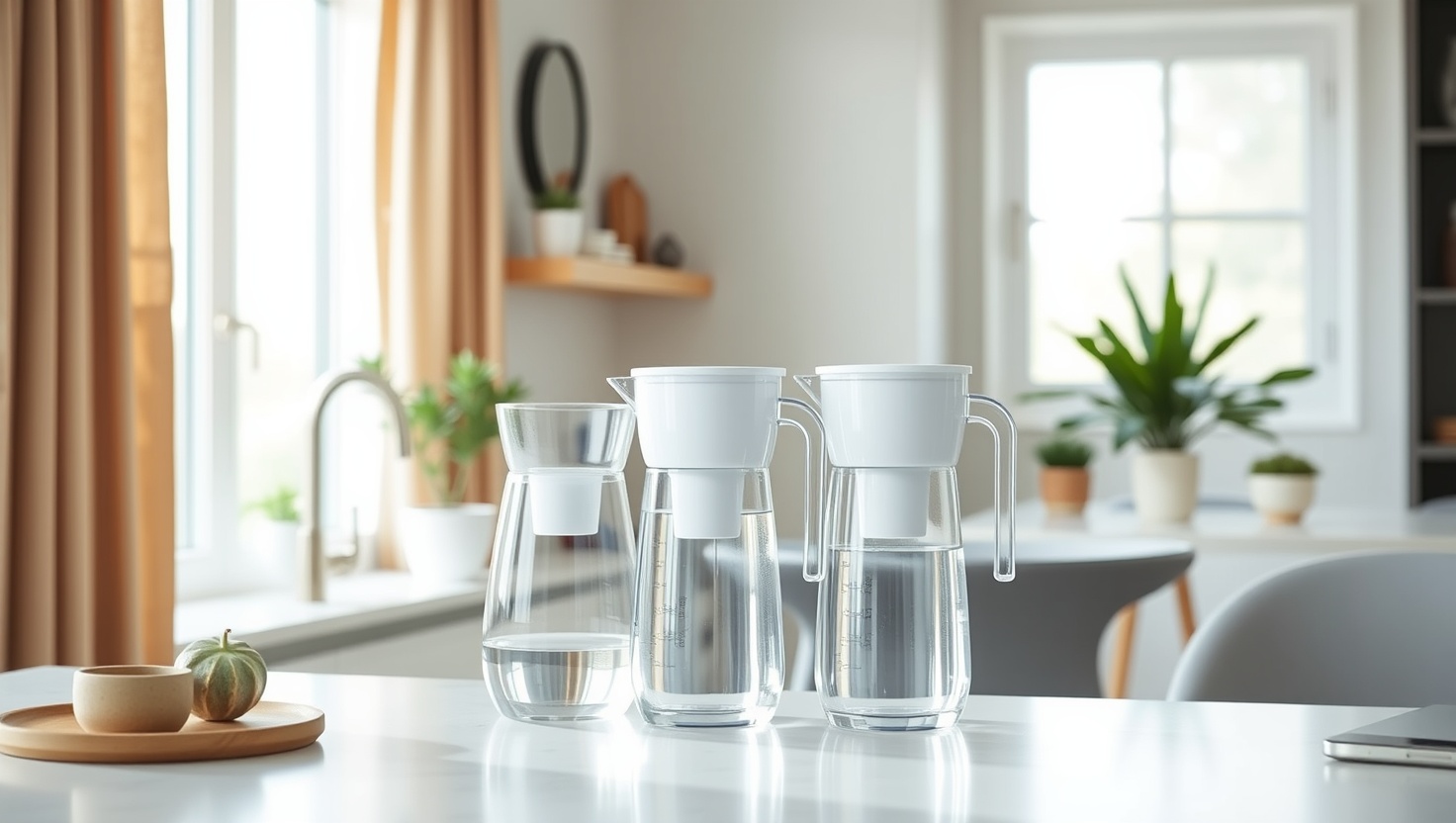
Most tap water in the United States contains PFAS. These are per- and polyfluoroalkyl substances — nicknamed "forever chemicals" because they do not break down in the environment or in your body. The EPA has set enforceable limits on six PFAS compounds as of 2024, but testing by the EWG shows detectable levels in tap water serving over 110 million Americans. Your water utility may be meeting the legal limit. That does not mean your water is clean.
Brita Denali with Elite Filter — Our Top Recommendation
The Brita Elite is not your grandmother's Brita. Forget everything you know about the basic white Brita filter — the Elite is a completely different product. It is NSF 42, 53, and 401 certified…
In a hurry? That’s our pick. Want the reasoning and the full comparison? Keep reading.
Here is the problem: that basic water filter pitcher sitting on your counter right now might not be removing PFAS at all. Standard Brita filters — the white ones that came with your pitcher — are not certified to reduce PFAS. Neither are many store-brand filters. You are pouring contaminated water through a filter that catches chlorine taste and not much else, and assuming your family is protected.
We compared the five best water filter pitchers available in 2026 based on independent lab testing, NSF certifications, filter longevity, cost per gallon, and what they actually remove. If you already have a whole house water filter, a pitcher adds an extra layer of point-of-use protection. If you do not, one of these pitchers is the fastest way to start drinking cleaner water today.
Key Takeaways
- Most standard water filter pitchers do NOT remove PFAS — you need an upgraded filter with NSF 53 or 401 certification
- Best overall: Brita Denali with Elite Filter ($35) — solid PFAS and lead removal, longest filter life at 120 gallons, best value per gallon
- Best filtration: ZeroWater 10-Cup ($40) — 99.6% TDS removal, includes a TDS meter so you can verify it works
- Best budget: PUR Plus 11-Cup ($30) — removes 20+ contaminants including lead, cheapest filter replacements at $0.28/gallon
- Best for contaminants: Epic Pure ($45) — independently lab-tested to remove 200+ contaminants including arsenic and uranium
- Best for well water: LifeStraw Home ($45) — the only pitcher that removes bacteria and parasites along with chemicals
The 5 Best Water Filter Pitchers in 2026
We ranked these by what matters most: what they actually remove, how long the filters last, and what it costs you per gallon of clean water. Every pitcher on this list removes lead and reduces PFAS — if a pitcher cannot do that in 2026, it does not belong on the list.
1. Brita Denali with Elite Filter — Best Overall
Brita Denali with Elite Filter
The Brita Elite is not your grandmother's Brita. Forget everything you know about the basic white Brita filter — the Elite is a completely different product. It is NSF 42, 53, and 401 certified, which means it is independently tested and verified to remove chlorine taste and odor, lead, PFAS (including PFOA and PFOS), pharmaceuticals, pesticides, and over 30 contaminants total. The filter lasts 120 gallons, which is 6 months for a single person or about 2 months for a family of four. At roughly $7 per replacement filter, that works out to about $0.06 per gallon of filtered water. The 10-cup Denali pitcher fits in most refrigerator doors and has an indicator that tells you when the filter needs replacing.
This is our top pick because it delivers the best combination of filtration quality, filter longevity, and cost per gallon. You get 90% of what ZeroWater removes at half the per-gallon cost and with far fewer filter changes.
Best for: Most people. If you want one pitcher that removes the important stuff (lead, PFAS, chlorine, pharmaceuticals) without spending a fortune on replacement filters, this is it.
Check Price on Amazon →2. ZeroWater 10-Cup — Best Filtration
ZeroWater 10-Cup Ready-Pour
ZeroWater does not mess around. Its 5-stage ion exchange filtration system removes 99.6% of total dissolved solids from your water — that is everything from lead and chromium-6 to PFAS, fluoride, and mercury. It is the only filter pitcher on the market that achieves a TDS reading of 000 (as in zero parts per million of dissolved solids). Every ZeroWater pitcher ships with a TDS meter so you can test your tap water before filtering, test after filtering, and see the difference with your own eyes. That transparency is rare in this industry.
The tradeoff is filter life. Because ZeroWater's ion exchange resin works so aggressively, the filters exhaust faster — typically 20-40 gallons depending on how contaminated your source water is. If your tap water has a high TDS reading (300+), you may be replacing filters every 2-3 weeks for a family. At roughly $15 per filter, that adds up. But if you live in an area with known contamination — near industrial sites, old lead pipes, or PFAS-affected water sources — ZeroWater's depth of filtration is unmatched by any other pitcher.
Best for: People who want the absolute maximum contaminant removal from a pitcher. Households with high-TDS water. Areas with known industrial contamination. Anyone who wants verifiable proof their filter is working (TDS meter included).
Check Price on Amazon →3. PUR Plus 11-Cup — Best Budget
PUR Plus 11-Cup Pitcher
The PUR Plus is the workhorse of the filter pitcher world. At $30 for the pitcher and roughly $7 per replacement filter that lasts 40 gallons, it delivers NSF 42 and 53 certified filtration at the lowest cost per gallon of any pitcher on this list — about $0.18 per gallon. It removes over 20 contaminants including lead, mercury, and certain pesticides, plus it reduces chlorine taste and odor. The 11-cup capacity is the largest on this list, and the pour spout is designed for one-handed use.
Where PUR falls short compared to Brita Elite is PFAS removal. The PUR Plus filter is not NSF 401 certified, which is the standard that covers emerging contaminants like PFAS and pharmaceuticals. PUR does claim some PFAS reduction, but without the NSF 401 certification, there is less independent verification. If PFAS are your primary concern, the Brita Elite or ZeroWater are stronger choices. But if you want solid lead and chlorine removal at the lowest possible cost, PUR Plus is hard to beat.
Best for: Budget-conscious families who want reliable lead and chlorine removal. College students. Anyone who wants a low-cost entry into filtered water. Households where PFAS are not the primary concern.
Check Price on Amazon →4. Epic Pure Water Filter Pitcher — Best for Contaminants
Epic Pure Water Filter Pitcher
The Epic Pure is the filter pitcher for people who have actually looked up their water quality report and did not like what they found. It removes over 200 contaminants — not a marketing number, but a claim backed by independent lab testing from Envirotek Laboratories and IAPMO. The list includes arsenic, lead, PFAS (PFOA, PFOS, and GenX), uranium, fluoride, chlorine, microplastics, pharmaceutical residues, and dozens of pesticides and herbicides. Most filter pitchers are tested against 15-30 contaminants. Epic Pure is tested against 200+.
The solid carbon block filter lasts 150 gallons — longer than every other pitcher on this list except the LifeStraw. At roughly $25 per replacement filter, the cost per gallon is about $0.17. The pitcher itself is made from 100% recycled Tritan plastic, and the company publishes their full lab test results online for anyone to review. If you want the broadest contaminant removal from a pitcher without stepping up to a whole house system, this is it. If you are already growing your own food at home, filtering the water you use to grow it matters just as much.
Best for: People in areas with known contamination (industrial, agricultural, or mining). Anyone concerned about arsenic or uranium in their water. People who want independent lab verification, not just manufacturer claims. Well water users (for chemical contaminants — see LifeStraw for biological).
Check Price on Amazon →5. LifeStraw Home Pitcher — Best for Well Water
LifeStraw Home Water Filter Pitcher
Every other pitcher on this list uses some combination of activated carbon and ion exchange to remove chemical contaminants. The LifeStraw Home does that too — but it adds something none of them have: a membrane microfilter that physically blocks bacteria, parasites, and microplastics down to 0.2 microns. This is the same technology LifeStraw built its reputation on in disaster relief and developing-world water purification. If you are on well water, if you travel with your pitcher, or if you have any reason to doubt the biological safety of your water source, the LifeStraw Home is the only pitcher on this list that addresses that.
The three-stage system works in sequence: membrane microfilter first (bacteria, parasites, microplastics), then activated carbon + ion exchange (lead, mercury, PFAS, chlorine, pesticides, pharmaceuticals). Each filter handles approximately 264 gallons, which is the longest effective life of any pitcher on this list. The pitcher is BPA-free and the design is sleek enough to sit on a counter without looking like laboratory equipment.
Best for: Well water users. Households without municipal water treatment. Travelers. Emergency preparedness. Anyone who wants biological protection (bacteria, parasites) in addition to chemical filtration.
Check Price on Amazon →Full Comparison: All 5 Pitchers Side by Side
Here is every pitcher compared on the specs that actually matter. Use this table to make your decision based on what is in your water and what you are willing to spend on filter replacements.
| Pitcher | Price | Filter Life | Key Removals | Best For |
|---|---|---|---|---|
| Brita Denali Elite | $35 | 120 gal | Lead, PFAS, 30+ contaminants | Best Overall |
| ZeroWater 10-Cup | $40 | 20-40 gal | 99.6% TDS, lead, PFAS, fluoride | Best Filtration |
| PUR Plus 11-Cup | $30 | 40 gal | Lead, mercury, 20+ contaminants | Best Budget |
| Epic Pure | $45 | 150 gal | 200+ contaminants, arsenic, uranium | Best for Contaminants |
| LifeStraw Home | $45 | 264 gal | Bacteria, parasites, lead, PFAS | Best for Well Water |
Head-to-Head: Brita Elite vs ZeroWater
This is the matchup everyone wants to see. Brita and ZeroWater are the two most popular filter pitcher brands, and they take fundamentally different approaches to water filtration. Understanding that difference is the key to choosing the right one.
Filtration Approach
Brita Elite uses a pleated carbon and ion exchange filter. It targets specific contaminants — lead, PFAS, chlorine, pharmaceuticals — and is certified by NSF to reduce them to safe levels. It does not attempt to remove everything from your water. Minerals like calcium and magnesium pass through, which is why Brita-filtered water still has a mineral taste and a TDS reading above zero.
ZeroWater uses a 5-stage ion exchange system that strips virtually everything from the water — beneficial minerals included. The result is water with a TDS reading of 000, which tastes very "flat" or "pure" to most people. Some love it. Others find it tastes strange compared to what they are used to. Neither approach is wrong — they are designed for different priorities.
Filter Life and Cost
This is where the real difference shows up in your wallet. Brita Elite filters last 120 gallons. ZeroWater filters last 20-40 gallons. For a family of four drinking half a gallon per person per day (a conservative estimate), that is:
- Brita Elite: One filter lasts about 2 months. Annual filter cost: roughly $42 (6 filters at $7 each). Cost per gallon: $0.06.
- ZeroWater: One filter lasts about 1-3 weeks. Annual filter cost: roughly $180-360 (12-24 filters at $15 each). Cost per gallon: $0.38-$0.75.
ZeroWater's filtration is superior. But you pay for it — literally — in replacement filter costs that are 4-8 times higher than Brita Elite over a year.
The Verdict
Choose ZeroWater if: You want the absolute maximum contaminant removal. You want to remove fluoride (Brita does not). You live in an area with high TDS or known industrial contamination. You want a TDS meter to verify your filter is working. You do not mind replacing filters more frequently.
Which Pitcher Should You Get?
Your water quality, your budget, and your water source determine the right answer. Here is the simplest decision framework.
1 You want the best value for daily use
Get the Brita Denali with Elite Filter ($35). It removes the contaminants that matter most — lead, PFAS, chlorine, pharmaceuticals — and the filters last longer than any competitor at this price point. For most people on municipal water, this is the right choice.
2 You want proof your filter actually works
Get the ZeroWater 10-Cup ($40). The included TDS meter lets you test before and after. When your tap reads 350 and your filtered water reads 000, you know exactly what you are getting. Just budget for more frequent filter replacements.
3 You are on a tight budget
Get the PUR Plus 11-Cup ($30). It is the cheapest pitcher, has the largest capacity (11 cups), and the replacement filters are the most affordable per gallon. Solid lead and chlorine removal at the lowest cost.
4 Your water report shows serious contamination
Get the Epic Pure ($45). When your concern goes beyond lead and chlorine to things like arsenic, uranium, or multiple PFAS compounds, Epic Pure's 200+ contaminant removal and independent lab testing give you the broadest protection available in a pitcher.
5 You are on well water or an untreated source
Get the LifeStraw Home ($45). It is the only pitcher on this list that removes bacteria and parasites. If your water is not municipally treated, this is not optional — it is essential. The 264-gallon filter life keeps ongoing costs reasonable.
Stop Guessing About Your Water
A $35 pitcher with the right filter removes more contaminants than most bottled water brands. Pick the one that matches your water and your budget — and stop paying a 3,000% markup for plastic bottles filled with someone else's tap water.
Best Overall: Brita Elite →Best Filtration: ZeroWater Most Thorough: Epic Pure
Frequently Asked Questions
Some do, most do not. Standard Brita filters (the white Brita Standard) are not certified to remove PFAS at all. The Brita Elite filter, ZeroWater, Epic Pure, and LifeStraw Home are all tested and shown to reduce PFAS including PFOA and PFOS. ZeroWater and Epic Pure are the strongest performers, with ZeroWater removing 99.6% of total dissolved solids and Epic Pure independently lab-tested against 200+ contaminants including multiple PFAS compounds. If PFAS removal is your primary concern, do not buy a basic filter — check for NSF 53 or NSF 401 certification, or look for independent lab testing specifically against PFAS chemicals.
It depends on the pitcher and your water quality. Brita Elite filters last approximately 120 gallons, which is about 6 months for one person or 2 months for a family of four. PUR Plus filters last around 40 gallons or about 2 months. ZeroWater filters last 20-40 gallons depending on your water's TDS level — if your tap water has high dissolved solids, ZeroWater filters will exhaust faster. Epic Pure filters last 150 gallons or about 3-4 months. LifeStraw Home filters last about 264 gallons. The key is to actually track usage rather than guessing. ZeroWater includes a TDS meter so you can test exactly when the filter stops working.
ZeroWater removes more contaminants than Brita, including fluoride, which Brita does not touch. ZeroWater's 5-stage ion exchange system achieves 99.6% TDS removal and is the only pitcher certified to reduce lead, chromium, and PFAS to non-detectable levels. However, ZeroWater filters cost more per gallon because they exhaust faster (20-40 gallons versus Brita Elite's 120 gallons). ZeroWater can also produce a slightly acidic or fishy taste when the filter nears the end of its life. Brita Elite is the better choice if you want solid filtration with lower ongoing costs. ZeroWater is the better choice if you want maximum contaminant removal and do not mind replacing filters more frequently.
Absolutely. A family of four spending $30 per week on bottled water spends $1,560 per year. A Brita Elite pitcher costs $35 upfront with filters running about $30 every two months — roughly $215 per year. That is a savings of over $1,300 annually. And here is the part most people miss: bottled water is often just filtered municipal water anyway. Aquafina is filtered tap water. Dasani is filtered tap water. You are paying a 3,000% markup for the plastic bottle. A quality pitcher filter gives you the same or better filtration at a fraction of the cost while eliminating hundreds of plastic bottles from landfills each year.
The Epic Pure Water Filter Pitcher removes the widest range of contaminants — over 200 including arsenic, lead, PFAS, uranium, fluoride, chlorine, and microplastics. It is independently lab-tested (not just manufacturer claims) and uses a solid carbon block filter that does not leach anything back into your water. The LifeStraw Home is a close second, particularly if your water source may contain bacteria or parasites, since its membrane microfilter physically blocks pathogens that carbon filters cannot catch. For well water or questionable sources, the LifeStraw Home is the healthiest choice. For municipal water with known chemical contamination, the Epic Pure gives you the broadest protection.