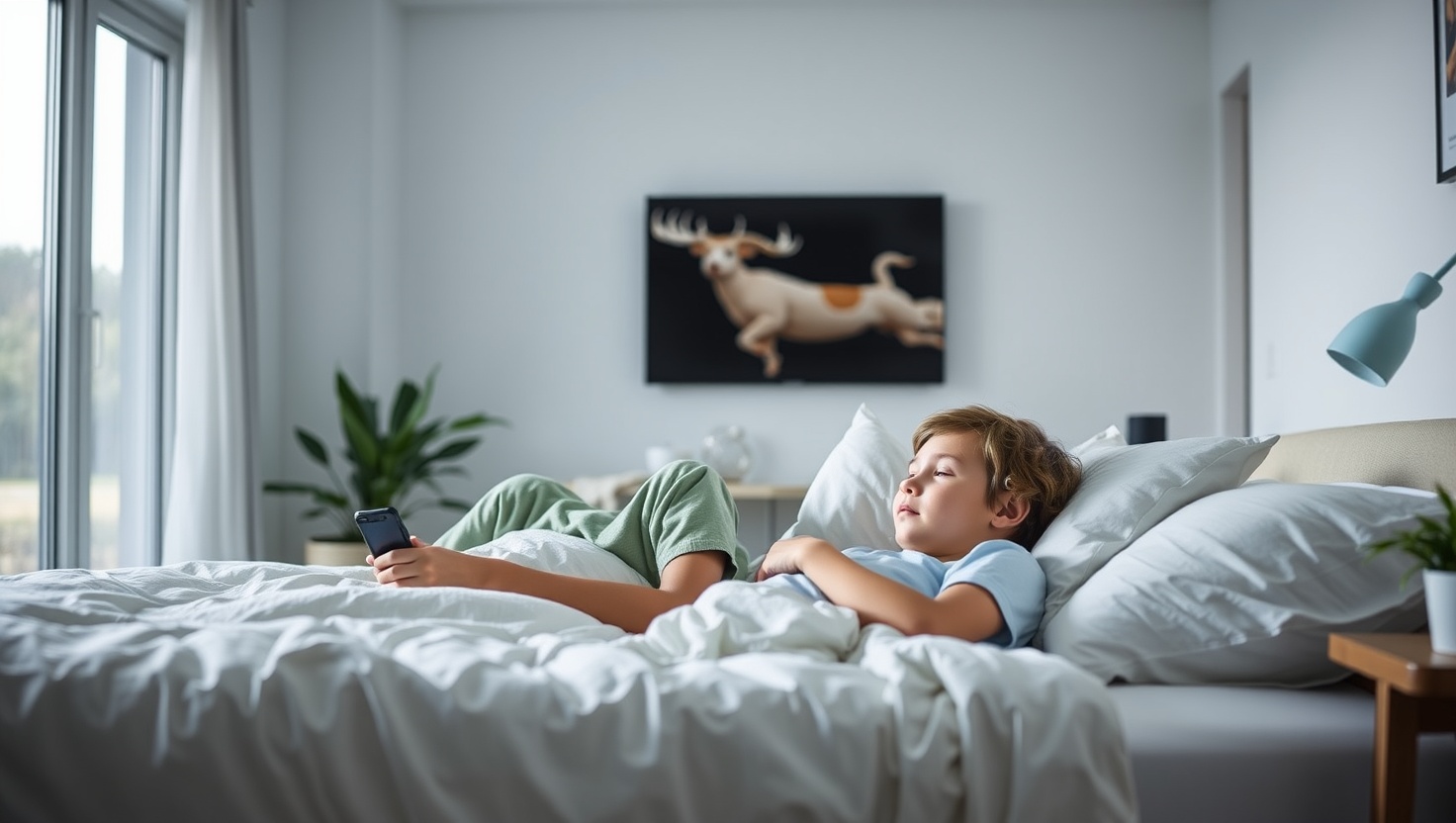
Your teenager goes to bed at 10pm. You check at 11:30pm and the phone screen is still glowing under the covers. They wake up at 7am with dark circles, drag through school, come home exhausted, nap for two hours, then stay up late again because they are not tired at bedtime. This is the screen-sleep cycle — and no amount of lecturing about "healthy sleep habits" breaks it. You have tried. They have heard you. Nothing changes.
Fitbit Charge 6 — Our Top Recommendation
The Fitbit Charge 6 earns the top spot because it combines clinical-grade sleep tracking accuracy with an app experience that teenagers actually engage with. The Daily Readiness Score integrates…
In a hurry? That’s our pick. Want the reasoning and the full comparison? Keep reading.
A sleep tracker changes the conversation from opinion to evidence. Instead of you saying "your phone is ruining your sleep" — a statement your teen has learned to dismiss — a sleep tracker shows them the data. Monday night: phone in bed until midnight, sleep score 48, deep sleep 32 minutes, total 5.5 hours. Tuesday night: phone plugged in at the kitchen charger at 9:30pm, sleep score 87, deep sleep 1 hour 42 minutes, total 8.2 hours. The tracker does not lecture. It does not judge. It presents numbers. And numbers are harder to argue with than parents.
This is not about surveillance. The best approach is giving your teen their own data — on their wrist, in their app, under their control. When a 16-year-old sees their own sleep score plummet after a TikTok binge and climb after a phone-free evening, they draw their own conclusions. That self-generated insight is worth more than a thousand parental warnings because it comes from within rather than being imposed from above.
Key Takeaways
- Blue light from screens suppresses melatonin by up to 58% — sleep trackers make that effect visible in personal data
- The Fitbit Charge 6 at $130 is the best overall pick — accurate sleep staging, sleep score, smart alarm, and an app teens actually use
- The Amazfit Band 7 at $45 is the budget winner — accurate enough for sleep tracking without a major investment
- Teens need 8-10 hours of sleep (AASM guidelines) — most get 6-7, and screens are the primary culprit
- Sleep trackers work best as personal experiments, not parental monitoring tools — frame it as their data, their insight
- Track trends over weeks: one bad night means nothing, but consistent patterns drive real behavior change
The Screen-Sleep Connection: What the Research Shows
The relationship between screens and teen sleep is not a theory debated by worried parents. It is a well-documented physiological cascade that starts with light and ends with exhaustion.
Blue light emitted by phone, tablet, and laptop screens has a wavelength of 450-490 nanometers — the exact range that suppresses melatonin production most effectively. A 2023 study published in the Proceedings of the National Academy of Sciences found that two hours of evening screen exposure reduced melatonin levels by 58% in adolescents compared to 23% in adults. Teenagers are biologically more sensitive to blue light than adults because their pupils are larger and their lenses are clearer, allowing more short-wavelength light to reach the retina.
But blue light is only half the problem. The content itself — TikTok algorithms, Instagram notifications, Snapchat streaks, group chat drama — triggers dopamine and cortisol responses that activate the sympathetic nervous system. Your teen's body enters a state of arousal that is the neurological opposite of sleep readiness. Even after the phone is down, the brain needs 30-60 minutes to shift from alert mode back to wind-down mode. This is why putting the phone away at 10pm does not mean falling asleep at 10:01pm.
The cumulative effect is devastating. A 2024 meta-analysis in Sleep Medicine Reviews covering 42 studies and over 200,000 adolescents found that teens who used screens within 60 minutes of bed experienced 23% less deep sleep and 31% less REM sleep compared to those who stopped 90+ minutes before bed. Deep sleep is when the body physically recovers and growth hormone is released. REM sleep is when the brain consolidates learning and processes emotions. Your teen is losing both.
What a Sleep Tracker Actually Measures
Before spending money, it helps to understand what you are buying. A modern sleep tracker worn on the wrist or finger uses optical heart rate sensors and accelerometers to estimate your sleep architecture — the different phases your brain cycles through during the night:
- Total sleep time: How many hours you actually slept versus how many hours you spent in bed. Most teens spend 8 hours in bed but only sleep 6-7 due to delayed sleep onset from screens.
- Sleep onset latency: How long it took to fall asleep after lying down. A consistently long onset time (30+ minutes) strongly correlates with pre-sleep screen use.
- Deep sleep (slow-wave sleep): The physically restorative phase. Should be 15-25% of total sleep. This is the phase most damaged by blue light exposure because melatonin suppression directly delays deep sleep onset.
- REM sleep: The phase for memory consolidation, emotional processing, and learning retention. Should be 20-25% of total sleep. Critical for teens who are studying and developing emotionally.
- Sleep efficiency: Time asleep divided by time in bed. Above 85% is healthy. Below 75% indicates a problem — usually phone-related in teens.
- Heart rate variability (HRV): Higher HRV during sleep indicates better recovery. Screens before bed lower HRV because the sympathetic nervous system stays activated.
The 5 Best Sleep Trackers for Teens in 2026
Fitbit Charge 6 — Best Overall Sleep Tracker for Teens
The Fitbit Charge 6 earns the top spot because it combines clinical-grade sleep tracking accuracy with an app experience that teenagers actually engage with. The Daily Readiness Score integrates sleep quality, HRV, and activity levels into a single number that your teen sees every morning. A score of 42 after a late-night scroll session versus 88 after a phone-free night is the kind of immediate, visible feedback that changes behavior without any parental intervention required.
Sleep staging on the Charge 6 breaks the night into awake, light, deep, and REM phases with accuracy that independent validation studies place at 85-89% agreement with polysomnography — the gold standard lab test. The sleep score algorithm weighs duration, deep sleep, REM sleep, restoration (sleeping heart rate versus resting heart rate), and consistency. It produces a number from 0-100 that correlates meaningfully with how your teen feels the next morning.
The Smart Wake alarm is the feature teens love most. Set a 30-minute wake window and the tracker vibrates during a light sleep phase within that window — so instead of being jolted awake from deep sleep by a blaring alarm, your teen wakes up during a natural transition. They feel more rested even with the same total sleep time. The silent wrist vibration also means they are not reaching for their phone alarm first thing in the morning, which often triggers a 20-minute social media check before even getting out of bed.
The Fitbit app is polished, well-designed, and popular among teens for its social features — step challenges and activity sharing with friends. This matters for sustained use. A tracker that sits in a drawer after two weeks is a waste of money regardless of its accuracy.
- Daily Readiness Score — one number that shows the impact of last night's choices
- 85-89% sleep staging accuracy — among the best for wrist-based trackers
- Smart Wake alarm — wakes during light sleep for a better morning
- SpO2 monitoring — detects potential sleep-breathing issues
- 7-day battery — charge once per week
- $130 — mid-range investment
- Some advanced features require Fitbit Premium ($10/month)
- Google account required since Fitbit-Google integration
Oura Ring 4 — Most Accurate and Most Discreet
The Oura Ring 4 is the most accurate consumer sleep tracker available — and the only one on this list that a teenager will actually forget they are wearing. That combination of accuracy and invisibility makes it uniquely effective for sleep tracking because it eliminates the two biggest compliance barriers: discomfort and self-consciousness. No teen wants to explain a chunky fitness band to their friends. A titanium ring that looks like jewelry has zero social friction.
Accuracy is where the Oura Ring genuinely separates itself. The ring form factor places sensors on the underside of the finger where blood vessels are closer to the surface and there is less motion artifact than the wrist. Independent validation published in the journal Sleep found that Oura Ring sleep staging achieved 91% agreement with polysomnography for total sleep time and 79% for individual sleep stages — the highest accuracy of any consumer wearable tested. For tracking the real impact of screens on sleep architecture, this level of precision matters.
The Oura app presents sleep data through a "Sleep Score" and detailed breakdowns of each sleep stage with timing, duration, and trends over days, weeks, and months. The "Trends" view is particularly useful for teens — it shows a rolling 2-week graph of sleep score alongside bedtime consistency, making the correlation between late-night phone use and poor sleep scores visually undeniable. The Resilience metric tracks how well the body handles stress based on daytime HRV patterns, adding another layer of insight into the screen-stress-sleep connection.
- 91% total sleep time accuracy — best consumer wearable tested
- Ring form factor — invisible, comfortable, no social stigma for teens
- Trend analysis shows patterns over weeks — not just single nights
- Resilience metric connects daytime stress to nighttime sleep
- Titanium construction — durable, water-resistant to 100m
- $349 — premium price for a teen accessory
- Requires Oura membership ($6/month) for full insights
- Sizing requires a free sizing kit — add 1-2 weeks before you can use it
- 5-day battery — shorter than some wrist trackers
Garmin Venu Sq 2 — Best for Active Teens Who Also Need Sleep Data
The Garmin Venu Sq 2 is the pick for teenagers who are already active — athletes, runners, swimmers, gym-goers — and need sleep tracking integrated into a comprehensive fitness platform. While the Fitbit Charge 6 focuses on sleep and daily readiness, the Venu Sq 2 treats sleep as one component of a complete health picture that includes training load, stress monitoring, respiration rate, and Garmin's Body Battery energy score.
Body Battery is the Garmin feature that resonates most with active teens. It assigns an energy score from 0-100 that charges during sleep and drains during physical and mental exertion throughout the day. A teenager who sleeps well sees their Body Battery charge to 85-95 overnight. A teenager who scrolled until 1am sees it charge to 40-55. When that same teen tries to perform at basketball practice on a Body Battery of 40 versus 90, the connection between sleep and athletic performance becomes viscerally real. For competitive teen athletes, this is the most powerful motivator to fix sleep habits.
Sleep tracking includes all stages (awake, light, deep, REM), sleep score, HRV status, and a Sleep Coach feature that suggests optimal bedtimes based on recent sleep patterns and upcoming schedule. The 11-day battery life is the longest on this list — charging once every week and a half means the tracker stays on the wrist continuously, capturing every night without interruption.
- Body Battery — shows teens how sleep directly fuels their performance
- 11-day battery — longest on this list by far
- GPS + sports tracking — doubles as a full fitness watch
- Sleep Coach suggests optimal bedtimes based on patterns
- AMOLED display — bright, clear, and responsive
- $170 — higher price than dedicated sleep trackers
- Garmin Connect app is feature-dense — can feel overwhelming at first
- Sleep accuracy slightly below Fitbit and Oura in independent testing
Amazfit Band 7 — Best Budget Sleep Tracker
The Amazfit Band 7 costs $45 and delivers sleep tracking that punches well above its price class. Sleep staging includes light, deep, and REM phases with a sleep quality score that reflects duration, depth, and consistency. For parents who want to test whether a sleep tracker will actually engage their teen before investing $130-$349, the Amazfit Band 7 is the low-risk entry point that still provides meaningful data.
The PAI (Personal Activity Intelligence) health score is the feature that differentiates Amazfit from other budget trackers. PAI combines heart rate data from all activities — including elevated heart rate during poor sleep — into a single rolling 7-day score. Maintaining a PAI score above 100 is associated with measurably lower health risks according to the HUNT study (a 35-year longitudinal study of 230,000 participants). Teens respond to gamified metrics, and PAI provides that gamification without the complexity of interpreting individual sleep stages.
The 18-day battery life is extraordinary for any tracker at any price. Your teen charges it once every two and a half weeks. This virtually eliminates the dead-tracker-in-the-drawer problem that kills most wearable habits within the first month. The tracker is always on, always tracking, always generating data. Consistency of wear is the single biggest predictor of whether sleep tracking leads to behavior change.
- $45 — lowest price with full sleep staging and SpO2
- 18-day battery — charge every 2.5 weeks
- PAI health score — gamified metric teens engage with
- Lightweight and comfortable for 24/7 wear
- Zepp app is clean and easy to navigate
- Sleep staging accuracy lower than Fitbit or Oura
- No smart alarm feature — standard alarm only
- Limited social/competitive features compared to Fitbit
Withings ScanWatch Light — Best Hybrid for Style-Conscious Teens
The Withings ScanWatch Light solves a specific problem: the teen who refuses to wear anything that looks like a fitness tracker. From the outside, the ScanWatch Light looks like a classic analog watch — round face, physical hands, minimalist design. Only the small digital subdial reveals it is a smart device. For image-conscious teenagers who would rather skip sleep tracking entirely than wear a rubber fitness band, this hybrid approach is the only one that works.
Beneath the traditional exterior, the ScanWatch Light packs a PPG heart rate sensor, accelerometer, and altimeter that track sleep stages, sleep score, respiratory rate during sleep, and activity throughout the day. The Withings Health Mate app presents sleep data in clean, medical-style reports that feel authoritative and serious — a tone that appeals to older teens (16+) who respond better to clinical data than gamified scores.
The 30-day battery life is the headline specification. One charge per month. This is by far the longest battery life on this list and it means the ScanWatch Light functions as a real daily watch that happens to also track sleep. There is no "I forgot to charge it" excuse. There is no visible reminder that it is a health device. It just sits on the wrist, looking like a watch, quietly recording everything — including the nights your teen's heart rate stays elevated until 1am because they were doom-scrolling.
- Analog watch design — zero fitness-tracker stigma
- 30-day battery — charge once per month
- Respiratory rate tracking during sleep — detects breathing irregularities
- Medical-grade sensors — Withings is an FDA-cleared health company
- Health Mate app has clean, clinical data presentation
- $130 — same price as Fitbit Charge 6 with fewer smart features
- Small digital display — limited on-wrist data visibility
- No GPS, no music control, no smartphone notifications on screen
- Less detailed sleep staging than dedicated trackers
Quick Comparison
| Tracker | Price | Battery | Sleep Accuracy | Best For |
|---|---|---|---|---|
| Fitbit Charge 6 | ~$130 | 7 days | 85-89% | Best overall |
| Oura Ring 4 | ~$349 | 5 days | 91% | Most accurate + discreet |
| Garmin Venu Sq 2 | ~$170 | 11 days | 80-85% | Active/athletic teens |
| Amazfit Band 7 | ~$45 | 18 days | 75-80% | Budget entry |
| Withings ScanWatch Light | ~$130 | 30 days | 80-85% | Style-first teens |
How to Use a Sleep Tracker to Break the Screen-Sleep Cycle
Buying a sleep tracker is step one. Using it effectively requires a framework that respects your teen's autonomy while leveraging the data to drive genuine behavior change. Here is what works:
Week 1: Baseline — No Changes
Have your teen wear the tracker for a full week without changing any habits. This is critical. You need baseline data that shows what their sleep currently looks like with their existing screen habits. Do not restrict phones, do not suggest earlier bedtimes, do not comment on their sleep scores. Just collect data. At the end of the week, sit down together and look at the numbers. Let the data speak first.
Week 2: The Experiment
Propose a simple experiment: three nights with phone plugged in outside the bedroom by 9:30pm, alternating with normal nights. Same bedtime, same wake time. Compare sleep scores. Most teens see a 15-30 point improvement on phone-free nights within the first experiment. That gap is their data — not your opinion, not your rule, their observation from their experiment.
Week 3 Onward: Negotiate From Data
Use the data to negotiate a sustainable system. Maybe the phone stays outside the bedroom on school nights but not weekends. Maybe the cutoff is 10pm instead of 9:30pm. The specific rules matter less than the principle: decisions are based on observed sleep data rather than parental authority. When your teen has agency over the experiment and ownership of the results, compliance is dramatically higher than imposed rules.
The full science behind blue light, melatonin suppression, and why 90 minutes is the magic buffer.
What Parents Get Wrong About Teen Sleep
Most parents blame laziness or poor discipline for their teen's sleep problems. The reality is more nuanced — and more fixable than you think.
Teens are biologically wired to stay up late. During puberty, the circadian rhythm shifts later by 1-3 hours. A 15-year-old's brain does not produce melatonin at 9pm the way an adult's does — natural melatonin onset in adolescents is closer to 10:30-11pm. This is called "delayed sleep phase" and it is hardwired biology, not defiance. Early school start times (7:30-8am) force teens to wake during their biological night, which is why the American Academy of Pediatrics recommends high schools start no earlier than 8:30am.
Screens amplify the problem but are not the only cause. The biological phase delay means teens are already vulnerable to late sleep onset. Screens pour gasoline on that fire by further suppressing the already-delayed melatonin. Remove the screens and the biological delay remains — but the delay shrinks from 2-3 hours past bedtime to 30-45 minutes, which is manageable.
Napping is a symptom, not the disease. Many parents ban afternoon naps thinking it will force earlier sleep onset. For chronically sleep-deprived teens, the opposite happens — they become so exhausted by evening that their body enters a stress response, cortisol rises, and they cannot fall asleep despite being tired. A strategic 20-minute nap before 3pm can actually improve nighttime sleep onset for severely sleep-deprived teens. The tracker data helps you see whether naps are helping or hurting.
Raise Humans, Not Followers
Practical digital wellness guides for parents. Tools and strategies that work — no judgment, no guilt trips.
If your teen will not give up screens before bed, blue light glasses reduce melatonin suppression by 50-80%.
Beyond the Tracker: Building a Sleep-Friendly Bedroom
A sleep tracker quantifies the problem and motivates change. But the tracker alone does not fix the environment. Pair it with these evidence-based changes for maximum impact:
- Phone charging station outside the bedroom. This single change has the highest impact-to-effort ratio of anything on this list. Buy a simple charging station for the kitchen or hallway. Every family member — including parents — plugs in at the same time.
- Analog alarm clock. The number one excuse for keeping the phone in the bedroom is "I need it for my alarm." Eliminate that excuse with a $15 alarm clock. The tracker's silent vibration alarm is even better.
- Temperature at 65-68 degrees F (18-20 degrees C). Cool rooms promote faster sleep onset and deeper sleep. This is one of the most well-established findings in sleep science and one of the easiest to implement.
- Blackout curtains. Especially important for teens who need to sleep past sunrise on weekends to recover from school-week sleep debt. Any light in the room suppresses melatonin and reduces deep sleep.
- No caffeine after 2pm. Caffeine has a half-life of 5-6 hours. An energy drink at 4pm means half the caffeine is still active at 10pm. Most teens do not realize that afternoon caffeine affects nighttime sleep.
For younger children (ages 4-13), activity trackers that turn movement into a game and replace screen time.
Data Beats Lectures
A $45-$349 sleep tracker turns "your phone ruins your sleep" from a parental opinion into measurable, personal data. Same message. Different messenger. Way more effective.
See the Fitbit Charge 6 →Frequently Asked Questions
Blue light from screens suppresses melatonin by up to 58% in adolescents. Combined with stimulating content that activates the sympathetic nervous system, screens delay sleep onset by 30-60 minutes and reduce deep sleep by 23% and REM sleep by 31% when used within 60 minutes of bed. A sleep tracker makes this effect visible in personal nightly data.
Focus on total sleep duration (8-10 hours for teens), sleep efficiency (above 85% is healthy), and deep sleep percentage (15-25% of total). Also watch sleep onset time — a consistent 45-minute gap between bedtime and sleep onset usually indicates pre-sleep phone use. Track trends over weeks, not single nights.
Modern wrist-based trackers achieve 80-90% accuracy for total sleep time and sleep stage detection. The Oura Ring 4 hits 91% for total sleep time. For tracking how habits affect sleep quality — which is the goal — this accuracy level is more than sufficient. You are tracking trends and patterns, not diagnosing disorders.
Compliance depends on comfort and perceived value. Slim bands and rings are comfortable enough that teens forget they are wearing them. The key is framing the tracker as their tool for their experiment — when they see their own sleep score drop 30 points after a late scroll session, the insight comes from within rather than from a parent.
No. If your teen consistently shows poor sleep despite behavior changes — under 6 hours total, very low deep sleep, or irregular patterns — consult a pediatric sleep specialist. Conditions like delayed sleep phase syndrome, sleep apnea, and anxiety-related insomnia need professional evaluation. A tracker identifies that a problem exists and provides data for that appointment.