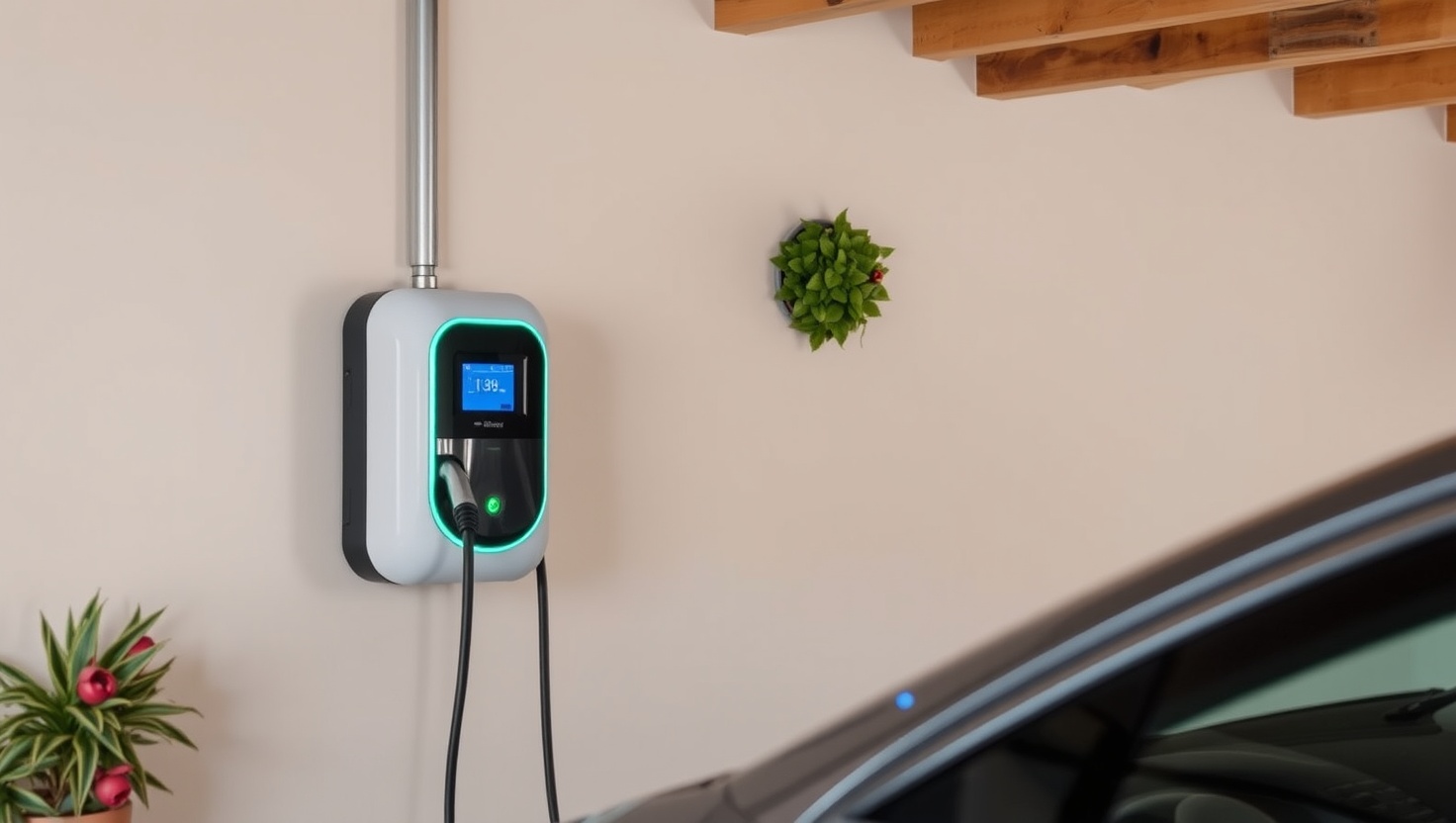
Your EV is plugged into a standard wall outlet right now, trickling in about 4 miles of range per hour. You left it charging overnight and woke up to... 40 miles. That is barely enough to cover your commute, let alone a grocery run or picking up the kids. You are driving one of the most advanced machines ever built, and you are charging it through a socket designed for table lamps.
A Level 2 home EV charger fixes this completely. Instead of 4 miles per hour, you get 25-40 miles per hour. Plug in after work, wake up to a full battery. Every single day. And thanks to the 30% federal tax credit (up to $1,000), your out-of-pocket cost is hundreds less than you think.
Here are the five best home EV chargers (Level 2) in 2026 — tested, compared, and ranked by who they are best for.
Key Takeaways
- Level 2 chargers deliver 25-40 miles of range per hour — roughly 7-10x faster than a wall outlet
- The 30% federal tax credit (up to $1,000) covers both the charger AND installation costs
- ChargePoint Home Flex is the best overall pick with adjustable 16-50A output and smart app control
- Budget pick: Grizzl-E Classic at ~$400 is a rugged, no-nonsense workhorse built for outdoors
- All five chargers on this list are Energy Star certified and support 240V operation
- Total installed cost typically runs $900-2,200 before the tax credit
Why Level 2 Charging Changes Everything
A standard 120V outlet (Level 1) delivers about 1.4 kW of power. A Level 2 charger runs on 240V — the same voltage as your dryer or oven — and delivers 7.7 to 11.5 kW depending on the amperage. That is the difference between adding 4 miles of range per hour and adding 40.
For most EV owners, Level 2 charging at home means you never think about charging again. You plug in when you get home, just like you plug in your phone at night. By morning, your battery is full. No more planning around public chargers. No more range anxiety. Just drive.
And there is a financial incentive that makes 2026 the best year to buy. The federal Section 30C tax credit gives you 30% back on the total cost of your charger and professional installation, up to $1,000. A $700 charger with $800 in installation costs? That is $1,500 total, with $450 coming back on your tax return. The credit runs through 2032, but the sooner you install, the sooner you start saving on fuel costs too.
What to Look for in a Level 2 Charger
Before diving into the products, here is what actually matters when choosing a home EV charger:
- Amperage (16A-50A): Higher amps mean faster charging. A 40A charger on a 50A circuit is the sweet spot for most homes. A 48A charger on a 60A circuit is the maximum most residential panels can handle.
- Connector type: J1772 is the universal standard for non-Tesla EVs. NACS (Tesla's connector) is now becoming standard across brands. Many 2026 chargers include both or an adapter.
- Cable length: 24-25 feet covers most garage setups. Anything under 20 feet can be frustrating if your charge port is on the opposite side.
- Smart features: App-based scheduling lets you charge during off-peak hours when electricity costs less. Energy monitoring tracks your exact charging costs. Some utilities offer special EV rates — smart scheduling takes full advantage.
- Indoor vs. outdoor rating: If your charger mounts outside or in an uninsulated garage, look for NEMA 4 (weatherproof) housing.
The 5 Best Level 2 Home EV Chargers in 2026
ChargePoint Home Flex
~$700 · After tax credit: ~$490
The ChargePoint Home Flex is the charger most electricians recommend, and for good reason. It offers adjustable amperage from 16A to 50A, so it works with virtually any home electrical panel — from a 20A breaker in an older house to a 60A circuit in a new build. The app is excellent: schedule charging for off-peak hours, track your energy usage and cost per session, and set reminders to plug in. It supports both J1772 and NACS connectors, is Energy Star certified, and qualifies for the 30% federal tax credit.
Pros
- Adjustable 16-50A covers any home panel
- Excellent app with scheduling and cost tracking
- J1772 + NACS connector support
- Energy Star certified
- UL listed, 23-ft cable, NEMA 3R rated
Cons
- Higher price point than basic chargers
- Requires WiFi for smart features
- App subscription for advanced analytics
Grizzl-E Classic
~$400 · After tax credit: ~$280
The Grizzl-E Classic is the pickup truck of EV chargers. Built in Canada with a NEMA 4 metal housing, it handles rain, snow, dust, and temperature extremes from -30°C to 50°C without breaking a sweat. No app, no WiFi, no fuss — just plug in and charge at a solid 40A (9.6 kW). If you park outside, live in a harsh climate, or just want something that will outlast your car, this is it. At ~$400 before the tax credit (potentially ~$280 after), it is also the best value on this list.
Pros
- NEMA 4 metal housing — extreme weather rated
- 40A / 9.6 kW charging speed
- Best price for a premium-build charger
- 24-ft cable, no WiFi required
- Canadian-built, outstanding reliability
Cons
- No smart features or app
- No energy monitoring or scheduling
- 40A max (not 48A)
Tesla Wall Connector
~$500 · After tax credit: ~$350
If you drive a Tesla, this is the obvious choice — but it is a genuinely great charger for any EV. The Tesla Wall Connector delivers up to 48A (11.5 kW) with a generous 24-foot cable. Tesla owners get seamless app integration, scheduled charging, and the fastest home charging speeds Tesla supports. Non-Tesla owners can use it too with the included J1772 adapter. The sleek wall-mount design looks clean in any garage. It also qualifies for the full 30% federal tax credit.
Pros
- 48A / 11.5 kW — fastest home charging for Tesla
- 24-ft cable with clean cable management
- Works with non-Tesla EVs via J1772 adapter
- Sleek, minimal design
- WiFi enabled with Tesla app integration
Cons
- Smart features limited for non-Tesla vehicles
- Requires 60A breaker for full 48A output
- No standalone energy cost tracking
Emporia Level 2 EV Charger
~$450 · After tax credit: ~$315
Emporia brings the best smart features at a mid-range price. The app tracks your charging energy usage in real time, calculates costs per session, and — here is the killer feature — integrates directly with Emporia's home energy monitor and solar panels. If you have a home solar setup, you can schedule your EV to charge when your panels are producing excess power. At 48A, it charges just as fast as the Tesla Wall Connector. The 30% tax credit brings this down to roughly $315.
Pros
- 48A / 11.5 kW charging speed
- Excellent energy monitoring and cost tracking
- Solar integration for free-energy charging
- Strong app with scheduling and usage history
- Best value for a smart charger
Cons
- Plastic housing (less rugged than Grizzl-E)
- WiFi required for all smart features
- Newer brand, less long-term track record
Autel MaxiCharger Home
~$550 · After tax credit: ~$385
The Autel MaxiCharger is for the tech-forward EV owner who wants every feature possible. It connects via both Bluetooth and WiFi, supports RFID access cards (useful if you share a driveway or have multiple users), and includes a built-in LED status ring that shows charging state at a glance. It ships with both NACS and J1772 connectors, runs at up to 50A, and has one of the most feature-rich apps in the category. If you want the smartest charger money can buy, this is it.
Pros
- Up to 50A / 12 kW — fastest on this list
- RFID access cards for multi-user setups
- Bluetooth + WiFi dual connectivity
- NACS + J1772 included
- 25-ft cable, NEMA 4X outdoor rated
Cons
- More expensive than simpler options
- App has a slight learning curve
- Overkill if you just want to plug in and charge
Quick Comparison Table
| Charger | Price | Amps | Smart App | Outdoor | Best For |
|---|---|---|---|---|---|
| ChargePoint Home Flex | ~$700 | 16-50A | Yes | NEMA 3R | Best overall |
| Grizzl-E Classic | ~$400 | 40A | No | NEMA 4 | Rugged / outdoor |
| Tesla Wall Connector | ~$500 | 48A | Tesla only | Indoor/covered | Tesla owners |
| Emporia Level 2 | ~$450 | 48A | Yes | NEMA 4 | Value smart |
| Autel MaxiCharger | ~$550 | 50A | Yes | NEMA 4X | Tech features |
Installation: What to Expect
Every Level 2 charger requires a dedicated 240V circuit. This is not a DIY project for most people — you need a licensed electrician. Here is what the process typically looks like:
Typical Installation Steps
- Electrician inspects your panel (need at least 200A with a free 240V slot)
- Runs a new 240V line from panel to your charging location (garage wall, carport, driveway)
- Installs a dedicated breaker (40A-60A depending on charger)
- Mounts the charger unit and connects wiring
- Tests the circuit and charger, walks you through the app
Cost: Professional installation runs $500-1,500 depending on the distance from your panel to the charger and whether your panel needs any upgrades. Remember, the 30% federal tax credit applies to installation costs too — not just the hardware. A $1,500 total project (charger + install) means $450 back on your taxes.
If your home has a 100-amp panel, you may need a panel upgrade ($1,500-3,000) before installing a Level 2 charger. This is worth getting assessed first. The ChargePoint Home Flex is particularly useful here because you can dial the amperage down to 16A and still get Level 2 speeds on a smaller panel.
Save More: Charge During Off-Peak Hours
Many utility companies offer time-of-use (TOU) rates or special EV charging rates. Electricity can cost 30-50% less between 11pm and 7am compared to peak afternoon hours. Every smart charger on this list (except the Grizzl-E) lets you schedule charging for these cheaper windows.
If you charge a 60 kWh battery from 20% to 80% every day, that is roughly 36 kWh per session. At peak rates (around $0.25/kWh), that costs $9.00 per charge. At off-peak rates ($0.12/kWh), the same charge costs $4.32. Over a year of daily charging, that scheduling alone saves you over $1,700.
Pair this with a home energy dashboard to see exactly where every kWh goes — your EV, your HVAC, your appliances, all in one view.
The Federal Tax Credit Explained
Under Section 30C of the Internal Revenue Code, you can claim 30% of the total cost of purchasing and installing a qualified EV charger at your home. The maximum credit is $1,000 for residential installations. Here is what qualifies:
- The charger hardware — any of the five chargers on this list qualify
- Installation labor — the electrician's bill counts toward the credit
- Electrical upgrades — new wiring, breaker, or panel work directly related to the charger
The credit is available through December 31, 2032. You claim it on IRS Form 8911 when you file your taxes. It is a tax credit, not a deduction — meaning it reduces your tax bill dollar-for-dollar.
For the full breakdown and step-by-step claiming instructions, read our EV charger tax credit guide for 2026. And if you are also looking at solar panels, the solar tax credit stacks on top of this one — two credits, two systems, one lower energy bill.
Which Charger Should You Buy?
Here is the short version:
- Want the best all-around charger? ChargePoint Home Flex. Adjustable amperage, great app, works with everything.
- Parking outside in any weather? Grizzl-E Classic. Built like a tank, lowest price, zero maintenance.
- Drive a Tesla? Tesla Wall Connector. Fastest Tesla charging, clean design, works with other EVs too.
- Want smart features at a fair price? Emporia Level 2. Best energy monitoring, solar integration, 48A fast.
- Want every tech feature available? Autel MaxiCharger. RFID, dual connectivity, 50A, future-proof.
No matter which one you pick, you are making a smart investment. The 30% tax credit lowers your cost, off-peak scheduling saves you money every month, and you will never sit at a public charging station wondering when your car will be ready again.
Charge at home. Wake up full. That is the whole point.
Ready to Charge at Home?
The ChargePoint Home Flex is our top pick. Adjustable amperage, smart app, works with every EV — and the 30% tax credit brings the real cost under $500.
Check Price on Amazon →