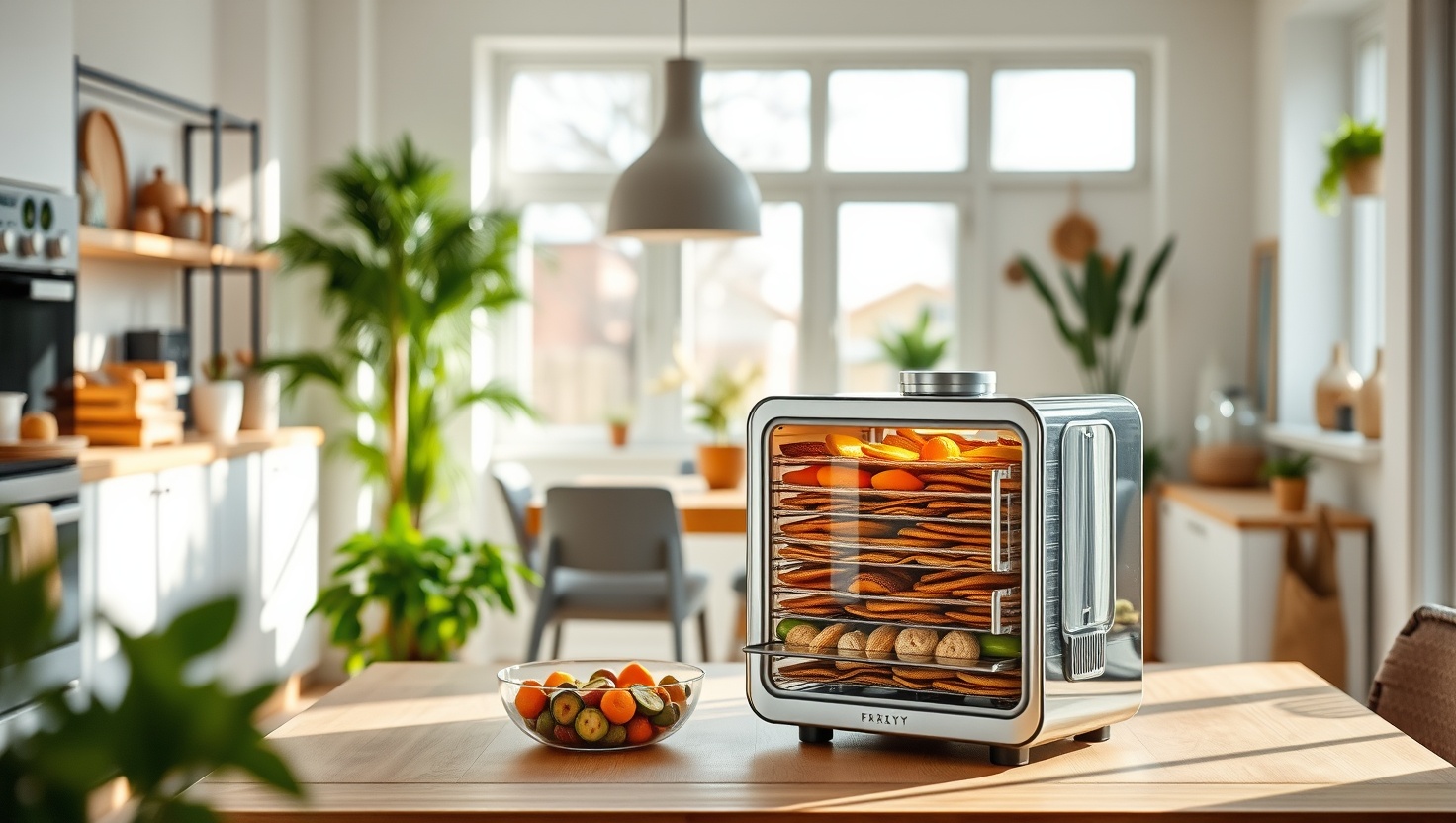
Growing your own food is step one. Preserving it so nothing goes to waste? That's mastery. A food dehydrator is the single most practical tool you can add to a self-sufficient kitchen — and the best food dehydrators for home preservation in 2026 make it easier than ever to build a pantry that doesn't depend on a supply chain.
Dehydrated food lasts 1-5 years on a shelf. It takes up a fraction of the space of canned goods. And unlike freeze-drying equipment that costs $3,000+, a quality dehydrator runs $60-280 and pays for itself the first time you turn a summer harvest into a year's worth of snacks, meals, and emergency stores.
We compared five of the best options right now — from a $60 starter to a $280 professional-grade machine — so you can pick the right one for your kitchen, your food, and your goals.
Key Takeaways
- The Excalibur 3926TB ($280) is the gold standard — rear-mounted fan, even drying, 9 trays, and a 26-hour timer
- The COSORI Premium ($130) is the best mid-range pick: digital controls, 6 stainless trays, and genuinely quiet operation
- The COSORI Lite ($60) is the best budget entry point — compact, simple, and capable for fruits, herbs, and light jerky
- Rear-mounted fans produce more even results than top or bottom fans — no rotating trays needed
- Dehydrated food retains more nutrients than canning and lasts 1-5 years in sealed, airtight containers
- Pair your dehydrator with a 30-day emergency food supply strategy for real food independence
Why a Dehydrator Beats the Alternatives
You could use your oven. Most people try it once and never do it again. Ovens cycle heat unpredictably, you can't leave the door cracked efficiently, and running a full oven for 8-12 hours to dry apple slices costs three times what a dehydrator uses. Dedicated dehydrators circulate low, consistent heat across multiple trays simultaneously — that's the whole point.
Freeze-drying produces a superior product with a longer shelf life, but the machines cost $2,500-4,000. For most households, a quality food dehydrator at $130-280 delivers 90% of the benefit at 5% of the cost. The preserved food looks different (denser, chewier) but the nutritional retention and shelf life are excellent.
The core mechanics: dehydrators remove 90-95% of a food's moisture using circulating warm air (95-165°F depending on food type). No moisture means bacteria, mold, and yeast can't survive. No preservatives needed. No refrigeration required.
Quick Comparison Table
| Dehydrator | Price | Trays | Wattage | Fan Position | Best For |
|---|---|---|---|---|---|
| Excalibur 3926TB | ~$280 | 9 | 600W | Rear | Serious preservers |
| Magic Mill Commercial | ~$200 | 10 | 760W | Rear | Large batches |
| COSORI Premium | ~$130 | 6 | 600W | Rear | Best mid-range |
| Nesco Gardenmaster | ~$90 | 4 (to 30) | 1000W | Top | Bulk expandable |
| COSORI Lite | ~$60 | 5 | 350W | Rear | Budget starter |
The 5 Best Food Dehydrators for Home Preservation
Excalibur 3926TB
~$280 · 9 trays · 600W · 15 sq ft drying space
If you're serious about food preservation, the Excalibur 3926TB is the machine serious people use. It has been the industry benchmark for home and small-farm dehydrating for decades — and the 2026 version keeps every feature that made it legendary. The rear-mounted Hyperion forced-air fan distributes heat horizontally across all 9 trays simultaneously. No hot spots. No rotating trays. Everything dries evenly whether it's on tray one or tray nine. The 26-hour timer means you can load it before bed and wake up to finished product. At 600W, it's actually energy-efficient for its output. The 15 square feet of total drying space means a full batch of jerky from a 5-pound roast fits in one run. This is the machine that pays for itself.
Pros
- Rear-mounted fan — no tray rotation needed
- 9 trays / 15 sq ft of drying space
- 26-hour programmable timer
- Even, consistent heat across all trays
- Industry-standard reliability
- Adjustable thermostat 105–165°F
Cons
- Largest footprint of any model here
- Analog dial (no digital display)
- No see-through door to check progress
- Overkill for occasional casual use
Magic Mill Commercial Dehydrator
~$200 · 10 trays · 760W · Stainless steel
Ten stainless steel trays, a rear-mounted fan, digital controls, and a transparent door that lets you monitor drying without opening the unit — the Magic Mill Commercial punches significantly above its price. At $200 it's positioned between the COSORI and Excalibur, and for households that want near-commercial output without the Excalibur's footprint, it delivers. The stainless steel construction means no plastic touching your food at any point. The digital thermostat and timer give you precise control, and the rear fan ensures consistent airflow across all ten trays. It runs slightly louder than the COSORI but the extra tray capacity more than compensates for anyone preserving harvests in volume.
Pros
- 10 trays — largest capacity in this price range
- Full stainless steel — no plastic food contact
- Rear-mounted fan for even drying
- Transparent door for monitoring
- Digital controls with precise temperature
Cons
- Louder than COSORI models
- Heavier and harder to store
- Larger footprint on the counter
- Timer maxes at 19.5 hours
COSORI Premium Food Dehydrator
~$130 · 6 trays · 600W · BPA-free stainless
The COSORI Premium hits the sweet spot most home preservers are actually looking for. Six stainless steel trays, digital controls with a clear display, a timer that goes up to 48 hours, and a 165°F maximum temperature for safe meat dehydration. The rear-mounted fan means you don't rotate trays, and it runs quieter than almost anything else in this price range — quiet enough to leave running in a kitchen or pantry without it becoming background noise you hate. The BPA-free construction throughout is a meaningful touch. At $130 it's accessible for most budgets, and the build quality feels like it belongs in a $200 machine. If you want one dehydrator that handles everything — jerky, fruit, herbs, vegetables, leather — without overthinking it, this is our pick.
Pros
- Digital controls with 48-hour timer
- Reaches 165°F — safe for meat/jerky
- Quiet operation — barely noticeable
- Rear-mounted fan for even drying
- BPA-free stainless steel trays
- Compact enough for most countertops
Cons
- Only 6 trays — limits batch size
- No transparent door
- Trays feel slightly flimsy vs. Excalibur
Nesco Gardenmaster FD-1018A
~$90 · 4 trays expandable to 30 · 1000W
If you have a serious garden and a serious harvest, the Nesco Gardenmaster is built for you. It ships with 4 trays but accepts up to 30 — which means when tomato season hits and you have 40 pounds of Roma tomatoes, you don't hit a wall. The 1000W top-mounted fan pressurizes the drying chamber to force air down through each tray, and Nesco's Converga-Flow design means you don't need to rotate trays either. The adjustable thermostat covers 95–160°F. At $90 with 4 trays it's affordable to start; each additional 2-tray expansion kit costs around $8-10. The trays are opaque plastic rather than stainless, which is the main trade-off at this price point, but they're BPA-free and dishwasher-safe.
Pros
- Expandable to 30 trays for bulk preservation
- 1000W power handles large loads efficiently
- Top-mounted fan with Converga-Flow airflow
- Affordable entry price at $90
- Extra trays are cheap to add ($8-10 each)
Cons
- Plastic trays (BPA-free but not stainless)
- Top fan can be louder than rear-fan designs
- No digital display or timer
- Tall stack with many trays can tip
COSORI Lite Food Dehydrator
~$60 · 5 trays · 350W · Compact
The COSORI Lite is the right answer to one question: "What's the cheapest way to start dehydrating food and not regret the purchase?" At $60 it competes with cheap stackable models that produce uneven results — but the Lite's rear-mounted fan and straightforward digital controls give you the same core technology as its bigger siblings in a more compact body. Five trays handles a solid day's worth of fruit slices or herbs without issue. Maximum temperature is 165°F so you can do jerky safely. Simple two-button operation means zero learning curve. If you're just starting out and want to know whether dehydrating fits your food preservation routine before investing $130-280, the COSORI Lite is where you begin.
Pros
- Best value at ~$60
- Rear-mounted fan for even drying
- Reaches 165°F for safe jerky
- Compact — fits smaller kitchens
- Simple controls, zero learning curve
Cons
- 5 trays limits batch size
- 350W means slower drying on thicker cuts
- Plastic trays rather than stainless
- Timer maxes at 48 hours (fine for most use)
What to Dehydrate: A Practical Starting Guide
Most people buy a dehydrator and immediately try to make jerky. That's fine — but it's actually one of the more involved processes. Start with fruits and herbs to get a feel for your machine, then graduate to vegetables and meat.
Fruits
Apple slices (dry at 135°F for 6-12 hours), banana chips (135°F, 6-10 hours), mango slices (135°F, 6-8 hours), and strawberry halves (135°F, 6-10 hours) are all beginner-friendly. Pre-treating with lemon juice prevents browning and adds a slight brightness to the flavor. Dried fruit is the most immediately satisfying output from any dehydrator — it tastes better than store-bought, costs less, and has no added sugar or preservatives.
Herbs
Fresh herbs from your garden dry in 2-4 hours at 95-115°F — the lowest heat setting on most machines. Basil, oregano, thyme, rosemary, parsley, and dill all work perfectly. You'll get roughly 3-4x the flavor concentration compared to commercially dried herbs. Dry on the tray in small bundles, store in glass jars away from light, and they'll stay potent for 1-2 years. This alone justifies owning a dehydrator if you grow herbs.
Temperature Guide by Food Type
- Herbs: 95–115°F — 2-4 hours
- Fruits: 125–135°F — 6-12 hours
- Vegetables: 125–135°F — 4-10 hours
- Meat/Jerky: 145–165°F — 4-8 hours
- Fish: 145–160°F — 6-10 hours
- Fruit leather: 135°F — 4-6 hours
Vegetables
Zucchini chips (season with salt and herbs before drying), cherry tomatoes halved, bell pepper strips, corn, green beans, and mushrooms all dehydrate beautifully. Most vegetables benefit from blanching first — drop them in boiling water for 2-3 minutes, then cold-shock in ice water before loading the trays. Blanching stops enzyme activity that causes color and flavor degradation during storage. Rehydrate dried vegetables in soups, stews, stir-fries, and rice dishes — they absorb liquid and reconstitute surprisingly well.
Jerky
Beef jerky is the high-value, high-satisfaction output that turns dehydrator skeptics into converts. Use lean cuts like top round, flank, or sirloin. Slice thin (1/4 inch), against the grain for tender jerky, with the grain for chewier. Marinate 6-24 hours. The USDA recommends heating beef to 160°F internal temperature before or after dehydrating for food safety. Any of the machines above with a 165°F setting handle this. Finished jerky lasts 1-2 months at room temperature in sealed bags, or 6+ months vacuum-sealed.
Jerky Tips for Beginners
- Choose lean cuts — fat doesn't dehydrate and causes rancidity
- Slice uniformly so everything finishes at the same time
- Pat dry before loading to speed up drying
- Test doneness by bending a piece: it should crack but not snap
- Let jerky cool completely before sealing — trapped steam causes mold
- Vacuum seal with oxygen absorbers for 6-12 month shelf life
How We Picked These Dehydrators
We evaluated each machine on five criteria: airflow design (rear fan vs. top/bottom), temperature range and accuracy, build quality and materials, tray capacity and expandability, and value for price. We specifically weighted airflow design heavily because it's the single biggest factor in whether you need to rotate trays mid-cycle. Front-door rear-fan designs like the Excalibur and COSORI consistently outperform top-mounted designs for even drying without manual intervention.
We excluded ultra-cheap stackable models (under $40) that consistently produce uneven results and have plastic heating elements that touch food. We excluded countertop ovens repurposed as dehydrators — they work but cost more to run and produce less consistent results. Every pick here is a purpose-built dehydrator in a category-appropriate price range.
Dehydrating pairs directly with your broader food independence strategy. If you're building a pantry that doesn't depend on external systems, check our guide to building a 30-day emergency food supply and the emergency preparedness hub for the full picture. And if you're growing the food before you preserve it, our electric kitchen composter guide closes the loop on kitchen-to-garden waste.
Ready to Stop Wasting Your Harvest?
Pick the dehydrator that matches your kitchen size, your batch volume, and your budget. The Excalibur for serious preservers, the COSORI Premium for most households, the COSORI Lite to start.
See the Excalibur 3926TB on Amazon →