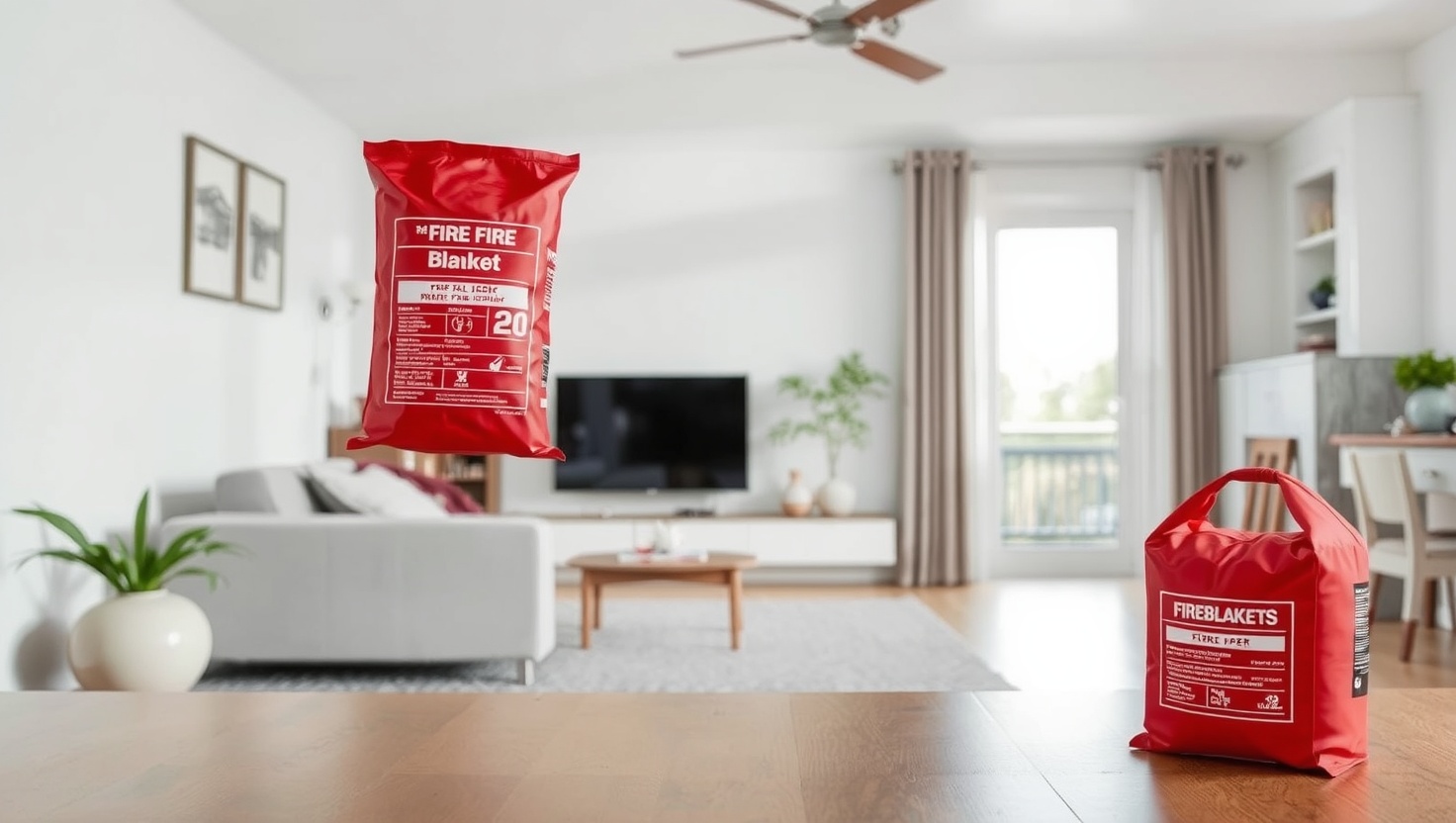
Prepared Hero Fire Blanket — Our Top Recommendation
The Prepared Hero Fire Blanket hits the sweet spot between quality, size, and price. The 40" x 40" fiberglass sheet handles any standard stovetop fire, small grill flare-up, or electrical fire with…
In a hurry? That’s our pick. Want the reasoning and the full comparison? Keep reading.
Kitchen fires are the number one cause of home fires — and when one starts, most people instinctively reach for water. That is the single worst thing you can do for a grease fire. Water hits hot oil, the oil explodes into a fireball, and a small stovetop flame becomes a kitchen inferno in under two seconds. The best fire blanket for your home in 2026 costs about $20, deploys in 3 seconds with zero training, and smothers flames by cutting off their oxygen supply. No mess, no chemicals, no panic required.
Yet most households do not own one. They have a smoke detector (maybe with a dead battery), possibly an extinguisher collecting dust under the sink, and absolutely nothing designed to handle the most common type of home fire quickly and safely. That gap between "having a fire start" and "putting it out before it spreads" is where people lose kitchens, homes, and lives.
We researched and compared the best fire blankets and compact fire safety tools available right now. Here are five products that fill that gap for under $40 each.
Key Takeaways
- Fire blankets smother small fires instantly with zero training — just pull, hold, and drape over the flames
- Never throw water on a grease fire — it causes burning oil to explode and spread the fire dramatically
- The Prepared Hero Fire Blanket (~$20) is the best overall pick for most kitchens
- Pair a fire blanket with a compact extinguisher — blankets handle small contained fires, extinguishers handle larger ones
- Place fire safety tools in four zones: kitchen, garage, bedroom hallway, and laundry room
- Fire blankets require no maintenance, no recharging, and no annual inspections — they just work when you need them
Fire Blanket vs Fire Extinguisher: When to Use Each
This is not an either/or situation. Fire blankets and extinguishers solve different problems. Understanding when to reach for each one means the difference between putting out a fire in seconds and making a bad situation worse.
How Fire Blankets Work
A fire blanket is a sheet of fire-resistant fiberglass fabric stored in a quick-release wall pouch. When a fire starts, you pull the tabs to release the blanket, hold it in front of your body as a shield, and place it over the fire source. The blanket cuts off oxygen, and the fire suffocates. No aiming required. No pins to pull. No pressure to maintain. A child can use one effectively.
How Fire Extinguishers Work
A fire extinguisher sprays a chemical agent (dry powder, foam, or CO2) that interrupts the combustion reaction. They require the PASS technique: Pull the pin, Aim at the base of the fire, Squeeze the handle, Sweep side to side. They work on larger fires that have spread beyond a single source — but they also create a massive mess, need annual inspection, and lose pressure over time.
| Feature | Fire Blanket | Fire Extinguisher |
|---|---|---|
| Best for | Small contained fires (pan, stovetop, grill) | Larger or spreading fires |
| Training needed | None — pull and drape | PASS technique required |
| Grease fires | Ideal — smothers without splashing | Only Class K extinguishers work safely |
| Mess factor | Zero cleanup | Chemical residue everywhere |
| Maintenance | None needed | Annual inspection, pressure checks |
| Reusable | Single use (residential models) | Rechargeable or single-use |
| Cost | $15-35 | $20-60 |
| Person on fire | Yes — wrap around person | Never spray a person |
| Shelf life | 5-7 years (no degradation if sealed) | 5-12 years (pressure can drop) |
The 5 Best Fire Blankets & Fire Safety Tools in 2026
This article contains affiliate links. We earn a small commission on purchases at no extra cost to you. We only recommend products we genuinely believe improve your home safety.
1. Prepared Hero Fire Blanket — Best Overall
The Prepared Hero Fire Blanket hits the sweet spot between quality, size, and price. The 40" x 40" fiberglass sheet handles any standard stovetop fire, small grill flare-up, or electrical fire with room to spare. The quick-pull tabs release the blanket from its compact wall pouch in under 2 seconds — no fumbling with packaging during an emergency.
What makes this our top pick is the combination of reliability and accessibility. The wall-mount pouch is slim enough to hang next to a stove without looking like safety equipment (it comes in neutral colors that blend with most kitchens). The fiberglass withstands temperatures up to 1,000 degrees Fahrenheit. And at roughly $20, there is no excuse not to have one in every high-risk area of your home.
Pros
- Quick-pull tabs for instant deployment
- 40"x40" covers standard stovetop fires easily
- Withstands up to 1,000°F
- Slim wall-mount pouch included
- No maintenance or inspections needed
- Under $20
Cons
- Single use only — replace after deployment
- Too small for very large fires (furniture, curtains)
- Fiberglass can irritate skin if handled roughly
- No carrying case for travel
We earn a commission on purchases — at no extra cost to you.
2. Siterwell Fire Blanket 2-Pack — Best Value
Two fire blankets for less than one name-brand alternative. The Siterwell 2-pack gives you a blanket for the kitchen and a second one for the garage, grill area, or workshop — all for about $18 total. Each blanket measures 39" x 39", which is standard kitchen-fire size, and deploys from the same style of pull-tab wall pouch.
The quality matches more expensive single-blanket options. Same fiberglass construction, same heat resistance (up to 1,076°F according to manufacturer testing), same zero-training deployment. The only real difference from the Prepared Hero is slightly less refined packaging and a marginally smaller size (39" vs 40" — functionally identical). If you want to cover multiple rooms without spending $20 per blanket, this is the obvious choice.
Pros
- Two blankets for under $20 total
- Same fiberglass quality as premium options
- Heat resistance up to 1,076°F
- Wall-mount pouches included for both
- Cover two rooms for the price of one competitor
Cons
- Packaging feels slightly less premium
- Pull tabs not quite as smooth as Prepared Hero
- Limited color options for the pouch
- Single use only
We earn a commission on purchases — at no extra cost to you.
3. Traeger Emergency Fire Blanket XL — Best for Large Fires
Standard 40-inch fire blankets handle stovetop fires perfectly. But what about a grill fire, a fireplace accident, or a larger source that needs more coverage? The Traeger XL measures 60" x 60" — large enough to smother a full-size charcoal grill, cover a person whose clothing caught fire, or drape over a burning piece of furniture.
The extra size makes this blanket heavier and slightly slower to deploy than kitchen-sized models, but the additional coverage area is invaluable for fires that have moved beyond a single pan. Keep this one in the garage near your grill setup, near a fireplace, or in any area where a larger fire source exists. The thicker fiberglass construction also provides better heat shielding if you need to use it as a personal fire shield to escape through a burning doorway.
Pros
- 60"x60" covers large fire sources
- Can wrap around a person whose clothes are burning
- Thicker fiberglass for better heat shielding
- Works for grills, fireplaces, workshop fires
- Heavy-duty pull tabs handle the extra weight
Cons
- Bulkier pouch — takes more wall space
- Slightly slower to fully deploy due to size
- Overkill for small kitchen pan fires
- Higher price point at ~$35
We earn a commission on purchases — at no extra cost to you.
4. First Alert Kitchen Fire Extinguisher — Best Compact Extinguisher
Sometimes a fire blanket is not enough. When flames have spread from the stovetop to the backsplash, when curtains catch, or when a fire grows beyond what a blanket can cover — you need the reach and power of an extinguisher. The First Alert Kitchen Fire Extinguisher is designed specifically for this scenario. It is compact enough to store in a cabinet, rated for the grease and electrical fires most common in kitchens, and costs about $25.
The canister design is smaller and lighter than a full-size extinguisher. It sprays a fine dry chemical that interrupts combustion, and the nozzle provides good aim control for directing the agent at the base of the fire. Keep this as your backup when the fire blanket approach fails or when a fire has already grown past the "drape and smother" stage. One important note: this is rated Class B:C (flammable liquids and electrical), not Class K (commercial cooking oils). For home use, that covers virtually all kitchen fire scenarios.
Pros
- Compact size fits in a kitchen cabinet
- Rated for grease and electrical fires
- Good nozzle control for aiming
- Trusted brand with decades in fire safety
- Affordable at ~$25
Cons
- Creates chemical mess that needs cleanup
- Requires basic PASS technique knowledge
- Limited discharge time (~10-12 seconds)
- Needs pressure check annually
- Not rated for deep fryer oil (Class K)
We earn a commission on purchases — at no extra cost to you.
5. Kidde Full Home Fire Extinguisher — Best Whole-Home Coverage
The Kidde Full Home extinguisher is rated Class A:B:C — meaning it handles ordinary combustibles (wood, paper, fabric), flammable liquids (grease, gasoline), and electrical fires. This is your all-purpose home defender for any fire type in any room. Mount one on each floor of your home and you have complete coverage for every fire scenario short of a structural blaze.
Unlike disposable kitchen extinguishers, the Kidde is rechargeable. After use (or after the pressure gauge drops into the red zone), a local fire equipment service can recharge it for a fraction of replacement cost. The included wall mount bracket keeps it visible and accessible — do not hide extinguishers in closets where you cannot reach them during a fire. At $40, this is the single most effective piece of fire safety equipment you can own for whole-home protection.
Pros
- Class A:B:C covers all common fire types
- Rechargeable — not single use
- Larger capacity for extended discharge
- Pressure gauge for at-a-glance readiness check
- Wall mount included for visible placement
- Trusted Kidde brand
Cons
- Larger and heavier than kitchen-only models
- Requires annual pressure inspection
- Chemical mess after discharge
- At $40, costs more than compact alternatives
We earn a commission on purchases — at no extra cost to you.
Where to Place Fire Safety Tools in Your Home
Owning fire safety tools is step one. Placing them where you can actually reach them during a fire is step two — and most people get this wrong. A fire extinguisher under the sink behind cleaning supplies? Useless when flames are between you and that cabinet. Here are the four zones every home needs covered.
1 Kitchen — Your Highest-Risk Zone
Mount a fire blanket on the wall between your stove and your kitchen exit. Not above the stove, not behind it — next to it, at grab height (4-5 feet). You want to pull that blanket without reaching over or past any flames. Add a compact kitchen extinguisher inside the nearest cabinet or mounted on the wall within 10 feet of the cooking area. Never place either tool where a fire would block your access to it.
2 Garage — Fuel, Chemicals, and Power Tools
Your garage holds gasoline, paint thinner, motor oil, power tools that spark, and possibly a hot water heater with a pilot light. Mount a full-size Class A:B:C extinguisher near the garage exit door — visible, unobstructed, and at eye level. An XL fire blanket near the workbench adds a secondary option for containing small fires before they reach fuel sources. This room has too many accelerants to rely on a single tool.
3 Bedroom Hallway — Your Escape Route
A fire extinguisher mounted in the hallway between bedrooms and the main living area serves a critical function: it lets you fight through a fire blocking your exit path. Pair this with a working smart smoke detector that wakes you with voice alerts telling you which room has the fire. The extinguisher is not for fighting the fire — it is for clearing your escape route if needed.
4 Laundry Room — The Forgotten Fire Zone
Dryer fires cause an estimated 2,900 home fires per year. Lint buildup in the vent line is essentially kindling waiting for a spark. Keep a fire blanket or compact extinguisher within arm's reach of your dryer. Clean your lint trap after every load, and have the vent line professionally cleaned annually. This is one of the most preventable fire scenarios — and one of the most commonly ignored.
The 5-Minute Home Fire Safety Audit
Walk through your home right now with this checklist. It takes five minutes and tells you exactly where your gaps are. Most homes fail at least three of these points.
- Kitchen: Do you have a fire blanket or extinguisher within arm's reach of the stove? (Not under the sink, not in a closed cabinet you have to fumble with.)
- Smoke detectors: Press the test button on every detector. Do they all sound? Check the manufacture date — anything older than 10 years needs replacing. (Our top smart detector picks here.)
- Extinguisher pressure: Check the gauge on every extinguisher in your home. If the needle is in the red zone, the unit will not work when you need it. Replace or recharge immediately.
- Escape routes: Can every bedroom occupant reach two exit points (door and window) without passing through the kitchen or garage? Are window exits actually functional — not painted shut or blocked by furniture?
- Dryer vent: Pull your dryer away from the wall and check the vent hose. If it is crushed, kinked, or has visible lint buildup around connections, clean or replace it today.
- Electrical panel: Is anything blocking your breaker box? Can you reach it in under 10 seconds from anywhere in your home? Do you know which breaker controls which circuit?
- Emergency lighting: If a fire knocks out your power at 2 AM, can you navigate to exits in complete darkness? Keep a flashlight in every bedroom. (Full blackout kit guide here.)
What Most People Get Wrong About Kitchen Fires
Kitchen fires account for roughly 49% of all home fires, according to the National Fire Protection Association. Nearly half. Yet most people have never practiced responding to one and hold dangerous misconceptions about what to do when flames appear on their stove.
Mistake #1: Throwing Water on a Grease Fire
This is the big one. Oil burns at temperatures far above water's boiling point. When water hits burning oil, it instantly vaporizes into steam — expanding to 1,700 times its liquid volume. That explosive expansion launches burning oil droplets in every direction. A contained pan fire becomes a kitchen-wide fireball in less than one second. If you remember nothing else from this article: never put water on a grease fire.
Mistake #2: Trying to Carry a Burning Pan
The instinct is to grab the burning pan and move it somewhere "safer" — the sink, the back door, outside. This almost always makes things worse. Burning oil sloshes over the sides when you move the pan, igniting anything it touches. Your hands shake from adrenaline, your grip fails, and now you have a burning pan of oil on your floor. Leave the pan where it is. Cover it with a fire blanket or a metal lid. Cut off the oxygen and let it die.
Mistake #3: Using the Wrong Extinguisher
Standard ABC dry chemical extinguishers work on kitchen grease fires, but they blast the burning oil with enough force to splash it. Aim at the base of the fire, not directly into the pan from above. Better yet, use a fire blanket first — it smothers without any splash risk. If you do use an extinguisher, stand back at least 6 feet and sweep the agent across the base of the flames.
Mistake #4: Not Having a Lid Ready
The simplest response to a pan fire is sliding a metal lid over the pan and turning off the heat. The lid cuts oxygen just like a fire blanket does. Keep a lid that fits your largest pan within reach whenever you cook with oil. This is not a product you need to buy — it is a habit you need to build. Lid on, heat off, walk away, wait 15 minutes.
Mistake #5: Leaving Cooking Unattended
Unattended cooking is the leading cause of kitchen fires. Oil reaches its smoke point, then its flash point, and ignites — all while you are in another room checking your phone. Stay in the kitchen when frying or using high heat. If you must leave, turn off the burner. Every single time. No exceptions.
Your home fire safety setup works best as part of a complete emergency plan. Make sure your family has a home fire escape plan with two exit routes from every room. Pair your fire tools with smart smoke and CO detectors that alert your phone anywhere. And keep a blackout kit ready for when a fire or electrical failure cuts your power.
Ready to close the gap in your home fire safety?
A fire blanket and compact extinguisher together cost less than a pizza dinner — and they protect everything that matters.
Get a Fire Blanket Get a Kitchen ExtinguisherFrequently Asked Questions
Get practical home safety guides in your inbox
One email per week. No spam, no fear-mongering — just honest advice on protecting what matters most.