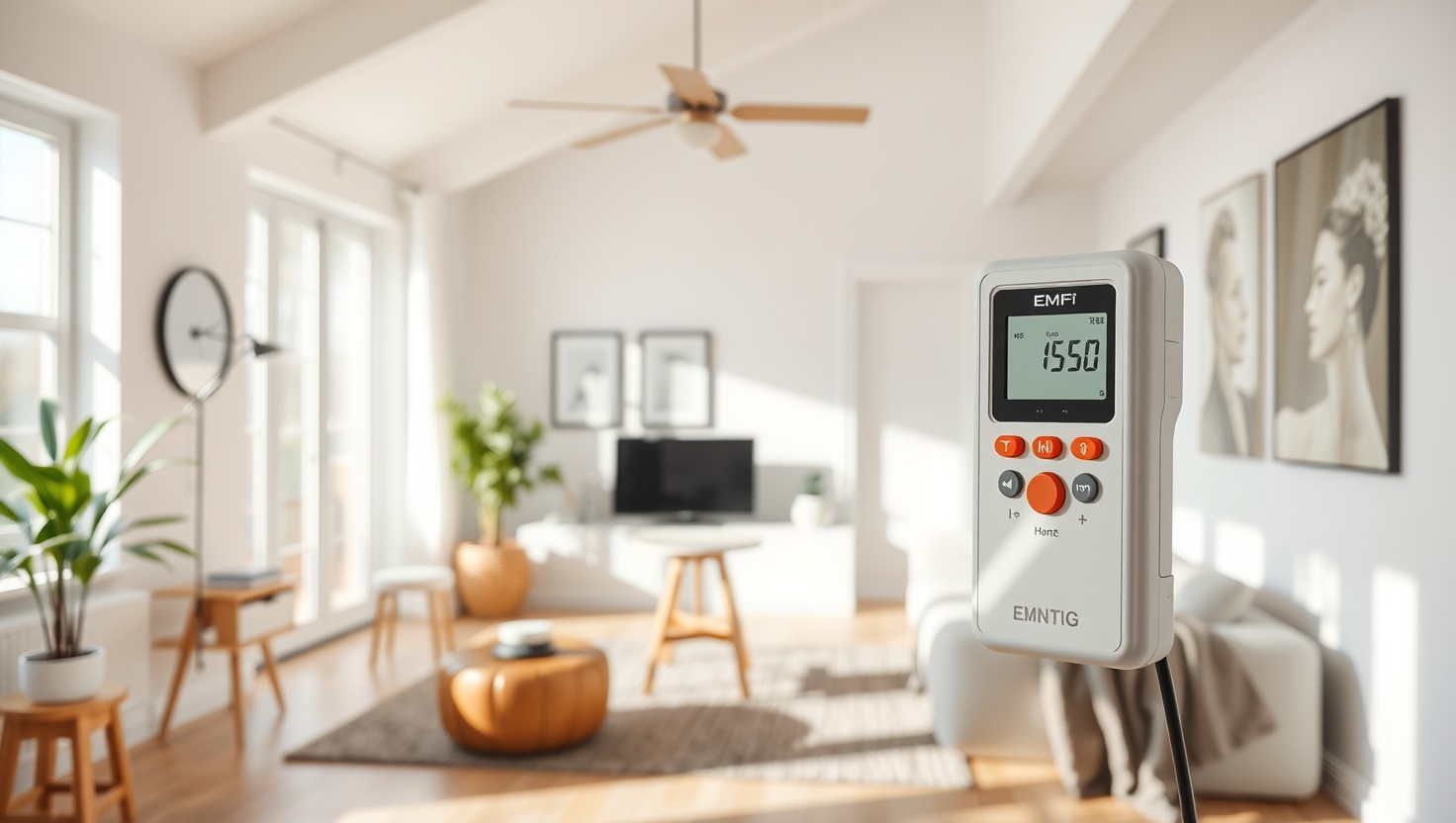
Most people have no idea what the electromagnetic field levels are in their own home. Not because it is a secret — but because nobody taught them to look. Your WiFi router, smart meter, microwave, baby monitor, and the 5G signal bleeding in from the street are all generating electromagnetic fields right now, in your living room, your bedroom, your kid's room. Whether that bothers you or not should be your call — but you cannot make that call without data.
TriField TF2 — Our Top Recommendation
The TriField TF2 is the most recommended EMF meter among building biologists, home inspectors, and serious self-testers. It measures magnetic fields, electric fields, and RF radiation — all from one…
In a hurry? That’s our pick. Want the reasoning and the full comparison? Keep reading.
An EMF meter gives you actual numbers. Not fear, not assumptions — measurements. You walk around your home with one, you see where the fields are high and where they are low, and then you decide what (if anything) to do about it. That is what this guide is about: the five best EMF meters for home use in 2026, ranked by accuracy, usability, and value.
Key Takeaways
- EMF fields come in three types: magnetic, electric, and radiofrequency (RF) — home sources include WiFi, smart meters, appliances, and cell towers
- The TriField TF2 ($170) is the gold standard all-in-one home meter — accurate, US-made, and trusted by professionals
- The GQ EMF-390 ($130) adds data logging and PC software — best for anyone who wants to track readings over time
- The Acoustimeter AM-11 ($350) is the precision tool for RF-only concerns like 5G and WiFi — peak hold catches bursts cheap meters miss
- Budget picks exist: the Latnex AF-3500 ($80) and GQ EMF-380 ($90) give useful readings without the professional price tag
- Measure first. Then decide what, if anything, to change. Knowledge is the point — not panic.
What Is EMF and Why Does It Exist in Your Home?
Electromagnetic fields are invisible areas of energy produced by electrically charged particles. They occur naturally (the Earth has its own magnetic field; sunlight is electromagnetic radiation) and are also generated by any device that uses electricity or transmits wirelessly. In your home, you are dealing with three distinct types:
- Magnetic fields — produced by current-carrying wires and electrical appliances. Your fuse box, extension cords, refrigerator motor, hair dryer, and power lines all generate these. Measured in milligauss (mG) or microtesla (µT).
- Electric fields — produced by voltage, even when a device is plugged in but not switched on. Wiring inside walls creates electric fields throughout your home. Measured in volts per meter (V/m).
- Radiofrequency (RF) radiation — produced by wireless devices. WiFi routers, smartphones, smart meters, baby monitors, cordless phones, Bluetooth devices, and 5G towers all emit RF. Measured in milliwatts per square meter (mW/m²) or microwatts per square centimeter (µW/cm²).
The debate about long-term health effects of low-level EMF exposure is genuinely unresolved in the scientific literature. What is not debatable is that these fields exist, that they are measurable, and that they vary significantly from room to room and device to device. An EMF meter does not tell you what to think — it tells you what is there.
Common EMF Sources in a Modern Home
Before you start measuring, it helps to know where to look. These are the highest-priority spots for a home EMF audit:
- WiFi router — often the highest RF source in the home. If yours is in the living room or, worse, the bedroom, readings can reach 50-200+ microwatts per square meter at close range.
- Smart meter — mounted on the outside of your home but transmits through walls. Peak transmissions occur in short bursts; a peak hold meter will catch them where a standard meter shows nothing.
- Bedroom electronics — charging smartphones, smart speakers, and tablets on or near the bed are the easiest wins: moving them across the room or switching to airplane mode overnight makes a measurable difference.
- Kitchen appliances — the microwave (when running), induction cooktop, and refrigerator compressor all produce magnetic fields. These drop off quickly with distance.
- Baby monitors and smart cribs — often placed within centimeters of a baby's head. RF emissions from some monitors are high; a meter will tell you exactly how high.
- External cell towers and 5G equipment — increasingly relevant. If you live near a small cell installation or a rooftop antenna, baseline RF in your home may already be elevated before you even turn on a device.
Once you measure, these bags are the simplest way to eliminate RF from your phone entirely — on your schedule.
The 5 Best EMF Meters for Home Use in 2026
TriField TF2 — Best Overall
The TriField TF2 is the most recommended EMF meter among building biologists, home inspectors, and serious self-testers. It measures magnetic fields, electric fields, and RF radiation — all from one device — with true RMS circuitry that gives stable, accurate readings rather than the jumpy numbers you get from cheaper alternatives. Made in the USA by AlphaLab, Inc., the TF2 has been independently validated for accuracy and is used by professionals who need numbers they can actually trust.
The display is analog with a digital readout, which sounds old-fashioned but is genuinely useful: the needle gives you an instant sense of field direction and movement, while the numbers give you precision. There are two magnetic field modes — standard and weighted — the weighted mode is optimized for detecting the 50/60 Hz fields from home wiring that are most relevant to daily exposure. RF detection covers 20 MHz to 6 GHz, which captures WiFi (2.4 and 5 GHz), Bluetooth, smart meters, and lower 5G bands.
- True RMS accuracy — readings you can rely on
- All three field types in one device
- Made in USA, 1-year warranty
- Analog + digital display is uniquely intuitive
- Covers WiFi, Bluetooth, smart meters, 5G
- $170 is a serious investment
- No data logging or PC connectivity
- Does not capture peak hold for burst signals
- Slightly bulky for pocket carry
Best for: Homeowners who want one definitive tool for a complete home audit, done right.
Check Price on Amazon →GQ EMF-390 — Best for Data Tracking
The GQ EMF-390 is a professional-grade meter that punches well above its price. Where the TF2 gives you a snapshot, the EMF-390 gives you the full picture over time: it logs readings to internal memory and syncs with free PC software so you can map out how your home's EMF environment changes throughout the day — when the smart meter transmits, when the neighbor's car WiFi pings, when the microwave runs. It measures magnetic, electric, and RF fields simultaneously on the same screen, which saves you switching between modes during a walkthrough.
RF sensitivity covers from 10 MHz to 8 GHz with separate EF and EMF channels. The backlit display is easy to read in any lighting. GQ has a strong user community with tutorials and reference readings, which helps new users interpret what they are seeing. At $130, it delivers more features than meters that cost twice as much.
- Data logging — track changes over days or weeks
- Free PC software for graphing and analysis
- Simultaneous multi-field display
- Covers up to 8 GHz including 5G bands
- Excellent value at $130
- More complex interface than the TF2
- Learning curve for the PC software
- Build quality feels less premium than TriField
Best for: People who want to understand their EMF environment over time, not just in a single walkthrough.
Check Price on Amazon →Acoustimeter AM-11 — Best Premium RF Meter
If radiofrequency is your primary concern — cell towers, WiFi, 5G small cells near your home — the Acoustimeter AM-11 is the instrument the professionals reach for. It is RF-only, which means it does not do magnetic or electric fields, but what it does, it does better than anything else in this price range. Coverage runs from 200 MHz to 8 GHz with genuine laboratory-grade accuracy. The peak hold function is the key differentiator: it captures the maximum field strength of short-duration RF bursts — smart meter transmissions, 5G beam pulses, phone check-ins — that conventional meters average out and miss entirely.
The display gives you both a digital readout and an LED bar graph that responds in real time, making it easy to locate the exact direction and source of RF signals. There is also an audio output — you can hear the characteristic patterns of different RF sources (WiFi sounds different from a smart meter pulse), which experienced users find invaluable for identification. Made in the UK, it is the industry standard for professional RF surveys and building biology assessments.
- Peak hold catches short RF bursts others miss
- Industry-standard accuracy from 200 MHz to 8 GHz
- Audio output for source identification
- LED bar graph for real-time directional finding
- Trusted by building biology professionals worldwide
- $350 — significant investment
- RF only — no magnetic or electric field detection
- Needs a separate meter for complete home audit
Best for: Anyone living near cell towers or 5G infrastructure who needs precise, professional-grade RF measurements.
Check Price on Amazon →Smart plugs let you cut power to devices on a schedule — a simple way to reduce both electricity use and EMF from idle appliances.
Latnex AF-3500 — Best Budget All-in-One
If you want to understand your home's EMF profile without spending $130-170, the Latnex AF-3500 is the budget pick that actually delivers useful data. It is a triple-axis meter, meaning it measures all three spatial directions simultaneously rather than requiring you to rotate the device to find peak readings — a real advantage for beginners who are still learning technique. It covers magnetic fields, electric fields, and RF in a single compact unit, with a clear digital display and intuitive controls.
Accuracy is not at the TriField level, but it is good enough to identify genuine hotspots in your home and compare relative levels between rooms and devices. Readings are consistent and repeatable. The RF detection range covers up to 3.5 GHz — which captures WiFi (2.4 GHz), but not higher 5G bands. For most suburban homes without 5G small cells immediately outside, this is sufficient for a first audit. If you later need more precision or 5G coverage, you upgrade — but start here.
- Triple-axis magnetic measurement — no rotation needed
- All three field types in one compact device
- $80 entry point — accessible for any budget
- Simple, intuitive controls
- Good enough for identifying hotspots and relative readings
- RF coverage tops out at 3.5 GHz — misses high-band 5G
- Less accuracy than TF2 or GQ-390 at precise levels
- No data logging
Best for: First-time home auditors who want real data without a major investment to start.
Check Price on Amazon →GQ EMF-380 — Best Budget RF Detector
The GQ EMF-380 is GQ's more affordable sibling to the EMF-390, and it is a solid performer for the price. RF detection runs from 10 MHz to 6 GHz — covering WiFi, Bluetooth, smart meters, and 5G sub-6 GHz bands — and the display gives you simultaneous EMF and EF readings. It lacks the data logging and PC software of the -390, but the core measurement performance is comparable for basic home use. Build quality is decent, the interface is straightforward, and GQ's reputation for accurate EMF instrumentation means the readings are trustworthy.
Where it falls short is in premium features: no peak hold for burst signals, no audio output, and no memory function. For a first-time user who wants to do a single home walkthrough and identify problem areas, those limitations rarely matter. You point it at your router, your smart meter, your phone — the numbers tell you what you need to know.
- RF covers up to 6 GHz including 5G sub-6 bands
- Simultaneous EMF and EF display
- GQ accuracy at a budget price
- Simple to use out of the box
- No data logging or peak hold
- No PC software connectivity
- Fewer features than the EMF-390 for $40 less
Best for: Budget-conscious buyers who specifically want RF detection up to 6 GHz without paying for data logging features they will not use.
Check Price on Amazon →Quick Comparison: All 5 Meters at a Glance
| Meter | Price | Fields | RF Range | Data Log | Best For |
|---|---|---|---|---|---|
| TriField TF2 | ~$170 | All 3 | Up to 6 GHz | No | Best overall accuracy |
| GQ EMF-390 | ~$130 | All 3 | Up to 8 GHz | Yes | Data tracking over time |
| Acoustimeter AM-11 | ~$350 | RF only | 200 MHz–8 GHz | No | Professional RF precision |
| Latnex AF-3500 | ~$80 | All 3 | Up to 3.5 GHz | No | Budget starter pick |
| GQ EMF-380 | ~$90 | RF + EMF | Up to 6 GHz | No | Budget RF detection |
How to Do a Home EMF Audit in 30 Minutes
Once you have a meter, here is a simple walkthrough to understand your home's EMF profile. You do not need to be an expert. You need a meter and 30 minutes.
Step 1: Establish a Baseline
Go outside, away from your home and any parked cars or power lines. Take a reading. This is your background level — the ambient EMF in your neighborhood. Note the magnetic, electric, and RF numbers. Everything higher than this inside your home is coming from a specific source.
Step 2: Walk Each Room Systematically
Move slowly through each room with the meter at chest height. Pause near electrical panels, appliances, and any wireless devices. Note where readings jump. Pay particular attention to sleeping areas — where you spend the most cumulative time — and anywhere children spend extended time.
Step 3: Identify the Top Sources
Bring the meter close to each device that registered high during the walkthrough. Common culprits: WiFi router (RF), smart meter on the wall (RF bursts), microwave (magnetic when running), refrigerator compressor (magnetic), baby monitors (RF). Write down the readings at one foot and three feet from each source — the drop-off is usually dramatic.
Step 4: Check the Bedroom at Night
Do a second sweep after dark with all your nighttime devices as they actually are — phone charging on the nightstand, smart speaker on, TV in standby. This is often the most eye-opening part of the audit. The difference between a charging phone on your nightstand and the same phone in airplane mode across the room is measurable and significant.
Secure your home without relying on cloud-connected devices that add to your home's wireless load.
Practical Ways to Reduce EMF in Your Home
Once you have your numbers, reducing exposure is often simpler than people expect. You do not need to rip out wiring or live without WiFi. You need targeted changes in the areas where you spend the most time.
- Put the router on a timer. A simple outlet timer ($10) turns your WiFi off at bedtime and back on in the morning. During sleep, there is no reason for it to be on. This single change eliminates the largest RF source in most homes for 7-8 hours a day.
- Charge your phone outside the bedroom. A charging cable does not care whether the phone is on your nightstand or on the kitchen counter. Move it across the house at night.
- Switch to wired ethernet where you can. Laptops and desktop computers do not need WiFi. A wired connection is faster, more reliable, and produces no RF. Smart TVs and streaming sticks can also run via ethernet adapter.
- Create distance from high-field appliances. Do not stand in front of the microwave while it runs. Do not sleep with your head against the wall where the fuse box is on the other side.
- Use airplane mode deliberately. When your phone is in your pocket or near your body and you are not expecting calls, airplane mode eliminates its RF emissions entirely. You are still reachable when you want to be.
- Smart meter buffer zone. If your smart meter is on a bedroom wall, rearranging the room so the bed is on the opposite wall creates meaningful distance. A faraday-based meter shield (installed by an electrician) can reduce transmission-direction RF if readings are very high.
The Matter standard is pushing smart home devices toward local processing — less cloud traffic, less unnecessary wireless activity in your home.
Understanding Safe Exposure Guidelines
There is no single universal safety standard for home EMF exposure, which is frustrating but honest — the science is still developing. Here are the most referenced benchmarks:
- ICNIRP (International Commission on Non-Ionizing Radiation Protection) — the most widely adopted regulatory framework. Sets RF public exposure limits at 10,000 microwatts per square meter (10 mW/m²). Most home devices are well below this.
- Building Biology Institute — a precautionary standard used for healthy home assessments. Recommends sleep area RF below 1 microwatt per square meter (far stricter than ICNIRP) and magnetic fields below 1 milligauss.
- BioInitiative Report — an independent scientific review that recommends a precautionary RF limit of 3-6 microwatts per square meter for chronic indoor exposure.
The gap between ICNIRP and the precautionary standards is significant. This is why measuring matters: you may be well under ICNIRP limits but well above Building Biology recommendations in certain areas of your home. Once you know, you can decide what standard makes sense for your situation — without anyone else making that call for you.
Ready to Measure Your Home?
Our top pick for most homeowners is the TriField TF2. It is accurate, covers all three field types, and is used by professionals worldwide. One device, one walkthrough, real numbers.
Get the TriField TF2 on Amazon →Get the Brainstamped Emergency Readiness Scan
Our free scan walks you through your home's biggest exposure points — EMF, water quality, air, and food security — with practical steps for each one.
Frequently Asked Questions
EMF meters measure electromagnetic fields across three categories: magnetic fields (measured in milligauss or microtesla), electric fields (measured in volts per meter), and radiofrequency/microwave radiation (measured in milliwatts per square meter or microwatts per square centimeter). Different meters cover different ranges — some cover one field type, others all three. The most useful home meters detect all three simultaneously, because your home has all three sources: power lines and appliances generate magnetic and electric fields, while WiFi routers, cell phones, smart meters, and 5G signals generate radiofrequency radiation.
There is no single universally agreed standard, but several organizations publish guidelines. The Building Biology Institute recommends keeping bedroom magnetic fields below 1 milligauss during sleep. The ICNIRP sets public RF exposure limits at 1000 microwatts per square meter averaged over 6 minutes. The BioInitiative Report recommends a precautionary limit of 3-6 microwatts per square meter for chronic exposure. In practice, most modern homes measure 0.1-0.5 milligauss in living areas and 0.5-5 microwatts per square meter of RF. Your bedroom while your phone charges next to your head will often spike to 10-50 microwatts per square meter. Knowing your actual numbers is the first step.
Not necessarily. A tri-field meter like the TriField TF2 or GQ EMF-390 covers all three in one device. That said, if you have a specific concern — for example, you live near a cell tower and want precision RF readings — a dedicated RF meter like the Acoustimeter AM-11 will give you far more detail, better sensitivity, and a peak hold function that catches short bursts that a general-purpose meter might miss. For most people starting their first home audit, a quality all-in-one meter is the right first tool. You can always add a specialist meter later once you know where your highest readings are.
Yes, and often more easily than people expect. The most impactful changes: move your WiFi router out of the bedroom and put it on a timer to shut off at night; switch smart devices near sleeping areas to wired ethernet where possible; keep your phone in airplane mode on your nightstand instead of active; create distance between yourself and appliances — EMF falls off sharply with distance (doubling your distance from a source reduces field strength by up to 75%). You do not need to eliminate all electromagnetic fields — that is neither possible nor necessary. The goal is informed decisions: know your numbers, reduce what makes sense for your lifestyle.
For most homeowners, yes. Cheap EMF meters under $30 often have poor accuracy — particularly in RF detection — and give readings that are difficult to interpret. The TriField TF2 has been independently validated for accuracy across all three field types, uses a true RMS measurement circuit that gives stable readings, and is made in the USA. At $170, it is an investment, but it is a tool you buy once and use for years. If your budget is tight, the Latnex AF-3500 at $80 is a solid starter with decent accuracy on all three fields. Just avoid the very cheap novelty meters — their readings are largely meaningless.